The Internet Chinese Text Archive

Here’s a Chinese resource that looks pretty cool: The Internet Chinese Text Archive.

The biggest problem with the site is it doesn’t set the proper encoding information!! So you have to manually set the encoding to “Chinese Simplified” very time. It’s really, really annoying. I’ve tried everything on the browser such as setting my preferred language to Chinese with no luck. Ugh… One trick I came up with is to mouse over each link and just read the url on the bottom bar of the browser. It’ll tell you what you’re looking at (in English no less) without having to reset the encoding every time. Then you can finally set the encoding when you get to the text you want.

Anyway, while this site looks cool, the material is far too advanced for me to make any recommendations. I thought I’d try to tackle some short stories first but it’s slow going.

Ooh la la, the 色情性爱 category looks interesting. Could be a good motivator to study Chinese.

Any good suggestions for people like me learning Chinese? Preferably something interesting, not too difficult, and as modern as possible.

大家有什么好建议吗?

KTNXBYE

Can you do it? Maybe not, but it can be done.

This is a question I hear often and one that I had myself at one point.

What is the difference between the potential form and 「~ことができる」?

As you know, the potential form is a relative straight-forward verb conjugation indicating that one is able to do that verb. The only strange exception is 「する」 which becomes 「できる」, a completely different verb to indicate “one is able to do”.

The situation gets a little bit murkier when you normalize a verb with a generic event 「こと」 and use 「できる」 instead of just using the potential form. Ultimately, it seems like there’s two methods of expressing the potential. (Don’t complain, Chinese has… oh I don’t even know how many, there’s too many to count.)

The natural question for any learner of Japanese would be, “What’s the difference and when do I use one instead of the other?” Indeed, an excellent question! What’s even more confusing is when the original verb is 「する」 therefore becoming 「することができる」. Hey, isn’t that redundant??

It’s longer

The first and easy answer is, the 「~ことができる」 version is longer. Ha ha, aren’t you glad I’m here to clear everything up for you? Seriously though, the fact that you have another particle in there allows a lot more flexibility. Nobody says you have to use 「が」, that’s just a sentence pattern simplification.

Saburooさん, author of the 現代日本語文法概説, has some very excellent examples.

読むことしかできない – Can only read it.
読めしかしない – ????

Semantic Differences

Besides the obvious grammatical differences, what the original question is really asking is whether there’s any differences in meaning and usage. I would say the differences in nuance is so subtle, it’s debatable whether discussing them would even help learners of Japanese. The short answer is they are pretty much interchangeable and you can stop reading here.

For the rest of you who like to torture yourselves like me, let’s think about it for a second. 「~ことができる」 uses a generic event 「こと」 and a generic verb 「できる」 to say that the event is able to be done. Doesn’t it sound a bit… generic? In fact, I think using 「~ことができる」 makes it sound more like a general statement about feasibility.

電車で行けますか? – Can you go by train?
電車で行くことができますか? – Is it possible to go by train?

You can take this idea further to talk about general rules and policies.

タバコを吸うことはできますか? – Is smoking allowed (for anybody)?
タバコを吸ってもいいですか?- Is it ok to smoke? (I want to smoke.)
タバコは、吸えますか? – Able to smoke? (Are you asking if I can smoke? Otherwise, why are you asking me if you can smoke?)

In a similar vein, you can see examples of when you might want to use 「することができる」. It can sound a bit more formal since it addresses a larger audience than you personally. In fact, companies might decide to substitute even more former-sounding words such as 「可能」 in the place of 「できる」. You can’t do this with the regular potential form.

インターネットで登録することができます。- It is possible to register on the internet.
インターネットで登録することが可能です。- It is possible to register on the internet.
インターネットで登録できます。- You can register on the internet.

Conclusion

This is an example where not worrying about every little detail and just getting a lot of input might be the better approach. However, I think it is worth the time to examine what words are being used and what they mean by themselves (in this case 「こと」 and 「できる」).

I hope this short explanation can at least give you a general idea of the slight difference between the potential form and 「~ことができる」. As I mentioned, they are very similar and often interchangeable. My final suggestion is to keep things as simple as possible. For instance, don’t say 「することができる」 if you can help it. Why make things more complex than they need to be?

On LaTeX, self publishing, and another dialogue

Though progress continues to be slow, the textbook project is finally turning into something I’m getting excited about. Lately, I’ve been thinking about layout and presentation.

Here is the second dialogue designed to demonstrate positive and negative state-of-being for nouns and adjectives. As usual, this deceptively simple conversation had a lot of thought put into it. This dialogue will be followed by pretty standard explanations of the conjugation rules and a brief description of よ and ね.

スミス: おはよう。
キム:  おはよう。
スミス: 元気?
キム:  あまり元気じゃない。
スミス: そう?
キム:  うん。最近、とても忙しい。
スミス: いいね。
キム:  全然よくないよ。
Smith: Morning.
Kim: Morning
Smith: How are you?
Kim: Not very good.
Smith: Is that so?
Kim: Yeah. I’m very busy lately.
Smith: That’s good.
Kim: It’s not good at all.
  1. おはよう [casual, exp] – Good Morning
  2. 元気(げんき) [na-adj] – lively, healthy
  3. あまり [adv] – not very (used with negative)
  4. そう [adv] – so
  5. うん [casual] – yes
  6. 最近(さいきん) [adv] – lately
  7. とても [adv] – very
  8. 忙しい(いそがしい) [i-adj] – busy
  9. いい [i-adj] – good
  10. 全然(ぜんぜん) [adv] – not at all (used with negative)

As you can see, it uses a two-column format for the Japanese and English translation. I debated on adding a kana-only version but couldn’t figure out how to fit it in. In the end, I decided if the vocabulary with the readings are right there, the reader shouldn’t have much trouble figuring it out. I’m still debating whether or not to add furigana however.

Though I had initially wanted to concentrate on the content only, I decided I should also think about the layout, presentation, and format. This is especially important for creating a printable book because I have to think about what size paper I want to use. And DocBook, as we know, deliberately leaves out any shred of formatting information. So I’m looking into setting up LaTeX and will see how that works out soon enough I hope.

I’m also looking into Lulu.com for self publishing. They even do audio CDs though they don’t currently package it with a book. Now all I have to do is figure out how to find other speakers besides myself for the characters and how to get some recording done with reasonably professional quality.

But first, I guess I should concentrate on writing the rest of the book. The next dialogue will cover the polite positive and negative state-of-being and the question marker 「か」 but that’s a topic for another blog post.

Random question, why do spell checkers keep telling me “dialogue” is misspelled? It is a word, isn’t it?

This chair is worth 2 playstations…

I was reading this blog entry on chairs (did I mention the huge number of blogs in my Google Reader?) and was shocked to see a picture of the exact chair I was sitting on.

Taking a closer look, I realized that indeed, I was sitting in a $979 chair. I think the best proof of how great this chair is in the fact that I never thought about my chair. This is in sharp contrast to the days of cursing at my crappy chair in Japan which didn’t even have back support beyond the first 5 lower vertebrae.

Not bad for working as a software developer for Library services. I also have a dual-monitor Dell dev box and a MacBook Pro for work. We’re located in Fremont, the center of the universe, a great location in Seattle. The atmosphere is really great and laid back as well. We’re currently really hurting for Database and QA resources so if you’re interested, take a look at the list of our open positions.

On the (possible) origin of 「出来る」

I was just working on an article (one of my 80 drafts) about the difference between the potential form and 「ことができる」 when an amazing insight hit me! I didn’t want to clutter up that article so I decided to write about it separately in this post.

I was discussing the potential form and how only 「する」 had this curious exception of using a completely different verb: 「できる」. While I never thought much about it these many years, with some Chinese under my belt now, I suddenty realized that “出来” was also used in Chinese to indicate potential!

In Chinese, “出来” means to “come out” and you can see various examples of this here.

叫全家人都出来, 我好给他们拍照。
Ask the whole family to come out so that I can take their photograph.

You may be wondering what this has to do with 「出来る」 but what the dictionary doesn’t tell you is that this “出来” is often combined with a verb to indicate that the verb is able to be performed. For example, “听得出来” means “able to hear”, basically the same definition as 「聞こえる」 in Japanese. The listening is coming out, therefore you can hear it. I guess it does kind of make sense, in a weird Chinese sort of way.

I harvested the following example from Google since my Chinese is not too good. So I hope I’m not making any mistakes here in the translation.

你能听得出来什么歌吗?
Can you hear what song it is?

Some of you may be wondering why there a “能” in there as well which seems redundant. Yeah well, sometimes it’s there and sometimes it’s not. (See, I told you I wasn’t very good at this.)

Chinese grammar (if indeed, there is such a thing) doesn’t seem very consistent but my guess is when you have a subject (in this case 你), you need 能 to act as the verb. The 得 (which is kind of like の but only for verbs) kind of rendered 听 a description rather than a traditional verb, hence the need for 能.

So things are a bit different for the negative case because you use 不 and don’t need 得. Here’s another similar example I pulled from Google.

听不出来我是谁吗?
Can’t you hear who I am?

Please feel free to correct me on any of this as I’m pulling these explanations out of my ass as I’m writing it.

Chinesepod has a great podcast discussing “不出来” and “得出来” so I encourage you to check it out. You can also find many additional podcasts with dialogues using “出来” by using the search box. Sorry, I can’t give you a direct link to the search results since it seems to POST and not GET. (John, this is a tiny suggestion for you.)

Conclusion

Anyway, I hope you can see how “出来” means more than just “come out” and is used to express potential as well. So the fact that Japanese uses a verb with the exact same kanji for a similar purpose seems a bit too much for mere coincidence. Could 「出来る」 be some kind of weird Japanized version of “出来”, originally derived from Chinese? Sounds like a good topic for a research paper. All I can say is it’s mighty suspicious that only 「する」 has this weird exception of becoming 「出来る」 unlike every other verb in the whole Japanese language.

Update

Kim pointed out something that I completely forgot about. Another odd potential exception is 「あり得る」 from 「ある」. Is the use of the kanji 「得」 here just another coincidence? The suspicion is growing…

But… but… Japan is such a small country!

Thought I’d share a fun link off my Google Reader. Now the site has some NSFW stuff in it but this link is safe (except for the occasional header) and shows a plethora of various dialects: 女の子が喋る方言で一番最高なのってなに?

「べっ、べつに好きやないき!勘違いせんといてや!」 by 愛知
「べっ、べつに好きとちゃうんやに!勘違いしやんといて!」 by 三重
「べっ、べつに好いとーわけじゃないっちゃけん! 勘違いせんどって!」 by 福岡
etc.
etc.
etc.

何でこんなに方言がいっぱいあるんや!?俺、まだ大阪弁すらできへんちゅうのに・・・。もうええわ。

So which is the cutest dialect? Having lived in Tokyo, I admit I have limited exposure to various dialects. But I would probably put Hiroshima near the top of the list, Tokyo at the bottom, and various Kansai dialects around the middle.

元気かいのー、どがいしょーるんの?

100をもらっていいですか?って俺しかいないか・・・

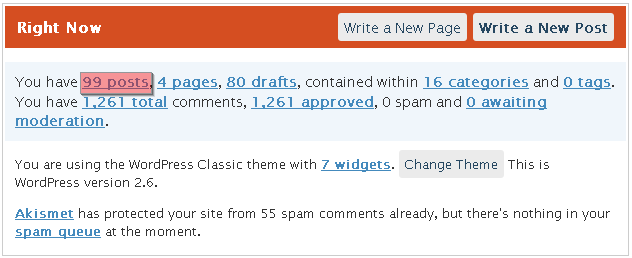
え~と、移動前のブログを含めて、長い間色んなことについて書いてしまいましたが、ついに、これで100回目の投稿になりました!その記念に、このポストをアップする前のスクリーンショットを載せます。

99 posts and 80 drafts... trouble finishing much?

99 posts and 80 drafts... trouble finishing much?

ご愛読とコメント、本当にありがとうございます。皆さんの感想や意見をいつも楽しく拝読しています。見てのとおり、まだ書き終わっていないポストもたくさんありますので、引き続き頑張ります!これからもよろしくお願いします!

Whoo hoo! This is my 100th post! Thanks everybody for reading this blog and for the comments! Obviously, I haven’t run out of stuff to write about. In fact, I’m having trouble just finishing my drafts.

If you’re curious about how I took the screenshot, check out FireShot. It’s awesome.

And I’m probably wasting my breath (or keyboard strokes) but I’d like to say to the spammers to just give up please. Your crap is going right into the trash.

My textbook introduction and first dialogue

As indicated in my last post, after struggling with the traditional textbook approach, I’ve decided to scrap everything and start afresh. I thought hard about what I wanted from a textbook when I first started learning Japanese and came to the conclusion that I didn’t want any babying or hand-holding. If my target audience can learn trigonometry and calculus, they should certainly be able to handle Hiragana and Katakana without having it spoon-feed to them one lesson at a time. So with that, I came up with the following introduction.

The Introduction

Who is this textbook for?

The intended audience of this textbook is for adult English speakers from High School level and beyond. It is intended to be compatible with a classroom format as well as for self-learners. However, for reasons explained in the next section, a conversation partner or a way to interact regularly with someone who speaks Japanese is highly recommended.

How does this textbook work?

This textbook is guided by certain principles for learning any language and some specific to learning Japanese. Based on my own experiences and from observing others, it is my belief that using the language in each aspect of reading, writing, speaking, and listening is the only way to truly master it. In addition, it must be practiced just as it’s used in real life in order for the skills to transfer into the real world.

However, in the case of Japanese, there is a large amount of new concepts and writing systems that must be mastered before people new to the language can begin to learn real Japanese. This is particularly true for English speakers with no background with Chinese characters or particle-based grammar. Therefore, there is a fairly large amount of background material in the beginning of this textbook to acquaint the new learner to the fundamental aspects of Japanese before starting with the actual lessons.

It is my opinion that consolidating the background material in the beginning makes for a more comprehensive approach for adult learners as compared to spreading it out through the lessons all the while using crippled and unnatural Japanese until the key concepts can be adequately explained.

The basic approach of this textbook can be summarized in the following steps:

  1. Get a rough idea of the general concept
  2. Comprehend via input in Japanese with English translations (both audio and written)
  3. Practice output with writing and conversation exercises
  4. Get output checked and corrected for further expansion

The word “rough” in the first step is very important here, especially for the background material. While the first section might seem quite extensive, the goal is to get only a general idea and fine-tune it by jumping in the language. So don’t worry about fully comprehending the first section before starting the lessons. If you continuously refer back as you learn the language, you will eventually learn it all through practice.

In the first section, I intend to cover Hiragana, Katakana, and Kanji similar to the beginning of my grammar guide. The only difference is more extensive practice exercises and plenty of audio. The Kanji section will be about how Kanji works and how to study it.

As for grammar, While I won’t go over specific grammar or conjugations until the lessons, I will provide a broad overview. I intend to cover what particles are, classifications of parts of speech, general sentence structure, and when to use the various politeness levels.

My first dialogue

I also spent a lot of time really thinking about the first dialogue. This dialogue was very important to me because I think it sets the tone for the rest of the book. And as I mentioned in my last post, I wanted to get the reader hooked on Japanese from the very beginning. After a great deal of thought, here’s what I came up with. (Any resemblance to persons fictional or real is purely coincidental.)

先生:  これは、本ですか?
クラス: いいえ、本じゃありません。それは、ペンです。

キム: このクラスは、簡単じゃない?
スミス: 私は、まだ難しいよ。
キム: 全然難しくないよ。
スミス: はい、はい。

先生: キムさん!
キム: はい!
先生: これは、なんですか?
キム: ええと・・・、紙ですか?
先生: はい、そうです。なんの紙ですか?
キム: ・・・はい?
先生: この紙は、キムさんの特別な宿題です。
キム: なんですか?

My goal in this dialogue was to cover the copula (or whatever you want to call it) and the negative tense for nouns and adjectives. I also wanted to have a good mix of polite and casual speech to show how each is used respective to the social position of the characters. I was really tempted to have Kim say 「わかりません」 in his second-to-last line but decided to hold off on negative tenses for verbs for now. I also wanted to write 「キムさんだけの特別な宿題です。」 but decided that was too advanced. See how hard this is? Actually, what I really wanted to write was 「この授業は、キムさんにとって簡単すぎるようなので、キムさんだけの特別な宿題を作りました。さぁ、喜んでください!おほほほほ!」

Personally, I think the best part of this dialogue is when Smith says, 「私は、まだ難しいよ。」 because it really shows that the topic particle is not the “subject” as we define it in English. Obviously, Smith is not saying she’s difficult since that makes no sense.

So that’s my first dialogue. It will, of course, have an English translation and a non-Kanji version for those who want to worry about the Kanji later. What do you think? I’m pretty happy with it but there will be lots more to come. Even though you really can’t tell yet, I already have an idea of what the various characters are like in my mind. I hope you will all eventually find out as I develop the story and finish the textbook!

Another approach to the textbook

I haven’t been spending as much time as I’d like on the textbook project and I think I’ve figured out the reason why. It’s just not turning out the way I like and therefore I don’t feel any excitement about working on it.

I’ve been approaching it the traditional style, basing the dialogue on lesson themes such as introductions and greetings. The problem is that it’s nearly impossible to make any kind of interesting dialogue with those kinds of themes. How many more books do we need with the same old dialogue as below?

A) おはようございます。おげんきですか?
B) おはようございます。はい、げんきです。Aさんは?
A) わたしも、げんきです。

I think I’m going to take time to think about another approach. One idea I had was to write all the dialogues first and based the book around them. Each chapter would break each dialogue down and work on practicing and expanding the concepts and grammar within the dialogue. Each dialogue would also build upon the previous one and grow more and more advanced. I know, it’s probably easier said than done, but I think my first goal should be creating a large selection of useful and interesting Japanese and less on the explanations.

Ultimately, my goal is to grab the reader and get him hooked from the very beginning. And what I have now just isn’t cutting it. Any suggestions for topics, characters, and story lines?

By the way, some of you may have noticed already but I added a new Feedback page. It’s currently empty but I hope to build it as a page for your feedback (duh).

It started with a language requirement

I have this bad tendency of never looking back in the past. As a result, I often have an extremely spotty memory of past events and the order in which they occurred. I also have another bad habit of never keeping anything around. Looking back, I really wished I had kept a journal of my Japanese studies so that I can better remember how I personally learned Japanese. Instead of crying over split milk, I decided to dig into my crusty memories and document what I remember before I forget it any further.

I hope I don’t sound like I’m trying to show off or anything. My intent was to write an interesting account of my personal experiences with Japanese. Feel free to share your own experiences with learning the language. You also might want to think about starting a journal and keeping all your old material together so you don’t end up in my position now.

Holy crap, class every day??

I started learning Japanese in my sophomore year in the fall of 2000. I had considered taking Japanese or Chinese during my freshman year but balked at the fact that unlike every other class, language classes met every weekday and often as early as 9 IN THE MORNING.

I had thought I could squeak by the language requirement by taking a proficiency exam in Korean. Then I spoke with a fellow student whose Korean was 10x better than me. I was freaked when she told me how hard the test was involving reading articles, writing essays, and other crazy activities in Korean. Unluckily for me, the college recently hired a Harvard grad from Korea to teach East-Asian History and he took over the role of conducting the test. So in my sophomore year, I bit the bullet and prepared myself to take Japanese class every weekday and IN THE MORNING so that I could graduate.

I sucked most of the first year
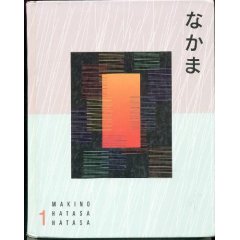
Don't use this

Don't use this texbook, trust me

We spent about 2 weeks learning Hiragana and I remember how difficult it was to memorize all the characters. I spend hours practicing on the whiteboard and would still space out on certain characters like 「ぬ」. I also remember lamenting the fact that 「学生」 sounded like “gaksei” instead of “gakusei” on an audio quiz.

I personally went through all the stuff I complain about in this blog. The Japanese curriculum recently switched to Nakama, which is not a very good textbook (though there are worse textbooks out there). It was weeks before we even learned any verbs and we started out with the freaking masu-form. I was also very confused by the “emphasis” explanation of 「んです」 and completely baffled when the teacher wrote 「Aさんは、何が好きですか。」 since it used both 「は」 AND 「が」. My poor knowledge of Korean certainly didn’t give me much of an advantage. Finally, casual form and slang wasn’t taught in that class nor in any of the more advanced classes.

Anyway, I was a pretty big slacker in Japanese 101. The only time I went to the Japanese club activities was at the end when “tea night” became “sake night”. The second and third year students spoke some stuff to me in Japanese and I was like, “Oh god, where’s the booze?”

I think it was somewhere between Japanese 102 and 103 (we were on trimesters) that I really started to pick up the pace. I really wish I could say what got me started putting so much extra time and effort on Japanese but I think it was for a number of reasons that came about gradually. I started hanging out with the Language Assistant and still remember our conversations about Japanese while walking around campus. It was from her that I learned casual speech and that you can do amazing things like modify a word more than once, for instance 「みたくなる」. I also asked her to coach me to make sure I was pronouncing every sound correctly, in particular 「つ」 and 「ふ」. (I have to admit Korean did help me with the 「ら、り、る、れ、ろ」 sounds.)

Even though we did end up going out for a while, I’d like to stress that it was my insistence on constantly asking questions and trying to speak in Japanese as much as possible that really improved it. I also asked her to correct my mistakes every time and took her corrections with the utmost appreciation and followup questions unlike other students who just got annoyed and brushed it off.

I think it was so easy to talk to her in Japanese because she knew exactly what I knew and how much I could understand. She was also very good at “dumbing down” or simplifying her Japanese for me. So I was very lucky to have such a tailored teacher and conversation partner. The only drawback was my girly Japanese since everything I knew about Japanese was from a girl.

そうよ!その時は本当にひどかったよ!

In the summer, I stayed on campus to do an internship for an internet startup in Minneapolis. I didn’t do much at my internship (it was during the bubble) but I picked up what meager Japanese material I could find at the library and studied with Jim Breen’s WWWJDIC. I quickly went through all of Nakama 2, which we started in Japanese 103 (you can imagine how boring 204 and 205 became after that) and waded through “An Integrated Approach to Intermediate Japanese“, which was pretty challenging. By the way, I don’t recommend either book though the latter wasn’t that bad as self-study material. However, the grammar explanations for patterns such as 「にとって」 and 「として」 are confusing and didn’t really help me much. My housemate also kindly lent me some comics to study, specifically 烈火の炎. I never got too far with that however because it was still too advanced for me at the time.

I think this was also the time I really started learning Kanji not by themselves but along with the vocabulary. I remember going to the school library and spending hours on the blackboard writing out the words I encountered in Kanji.

Also, for about a month, a bunch of students from 中央大学 came over to do an English summer program at my school. Hanging out with them after work was one of the best times of my life and really motivated me to improve my Japanese. The fact that I couldn’t understand any of their conversations was also another factor. They once tried to explain 「やばい」 to me because I kept hearing it all the time and I never really did get it until much later. (Hint: It means “dangerous”!)

At the end of the first year, I would say I was at a low intermediate level. I could speak Japanese but my vocabulary was limited and I still couldn’t understand many conversations in Japanese at all. The sad thing is, in terms of college courses, the fact that I could even speak at all put me past Japanese 204, 205, and 206. Needless to say, I had no trouble getting straight A’s in all those classes except 206, which I skipped for an advanced elective since 206 wasn’t part of the language requirement. (I got an “A” in that too by the way.)

Fluency in 2 years before setting foot in Japan

My second year was pretty much a continuation of my studies using what I could get my hands on and the WWWJDIC. When I had no internet, I used JWPce on my laptop instead. The fact that I had absolutely nothing else to do and was bored out of my mind during most of my breaks really helped

I really don’t remember what I studied but I think it was just random stuff of no particular interest. I didn’t have access to a lot of Japanese works to study from and didn’t know where to find them. I think it was mostly anything I could find in Japanese at libraries and a 「きまぐれオレンジ☆ロード」 light novel I picked up somewhere, which I never even came close to finishing anyway. I’m sure I looked at some random stuff online too though I didn’t have the skill or dedication to read any Japanese news. I also installed Windows 2000 on my laptop so that I could install a Japanese version of IE/Explorer and other Japanese programs. I think every little bit of Japanese studied here and there really added up, even if it was just a paragraph or even a sentence.

I also spent a lot of time with the International students from Japan and the Language Assistant (which changes every year). Though we were just friends, I even unofficially helped her grade the workbooks from time to time.

At this point, after having met some really great people from Japan, I was determined to do study abroad in the fall of my senior year. I applied to the Waseda program as part of the ACM (finally, a good thing about going to a Midwest college!) and was soon on my way to go to Japan for the very first time.

After the end of the second year, I would say I was at a high intermediate level. My vocabulary (with Kanji of course) was greatly increased and while I didn’t understand everything, I could speak pretty fluently and understand the gist of most conversations.

Studying abroad and getting a job

Taken during study abroad

Taken during study abroad

I arrived in Japan for the first time in my life in the fall of 2002. This was after staying a month in Korea with my Aunt and a full 5-10 lbs heavier from pigging out on the amazing food. I was nervous and excited but also pretty confident in my Japanese. So I was shocked when I couldn’t understand a word when I went to stores and restaurants. It took a little time before I could adjust to the unique language such as 「店内でお召し上がりでしょうか?」 and the speed in which they spoke.

One of the first things I did in Japan was buy an electronic dictionary. Due to my student budget, I selected a cheaper, low-end Casio EX-word. Though the WWWJDIC and edict dictionary were long time pals, I could finally do some studying without having to use a computer or laptop. I really wish I know how many words I’ve looked up in those tools. I would guess somewhere in the thousands or even tens of thousands of words.

Anyway, all that studying must have payed off because when it came time to take our Japanese placement exam, I managed to finish the entire test while most gave up early as the test got progressively harder. Our Japanese language classes were divided into a total of 13 levels and I passed into level 13 for both Japanese and the Kanji classes. We didn’t even get any textbooks like the other students because most of the material were articles and documentaries such as プロジェクトX 挑戦者たち. The only other person to make it through level 13 in our ACM group had actually gone to High School in Japan! In total, there were 5 or so additional students from the GLCA and other schools and all of them had lived in Japan at some time before.

Needless to say, the class was insanely hard but I still managed to get through 3 months with a B+. After another month in Korea during Winter break, I returned to Minnesota to finish up my Computer Science degree. I also continued taking advanced Japanese electives, which seemed like a breeze after my ordeal at Waseda and continued to boost my overall GPA. I’m pretty sure this is also when I started writing my guide to Japanese grammar.

While I was preparing for my senior CS presentation and exam, I realized I needed a job. I thought, “What a great idea it would be to advance both my CS career and Japanese by working at a Japanese tech company!” My great idea brought on some stressful times as I had to fly twice to Japan (the first time at my expense), and stay with friends and host family to interview in Japan. This is all the while I was still taking classes. I actually did my paper midterm exam (take-home obviously) from my friend’s computer in Japan. Fortunately, it was all worth it as I finally got the job after anxiously waiting a month after graduation for all the paperwork and whatnot to go through the monster that is Hitachi.

At the end of my third year, I was at a very Advanced level having close to an adult vocabulary and able to successfully interview (multiple times) in Japanese to land a job with a Japanese company. I could also live comfortably in Japan and do day-to-day activities. However, I still didn’t have those native ears and had trouble understanding people in very noisy environments or middle-aged men who mumbled. I also had little experience in business Japanese. Obviously, this wouldn’t be a problem for long.

The death of a salaryman

Though the next three years working as a salaryman in Japan were very stressful times, it certainly did improve my Japanese. At first, it was embarrassing that I still couldn’t understand a lot of what my bosses were saying because they spoke so quickly and with almost no enunciation. But after a couple years, I got used to it and even started sounding like a middle-aged salaryman myself. And what do you know, I got some good job skills at the same time. I even mastered the dreaded phone!

はい、日立製作所でございます。・・・はい。・・・恐れ入りますが、鈴木は只今会議中で不在ですけれども・・・。・・・ええ。では、戻りましたら折り返しをさせていただきます。もう一度、お名前をお伺いしてもよろしいでしょうか。はい、わかりました。では、失礼します。

I finished up the remainder of most of the grammar guide during this time. I also took the JLPT level 1 just to have something to prove I knew Japanese. Thanks to company policy, I also took the TOEIC every year and got a perfect score but I don’t think that’s going to help me with anything…

Also, my trusty Casio EX-word finally died and I replaced it with a Korean-equipped EX-word XD-H7600 just in case I wanted to study Korean ever. Unfortunately, this never happened. Around my 5th or 6th year, I also began to take an interest in Chinese and bought a Canon wordtank G90 to study Chinese. I do still use that one for my Chinese studies but not as often as I’d like.

After 4 or 5 years of studying Japanese, I’m at a near-native or 帰国子女 level. I can follow all conversations even with the most hard to understand people even with dialects and in crowded situations such as the cafeteria or 居酒屋. The only part I’m still missing is a lot of cultural information such as famous actors, locations, history, etc.

Not much going on now

Now that I’m back in the States and after almost 8 years, I really don’t do much in terms of learning Japanese. Sure, I read the occasional novel and buy One Piece every 3 months, but my Japanese has been pretty much the same for the last 2 or 3 years even while I was living in Japan. The major difference is that I’m missing out on recent and popular culture that I was finally starting to accumulate.

Lately, I’ve mostly been thinking about effective ways to teach Japanese and why the success rate for mastering it is so low. Of course, I also spend a lot of time on this blog and increasingly more time on the textbook.

I’d also like to improve my Chinese but I’m leisurely taking my time (started several years ago and still not at my first-year Japanese level). Maybe that will change if an opportunity involving China turns up.

Did my experiences shed any light on mastering Japanese? I can’t help but wonder what it would have been like to start studying Japanese today with all this new stuff such as podcasts and social networks. In particular, I wonder how much my own grammar guide would have helped me if someone else had wrote it 8 years ago. What do you think?