Ordering food in real Japanese (part 1)

Phrases won't help you if you can't read the menu

If you ever learned how to order food in a classroom and/or textbook, let me assure you that is not how it’s done. Because Japanese employs a relative system of politeness, as a customer of the food establishment, you are automatically on top of the societal ladder regardless of your actual social status. Of course, that also means you’re at the very bottom when you meet with customers in your own job.

This typically means you need the following skills for ordering food in Japan.

  1. Very little speaking skill: You’re not obligated to say much. Just grunt and point at what you want (I write this just in case but this is a joke as grunting is generally frowned upon). Ordering food in Japan typically involves as much grammar as saying the name of the dish and maybe 「と」 if you are ordering multiple things (and a period if you insist).
  2. Awesome listening skills: You do however need to understand a bunch of honorific language spoken very, very quickly by somebody who has to say the same thing over and over again
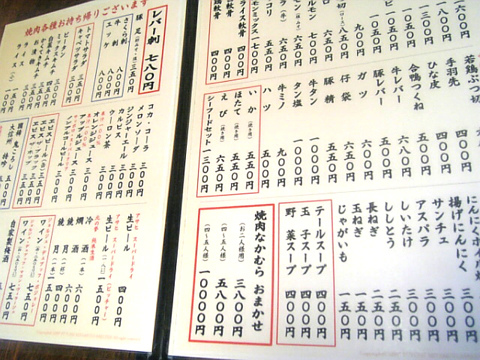
  3. Awesome reading skills: Unless you want to eat only in fast food or family restaurants, most restaurants have no pictures and can look like some sort of ancient Chinese poem as far as you know unless you’ve beefed up learning the names of various dishes in Kanji.
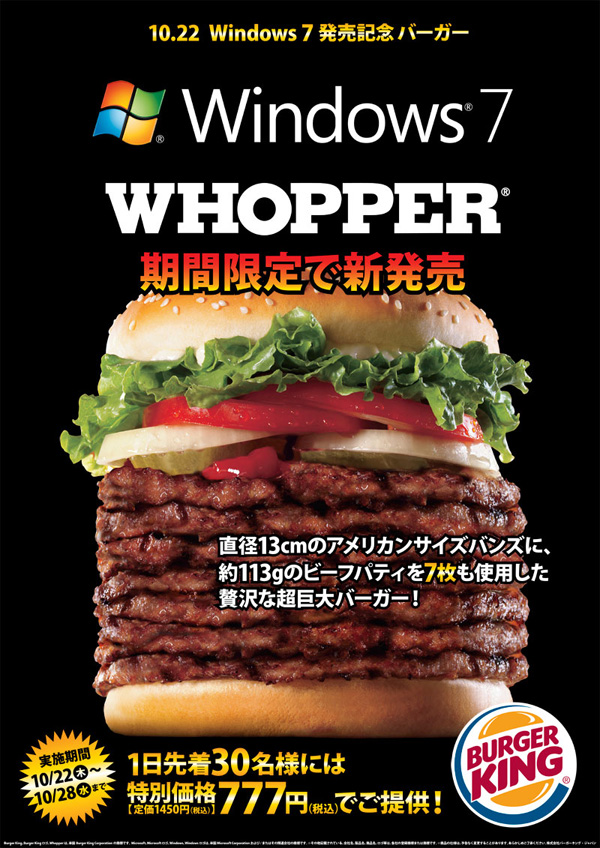
windows 7 whopper

Contrary to popular belief, you can eat big in Japan (at least for a limited time)

Let me tell you, I thought I was pretty good at Japanese when I first arrived in Japan but when I went to buy something for the first time at a convenience store, I didn’t understand a lick of what was being said. How embarrassing!

So in this multi-part series, we will look at various types of foods and what they are called so that you can easily order them like a pro! In this part, we’ll look at some phrases that should help you navigate your way through convenience stores and fast food restaurants.

Conbini and Fast Food

You don’t really need to learn menu items in advance for convenience stores (コンビニ) or fast food restaurants. Obviously, you just pick up what you want in convenience stores and pictures are plentiful in fast food restaurants including mostly food you’re already familiar with such as the standard burgers and fries. However, the employees are going to ask you all sorts of stuff such as whether to take out or if you want to order the combo. And if you’re new to this, chances are highly likely that it will sound like a bunch of gibberish.

Just try to catch a few key words from these phrases because it’s going to be really fast. And of course, the universal rule of learning languages is that asking people to repeat themselves will not slow it down one iota.

Conbini expressions

  1. お箸おつけしますか?
    Would you like chopsticks?
  2. 袋にお入れしますか?
    Shall I put (your items) in a bag for you ?
  3. このままでよろしいですか?
    Is it ok just like this (without a bag)?
  4. 温めますか?
    Shall I heat up your food?

Fast food expressions

  1. こちらでお召しあがりですか?
    Is it for here?
  2. 店内でお召しあがりでしょうか?
    Is it for here?
  3. お持ち帰りですか?
    Is it for take out?
  4. お飲み物はいかがですか。
    How about a drink?

The lists are pretty short but the whole process is pretty standardized (and probably in a manual and everything). It should be enough to get you out the door with your food at the very least but feel free to add other expressions you’ve frequently heard that I missed in the comments.

Finally, if you’re bored see if you can identify the various おでん ingredients. I’m not going to bother going over them because as I recall, it’s all self-service at the convenience store.
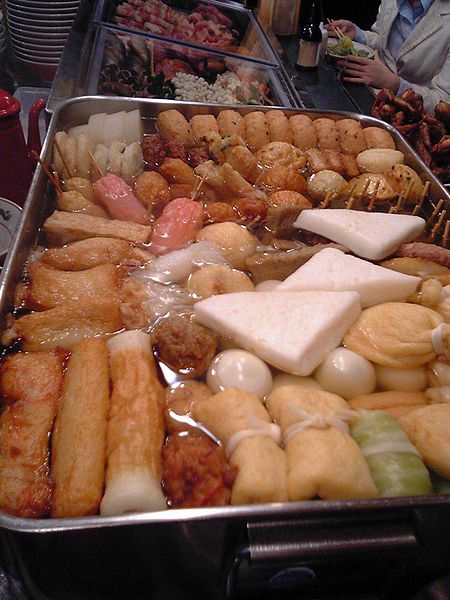
oden ingredients

Tae Kim’s random tech news

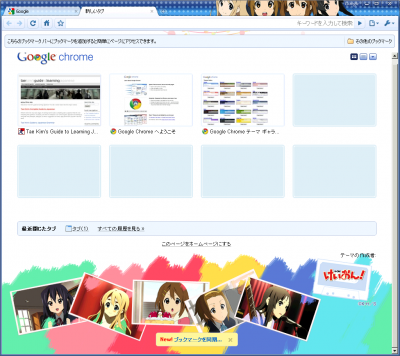
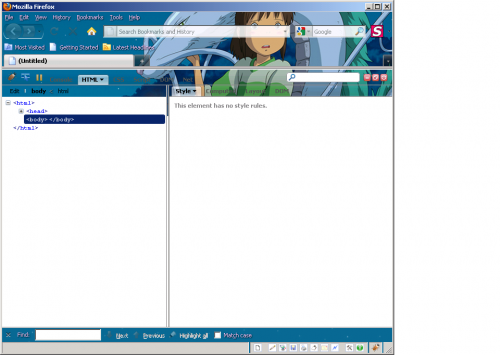
I tried the new version of Chrome yesterday (see review). The Japanese font still looked crappy. However, I found out that if you change Chrome to the Japanese version, it magically fixes itself.

Chrome English version (Win XP):

Chrome Japanese version (Exact same machine):

I’m now considering switching to Chrome with this discovery. It’s much faster than Firefox and the themes look nicer than Firefox personas because it’s not scattered across all the UI elements. Still, with web development, you’ll have to pry Firebug from my cold dead fingers.

By the way, the images in this post were cropped and re-sized using the new image editing tool built in WordPress 2.9. It works but it’s still kind of buggy. For some reason, it won’t let me crop to a really small size. Also, you can’t crop it more than once without saving it first otherwise it crops a completely different area.

Speaking of CMS, I tried Drupal 7 on a demo site. It looks completely revamped. My biggest gripe looks fixed finally. You can actually navigate away from the page or lose your wireless connection and come back to the page without it going of of its way to erase all your content. Wow, that’s a low bar to clear. The book module navigation doesn’t look any better though. <sarcasm>Nobody write books online anyway, right?</sarcasm> Looking forward to what’s looking to be a painful upgrade process once it comes out.

So there you have it, my random tech news update. Nobody cares anyway, right? Apple’s releasing new shit today! If you ask me, an iPod touch with a bigger screen is lame, no matter what it does. It sucks that you have to hold it in one hand while using the other to interface with it. Your thumb will probably get in the way and your wrist won’t last for very long. In any case, I’m not keen on reverting to one-hand typing on a device that doesn’t even fit in my pocket.

Putting on your clothes was never so hard!

We really take the verb, “to wear” for granted and you never realize how much until you try to say the same thing in Japanese. 「着る」(きる) is the verb meaning “to wear” in Japanese and is pretty simple to use as you can see by the examples below.

シャツを着る。- Wear shirt.
ジャケットを着ています。- Wearing jacket.

Awesome. So we’re done right?

No.

If things were that simple, I wouldn’t be writing this. You will appreciate how flexible and awesome the English verb “to wear” is compared to 「着る」. It’s like Superman vs Steve Erkel (forget that one episode where Steve Erkel was Superman). We can wear hats, pants, gloves, scarves, shoes, accessories, just about anything that sticks to your body. Unfortunately, you cannot use 「着る」 with any of these items. The only thing you can use with 「着る」 are things that cover your upper-body such as shirts and jackets. Things that extend from your upper-body down past your waist such as overcoats and dresses also use this verb as well. So what about everything else? Well, I prepared a wonderful list for you to study. 「など」 means “etc”. Have fun!

Things you wear and their respective verbs

  1. 着る 【き・る】- to wear
    Clothes that cover your-upper body and more (シャツ、ブラウス、ジャケット、ドレスなど)
  2. 履く 【は・く】- to wear
    Clothes for your lower-body and feet (ずぼん、ジーンズ、靴下、ブーツ、靴など)
  3. 被る 【かぶ・る】 – to cover
    Items that go over such as hats (帽子など)
  4. かける – to hang
    Items that hang such as glasses and sunglasses (メガネ、サングラス)
  5. 巻く 【ま・く】 – to wrap
    Items that wrap around such as scarves (スカーフ、マフラーなど)
  6. 締める 【し・める】 – to tie
    Items that fasten such as neckties and belts (ネクタイ、ベルト、帯など)
  7. 着ける 【つけ・る】
    Items that attach such as wigs and earrings (かつら、イヤリング、ピアスなど)
  8. はめる – to insert
    Items you stick your finger into such as rings (指輪)
  9. する – to do
    A generic term for things like gloves, earrings, necklaces (手袋、イヤリング、ネックレス)

And don’t forget that these verbs are just for the actually act of donning the item. You must use the 「~ている」 progressive tense for when somebody is in the state of wearing them. I’m tired so I won’t even go into the words for taking things off. You can go with just 脱ぐ(ぬぐ) for clothing and 外す(はず・す) for accessories.

I have to confess that I’m not exactly a fashion guru so do feel free to add types of apparel I missed in the comments.