I’m soooo boring! Hee hee *snort*

I know there’s still many of you out there that still feels uncomfortable about the difference between the 「は」 and 「が」 particle. You might have even read my first post which covered this very topic. Maybe my explanation didn’t “vibe” with you (translation: something’s wrong with you), so let me give you a more concrete example. Ignore the parentheses, I really don’t know where they come from. I think it’s a secret WordPress plugin.

I’m going to be revisit the two particles with the following story.

While chatting over dinner at a restaurant with fellow exchange students and some Japanese students, one of the exchange students exclaimed,

「私はつまらない~! \(*^o^)/」

We all had a good laugh because it seemed like she was saying she was boring.

If you’re reading this K, I don’t mean to insult you in anyway. Honestly, it’s the kind of mistake we’ve all made in the past. So exactly what was wrong with what she said? Doesn’t 「私はつまらない」 mean “I’m bored”? If not, how can you say “I’m bored” without insulting yourself?

The topic: direct relation=0%, implied=100%

The answer will probably blow away some of you new to this language. 「私はつまらない」 can mean either, “I’m bored” OR “I’m boring” or more accurately, 「私は」 gives us no information on which interpretation is correct.

The 「は」 topic particle only tells us the general topic of the conversation and has no direct connection to the rest of the sentence. All it says is, “this is what I’m going to talk about” and doesn’t explicitly specify its relation to the rest of the sentence.

私はつまらない~! – As for me, boring!

As you can see from the translation, saying 「私はつまらない」 without any context is highly suggestive of your incredibly boring and dull personality. If there was additional context, you might be able to pull it off such as the next example.

A) みんな、楽しんでいるよね? – Everybody’s having fun, right?
B) 私は、つまらないよ。 – As for me, boring.

Here, you can make the argument that you’re saying you’re bored because the question just asked was whether everybody was having fun. Another example is when you make it very clear that the role of 「つまらない」 is completely unrelated to you.

A) この映画は面白いの? – Is this movie interesting?
B) 私は、つまらないと思う。 – As for me, think (the movie) is boring.

The identifier: it’s this one

So if the topic particle doesn’t really seem to work, what if we use the 「が」 particle instead? The 「が」 particle doesn’t specify whether you’re boring or bored either. It just identifies you as the one that is 「つまらない」. Whether that means boring or bored is kind of pretty much up to the interpretation of the listener.

A) 私がつまらない。 – I’m the one that is boring/bored.
B) ?

B would be pretty puzzled because A is identifying herself as the one that is boring or bored and B didn’t know they were trying to find the one that was boring/bored. The only context in which 「が」 would make sense here is if you were trying to identify the one that was boring/bored, in other words, answering the question, “which is the one that is bored/boring?”

A) 誰がつまらない? – Who is the one that is bored/boring?
B) 私がつまらないよ。 – I’m the one that is bored/boring.

If you do a google search on “私がつまらない”, you’ll get a small number of results because this kind of situation is pretty contrived. So 「が」 doesn’t really work for our purposes.

Conclusion

In general, unless you want to make a distinction between your own opinion versus other people around you, you should generally avoid using 「私は」 at all. The ambiguity of topic’s role in the sentence makes using 「私は」 and 「つまらない」 together a dangerous combination.

「私が」 doesn’t really work either because it identifies you as the one that is boring or bored among all the people who are potentially bored/boring. The only context in which it would make sense is if you knew somebody was boring/bored and you were trying to figure out which one among a group of people was the boring/bored one. It’s not a very likely scenario, which probably means you’re not using 「が」 correctly.

It is important to remember that people generally will assume you’re talking about yourself unless you say otherwise. So for the most part, you don’t have to say 「私」 with either particle. People learning Japanese often get so catch up with the contrived differences between 「は」 and 「が」, they often forget the option of using neither. So to conclude, in the original story, I would probably suggest to K to say something along the lines of the following instead next time.

「なんかつまんない~! \(*^o^)/」
The story of A-san

My twitter account is the story of A-san told in the form of a dialogue. Rules for replying and adding your own dialogue lines are below. Not sure how well it’s going to work but here goes.

気まぐれ会話のルール:
1)会話の続きは、「@kimchi314」の返事で行う。
2)会話の続き以外の返事はダメ。
3)返事は、日本語だけ。
4)話し手を明確にする。

例えば、「@kimchi314 A:ありがとう」

Update: I will retweet any interesting replies (with maybe a little embellishment). Eventually, I will follow good contributors. Use #kimagure for meta discussion about 気まぐれ会話

Ordering food in real Japanese part 2 (ramen)

The response to part 1 was very positive so as promised, here’s part 2 of ordering food in real Japanese. I imagine the first thing most people come up with when thinking about Japanese food is “sushi” but for me, I would definitely say it’s “ramen”. Ramen was definitely a big part of what got me interested in the Japanese culture very early on. Tampopo is still one of my favorite movies of all time. If you haven’t watched it yet, you’re seriously missing out.

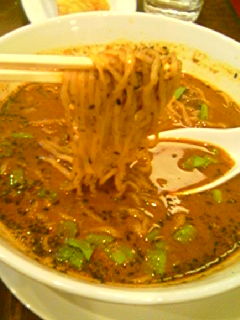
tasty ramen

四川黒ごまタンタン麺

Ahh, the rich and complicated world of ramen. There’s so many things to cover but let’s just start with the basics. First of all, ramen is everywhere in Japan so finding it is like trying to find a Starbucks, not very difficult. However, Ikebukuro is perhaps one of the neighborhoods more famous for it’s ramen. There’s one I particularly liked whose name I can’t recall where you can crush your own fresh garlic (I love garlic).

Main Ramen Types

Before we get into all the crazy ingredients that can go into ramen, you should first become familiar with the major types of ramen. These types will be generally enough to get your ramen fix in most generic ramen shops. Of course, many restaurants try to come up with clever names but it’s usually just marketing for these basic types of ramen.

  • 醤油ラーメン (しょうゆラーメン) – The most common and generic type of ramen. Nothing much to comment on here except that it doesn’t really taste like soy-sauce at all. Sometimes 「醤油」 is written as 「正油」.
  • 塩ラーメン (しおラーメン) – A simple, refreshing salt-based flavor. (It works great for hangovers.)
  • 味噌ラーメン (みそラーメン) – As the name “miso ramen” implies, the soup’s flavor is based mainly off of miso. If you like miso, you’ll probably like miso-ramen.
  • 坦々麺 (タンタンメン) – A spicy soup with the taste of sesame seeds either black or white.
  • 豚骨ラーメン(とんこつラーメン) – Literally meaning “pork bone ramen”, the soup is flavored by boiling pork bones in water. This gives the soup a whiteish color. Personally my favorite type of ramen.
  • チャーシューメン – Most ramen come with a slice of pork flavored differently depending on the ramen called 「チャーシュー」. This ramen is for lovers of 「チャーシュー」 as it has several heaped on.
  • ねぎラーメン – For those who like 「ねぎ」 or green onion, this ramen is for you. It’s heaped with the stuff.
  • つけめん – In this variation, the noodles are dipped in the soup as you eat. I don’t really like it that much because it tends to get cold very quickly but I do enjoy a spicy one occasionally.

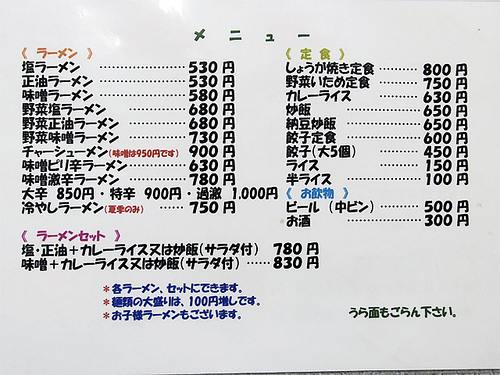
A typical ramen menu (among other things)

This is the main list but there are other types of ramen out there like 「カレーラーメン」, for example.

Noodle Types

In addition to the major types of ramen, sometimes the cook will ask you how hard you want your noodles. Personally, I prefer al dente as do many of the more hard-core ramen enthusiasts. You can even ask for soft but who likes soggy noodles? Another great trick for a really filling meal, if the option is available, is to save the soup and order an extra ball of noodles. This is called 「替え玉」(かえだま). It’s like an extra bowl of ramen often for as little as several hundred yen!

  1. めんの硬さ(めんのかたさ) – hardness of noodle
  2. 固めん(かためん) – hard noodle
  3. 普通(ふつう) – normal
  4. やわらかめ – on the soft side

Ramen Ingredients

Oh boy, this is going to be a doozy. A small number of ramen shops give you a list of ingredients, allowing you to choose each and every ingredient in your ramen (often charging you extra for each one). My wife usually picks miso, butter, and corn…. Ugh…

In Japanese, this is called 「具」(ぐ), which basically describes the solid stuff in any kind of soup or stew. There are a lot of ingredients so I’m only going to go over the major ones except for those we already look at in the major ramen types.

  1. のり – seaweed (you know the stuff)
  2. 煮玉子(にたまご) – boiled egg (my favorite), among other similar variations of egg including: 「半熟玉子」(はんじゅくたまご) and 「味玉子」(あじたまご)
  3. メンマ – bamboo shoots
  4. もやし – bean sprouts (pretty standard)
  5. ナルト – steamed fish-paste cake, you know the one with a pink swirl on it (impossible to find picture due to comic named after it)
  6. キクラゲ - some sort of mushroom, usually chopped up to look like black stringy things, pretty tasty

Also check out this the wikipedia ramen entry. There’s a lot more information about ramen as well, such as regional specialties. It’s all in Japanese but there’s also plenty of yummy pictures to feast your eyes on. Lovers of garlic and thick とんこつ soup like me will love 熊本ラーメン, though as I painfully learned first-hand, you probably don’t want to actually eat all the garlic chips.

So there you have it. Welcome to the wonderful world of ramen! This post just barely scratching the surface so you haven’t seen nothing yet!

Thoughts on podcast mics?

My wife’s friend Akina is coming to visit next month, so I thought I’d take this opportunity to capture her nice voice with a nice microphone. It’s a short visit so time will be limited but I figured I could at least get the Hiragana sounds done (male version by yours truly). I’m looking for a budget mic that costs less than $100 and can be used by multiple people in a quiet room. Does anybody have any good recommendations? I’m currently thinking about buying the blue snowball. I definitely like that it has an omni-mode so that I don’t have to buy a mic for each person once I get to doing audio for conversations.

Thanks to the kind folks who’ve contributed to the audio fund, I now have enough funds there to cover a mic under $100. But you know what? I’m going to pay for it out of pocket because I’d like the donations to go to something more than just gadgets that I want to buy anyway. I’d also like to take this opportunity to thank those who have contributed so far (discreetly ordered in dollar amounts heh). Thanks and I hope to bring some audio to the site in the near future.

  • Mike C.
  • Steven S.
  • Jeff M.
  • The Compagniye Store
  • Jonathan G.
  • Oliver N.
  • Daniel C-W.
  • Helen F.
  • Llorenç S. C.
  • William T.

Thanks again!