
The root of this problem lies in the fact that these textbooks try to teach you Japanese with English. They want to teach you on the first page how to say, "Hi, my name is Smith," but they don't tell you about all the arbitrary decisions that were made behind your back. They probably decided to use the polite form even though learning the polite form before the dictionary form makes no sense. They also might have decided to include the subject even though it's not necessary and excluded most of the time. In fact, the most common way to say something like "My name is Smith" in Japanese is to say "am Smith". That's because most of the information is understood from the context and is therefore excluded. But does the textbook explain the way things work in Japanese fundamentally? No, because they're too busy trying to push you out the door with "useful" phrases right off the bat. The result is a confusing mess of "use this if you want to say this" type of text and the reader is left with a feeling of confusion about how things actually work.
The solution to this problem is to explain Japanese from a Japanese point of view. Take Japanese and explain how it works and forget about trying to force what you want to say in English into Japanese. To go along with this, it is also important to explain things in an order that makes sense in Japanese. If you need to know [A] in order to understand [B], don't cover [B] first just because you want to teach a certain phrase.
Essentially, what we need is a Japanese guide to learning Japanese grammar.
In the beginning, the English translations for the examples will also be as literal as possible to convey the Japanese sense of the meaning. This will often result in grammatically incorrect translations in English. For example, the translations might not have a subject because Japanese does not require one. In addition, since the articles "the" and "a" do not exist in Japanese, the translations will not have them as well. And since Japanese does not distinguish between a future action and a general statement (such as "I will go to the store" vs. "I go to the store"), no distinction will necessarily be made in the translation. It is my hope that the explanation of the examples will convey an accurate sense of what the sentences actually mean in Japanese. Once the reader becomes familiar and comfortable thinking in Japanese, the translations will be less literal in order to make the sentences more readable and focused on the more advanced topics.
Be aware that there are advantages and disadvantages to systematically building a grammatical foundation from the ground up. In Japanese, the most fundamental grammatical concepts are the most difficult to grasp and the most common words have the most exceptions. This means that the hardest part of the language will come first. Textbooks usually don't take this approach; afraid that this will scare away or frustrate those interested in the language. Instead, they try to delay going deeply into the hardest conjugation rules with patchwork and gimmicks so that they can start teaching useful expressions right away. (I'm talking about the past-tense conjugation for verbs in particular) This is a fine approach for some, however; it can create more confusion and trouble along the way much like building a house on a poor foundation. The hard parts must be covered no matter what. However, if you cover them in the beginning, the easier bits will be all that easier because they'll fit nicely on top of the foundation you have built. Japanese is syntactically much more consistent than English. If you learn the hardest conjugation rules, most of remaining grammar builds upon similar or identical rules. The only difficult part from there on is sorting out and remembering all the various possible expressions and combinations in order to use them in the correct situations.
※Before you start using this guide, please note that half brackets like these: 「」 are the Japanese version of quotation marks.
This is why I'm a firm believer of learning by example. Examples and experience will be your main tools in mastering Japanese. Therefore, even if you don't get something completely the first time right away, just move on and keep referring back as you see more examples. This will allow you to get a better sense of how it's used in many different contexts. Unfortunately, writing up examples takes time and is slow going. (I'm trying my best!) But lucky for you, Japanese is everywhere, especially on the web. I recommend practicing Japanese as much as possible and referring to this guide only when you cannot understand the grammar. The Internet alone has a rich variety of reading materials including websites, bulletin boards, and online chat. Buying Japanese books or comic books is also an excellent (and fun) way to increase vocabulary and practice reading skills. Also, I believe that it is impossible to learn correct speaking and listening skills without a model. Practicing listening and speaking skills with fluent speakers of Japanese is a must if you wish to master conversational skills. While listening materials such as tapes and T.V. can be very educational, there is nothing better than a real human with which to learn pronunciation, intonation, and natural conversation flow. If you have specific questions that are not addressed in this guide, you can discuss them at the Japanese grammar guide forum.
www.guidetojapanese.org/forum/
Don't feel discouraged by the vast amount of material that you will need to master. Remember, every new word or grammar learned is one step closer to mastering the language!
(minus differences in fonts),
then you need to install Japanese language support or use some kind of gateway to convert the
characters. Links to instructions and a translation gateway are below.
Japanese Language Support
Translation Gateway (Considerably slower)
Also, please make sure you have a recent browser to enjoy all the benefits of stylesheets. I recommend Firefox.
Don't worry about having to manually look up all the Kanji and vocabulary. You can go to the WWWJDIC and paste all the examples there to quickly look up most of the words.
All the material presented here including examples is original except for some of the common terminology and when explicitly stated otherwise. I hope you enjoy this guide as much as I enjoyed writing it. Which is to say, frustrating and time-consuming yet somehow strangely mixed with an enormous feeling of satisfaction.
There are bound to be (many) small errors and typos especially since I wrote this in ed, haha, just kidding! (Sorry, nerd joke). I actually wrote this in Notepad which has no spellcheck, so please forgive the numerous typos! Please post any feedback, corrections, and/or suggestions at the Japanese Grammar Guide Forum
Well, no more chit-chat. Happy learning!
-Tae Kim
This page has last been revised on 2005/6/8
Changed feedback from email to the forum (2005/6/8)
Japanese (n): The devil's own tongue designed
to thwart the spread of Christianity
Chinese characters, called kanji in Japanese, are also heavily used in the Japanese writing. Most of the words in the Japanese written language are written in kanji (nouns, verbs, adjectives). There exists over 40,000 kanji where about 2,000 represent over 95% of characters actually used in written text. There are no spaces in Japanese so kanji is necessary in distinguishing between separate words within a sentence. Kanji is also useful for discriminating between homophones, which occurs quite often given the limited number of distinct sounds in Japanese.
Hiragana is used mainly for grammatical purposes. We will see this as we learn about particles. Words with extremely difficult or rare kanji, colloquial expressions, and onomatopoeias are also written in hiragana. It's also often used for beginning Japanese students and children in place of kanji they don't know.
While katakana represents the same sounds as hiragana, it is mainly used to represent newer words imported from western countries (since there are no kanji associated with words based on the roman alphabet). The next three sections will cover hiragana, katakana, and kanji.
Intonation of high and low pitches is a crucial aspect of the spoken language. For example, homophones can have different pitches of low and high resulting in a slightly differently sounding of the word even if it is written with the same sounds. The largest barrier to proper and natural sounding speech is incorrect intonation. Many students often speak without paying attention to the correct enunciation of pitches making speech sound unnatural (the classic foreigner's accent). It is not practical to memorize or attempt to logically create rules for pitches, especially since it can change depending on the context or the dialect. The only practical approach is to get the general sense of pitches by mimicking native Japanese speakers with careful listening and practice.
This page has last been revised on 2004/11/24
Here is a table of hiragana and similar-sounding English consonant-vowel pronunciations. It is read up to down and right to left, which is how most Japanese books are written. In Japanese, writing the strokes in the correct order and direction is important, especially for kanji. Because handwritten letters look slightly different from typed letters (just like how 'a' looks totally different when typed) you will want to find a source such as a website or textbook that will show you how to write the characters. I must also stress the importance of correctly learning how to pronounce each sound. Since every word in Japanese is composed of these sounds, learning an incorrect pronunciation for a letter can severely damage the very foundation on which your pronunciation lies.
| n | w | r | y | m | h | n | t | s | k | ||
|---|---|---|---|---|---|---|---|---|---|---|---|
| ん | わ | ら | や | ま | は | な | た | さ | か | あ | a |
| ゐ* | り | み | ひ | に | ち (chi) | し (shi) | き | い | i | ||
| る | ゆ | む | ふ (fu) | ぬ | つ (tsu) | す | く | う | u | ||
| ゑ* | れ | め | へ | ね | て | せ | け | え | e | ||
| を | ろ | よ | も | ほ | の | と | そ | こ | お | o |
Hiragana is not too tough to master or teach and as a result, there are a variety of web sites and free programs that are already available on the web. I strongly urge you to go to this web site to hear the pronunciations of each character. The relevant sections are 2.1 to 2.11. I also suggest recording yourself and comparing the sounds to make sure you're getting it right.
When practicing writing hiragana by hand, the important thing to remember is that the stroke order and direction of the strokes matter. There, I underlined, italicized, bolded, and highlighted it to boot. Trust me, you'll eventually find out why when you read other people's hasty notes that are nothing more than chicken scrawls. The only thing that will help you is that everybody writes in the same order and so the "flow" of the characters is fairly consistent. I strongly recommend that you pay close attention to stroke order from the beginning starting with hiragana to avoid falling into bad habits. Go to this web site to see little animated gifs of stroke order and practice from there.
※ As an aside, an old Japanese poem called 「いろは」 was often used as the base for ordering of the hiragana alphabet until recent times. The poem contains every single letter of the hiragana alphabet except for 「ん」 which probably did not exist at the time it was written. You can check out this poem for yourself in this wikipedia article. As the article mentions, this order is still sometimes used in ordering lists so you may want to spend some time checking it out.
All the possible combinations of muddied consonant sounds are given in the table below.
| p | b | d | z | g | |
|---|---|---|---|---|---|
| ぱ | ば | だ | ざ | が | a |
| ぴ | び | ぢ (ji) | じ (ji) | ぎ | i |
| ぷ | ぶ | づ (dzu) | ず | ぐ | u |
| ぺ | べ | で | ぜ | げ | e |
| ぽ | ぼ | ど | ぞ | ご | o |
| p | b | j | g | r | m | h | n | c | s | k | |
|---|---|---|---|---|---|---|---|---|---|---|---|
| ぴゃ | びゃ | じゃ | ぎゃ | りゃ | みゃ | ひゃ | にゃ | ちゃ | しゃ | きゃ | ya |
| ぴゅ | びゅ | じゅ | ぎゅ | りゅ | みゅ | ひゅ | にゅ | ちゅ | しゅ | きゅ | yu |
| ぴょ | びょ | じょ | ぎょ | りょ | みょ | ひょ | にょ | ちょ | しょ | きょ | yo |
| Vowel Sound | Extended by |
|---|---|
| / a / | あ |
| / i / e / | い |
| / u / o / | う |
For example, if you wanted to create an extended vowel sound from 「か」, you would add 「あ」 to create 「かあ」. Other examples would include: 「き → きい」, 「く → くう」, 「け → けい」, 「こ → こう」, 「さ → さあ」 and so on. The reasoning for this is quite simple. Try saying 「か」 and 「あ」 separately. Then say them in succession as fast as you can. You'll notice that soon enough, it just sounds like you're dragging out the / ka / for a longer duration than just saying / ka / by itself. You can try this exercise with the other vowel sounds if you like. Try to remember that you are, in fact, saying two characters with blurred boundaries. In fact, you may not even have to consciously think about long vowels and simply pronounce the letters together quickly to get the correct sound.
In addition, while the / e / vowel sound followed by 「い」 is usually considered to a long vowel sound, the pronunciation is actually a slurred connection of the / e / and / i / vowel sounds. In other words, it should be pronounced like / ay / (as in "acorn") and not just a long / e /.
It's important to make sure you hold the vowel sound long enough because you can be saying things like "here" (ここ) instead of "High School" (こうこう) or "middle-aged lady" (おばさん) instead of "grandmother" (おばあさん) if you don't stretch it out correctly!
There are rare exceptions where an / e / vowel sound is extended by adding 「え」 or an / o / vowel sound is extended by 「お」. Some examples of this include 「おねえさん」、「おおい」、and 「おおきい」. Pay careful attention to these exceptions but don't worry, there aren't too many of them.
This page has last been revised on 2006/4/7
Added reference to 「いろは」 (2005/8/3)
/ei/ should be pronounced as /ay/ and not just a long /e/ (2006/4/7)
|
|
Click on the flip link to show or hide each character.
| n | w | r | y | m | h | n | t | s | k | ||
|---|---|---|---|---|---|---|---|---|---|---|---|
| ん flip |
わ flip |
ら flip |
や flip |
ま flip |
は flip |
な flip |
た flip |
さ flip |
か flip |
あ flip |
a |
| り flip |
み flip |
ひ flip |
に flip |
ち flip |
し flip |
き flip |
い flip |
i | |||
| る flip |
ゆ flip |
む flip |
ふ flip |
ぬ flip |
つ flip |
す flip |
く flip |
う flip |
u | ||
| れ flip |
め flip |
へ flip |
ね flip |
て flip |
せ flip |
け flip |
え flip |
e | |||
| を flip |
ろ flip |
よ flip |
も flip |
ほ flip |
の flip |
と flip |
そ flip |
こ flip |
お flip |
o |
| 1. ku | ru | ma | = | くるま |
| 2. a | shi | ta | = | あした |
| 3. ko | ku | se | ki | = | こくせき |
| 4. o | su | shi | = | おすし |
| 5. ta | be | ru | = | たべる |
| 6. wa | ka | ra | na | i | = | わからない |
| 7. sa | zu | ke | ru | = | さずける |
| 8. ri | ku | tsu | = | りくつ |
| 9. ta | chi | yo | mi | = | たちよみ |
| 10. mo | no | ma | ne | = | ものまね |
| 11. hi | ga | e | ri | = | ひがえり |
| 12. pon | zu | = | ぽんず |
| 13. hi | ru | me | shi | = | ひるめし |
| 14. re | ki | shi | = | れきし |
| 15. fu | yu | ka | i | = | ふゆかい |
| 1. nu | ru | i | o | cha | = | ぬるいおちゃ |
| 2. kyu- | kyo | ku | = | きゅうきょく |
| 3. un | yo-| jo- | ho- | = | うんようじょうほう |
| 4. byo- | do- | = | びょうどう |
| 5. jyo- | to- | shu | dan | = | じょうとうしゅだん |
| 6. gyu- | nyu- | = | ぎゅうにゅう |
| 7. sho- | rya | ku | = | しょうりゃく |
| 8. hya | ku | nen | ha | ya | i | = | ひゃくねんはやい |
| 9. so | tsu | gyo- | shi | ki | = | そつぎょうしき |
| 10. to- | nyo- | byo- | = | とうにょうびょう |
| 11. mu | ryo- | = | むりょう |
| 12. myo- | ji | = | みょうじ |
| 13. o | ka- | san | = | おかあさん |
| 14. ro- | nin | = | ろうにん |
| 15. ryu- | ga | ku | se | i | = | りゅうがくせい |
| 1. きゃっかんてき | = | kyakkanteki |
| 2. はっぴょうけっか | = | happyoukekka |
| 3. ちょっかん | = | chokkan |
| 4. ひっし | = | hisshi |
| 5. ぜったい | = | zettai |
| 6. けっちゃく | = | kecchaku |
| 7. しっぱい | = | shippai |
| 8. ちゅうとはんぱ | = | chuutohanpa |
| 9. やっかい | = | yakkai |
| 10. しょっちゅう | = | shocchuu |
This page has last been revised on 2006/11/20
Katakana represents the same set of phonetic sounds as hiragana except, of course, all the characters are different. Since foreign words must fit into this set of [consonants+vowel] combinations, they undergo many radical changes resulting in the case where English speakers can't understand words that are supposed to have been derived from English! As a result, the use of katakana is extremely difficult for English speakers because they expect English words to sound like... well... English. Instead, it is better to completely forget the original English word, and treat the word as an entirely separate Japanese word, otherwise you can run into the habit of saying English words with English pronunciations (whereupon a Japanese person may or may not understand what you are saying).
| n | w | r | y | m | h | n | t | s | k | ||
|---|---|---|---|---|---|---|---|---|---|---|---|
| ン | ワ | ラ | ヤ | マ | ハ | ナ | タ | サ | カ | ア | a |
| ヰ* | リ | ミ | ヒ | ニ | チ | シ | キ | イ | i | ||
| ル | ユ | ム | フ | ヌ | ツ | ス | ク | ウ | u | ||
| ヱ* | レ | メ | ヘ | ネ | テ | セ | ケ | エ | e | ||
| ヲ* | ロ | ヨ | モ | ホ | ノ | ト | ソ | コ | オ | o |
Katakana is significantly tougher to master compared to hiragana because it is only used for certain words and you don't get nearly as much practice as you do with hiragana. To learn the proper stroke order (and yes, you need to), here is the same web site as before except it is for katakana.
Also, since Japanese doesn't have any spaces, sometimes the symbol 「・」 is used to show the spaces like 「ロック・アンド・ロール」 for "rock and roll". Using the symbol is completely optional so sometimes nothing will be used at all.
| v | w | f | ch | d | t | j | sh | |
|---|---|---|---|---|---|---|---|---|
| ヴァ | ワ | ファ | チャ | ダ | タ | ジャ | シャ | a |
| ヴィ | ウィ | フィ | チ | ディ | ティ | ジ | シ | i |
| ヴ | ウ | フ | チュ | ドゥ | トゥ | ジュ | シュ | u |
| ヴェ | ウェ | フェ | チェ | デ | テ | ジェ | シェ | e |
| ヴォ | ウォ | フォ | チョ | ド | ト | ジョ | ショ | o |
| English | Japanese |
|---|---|
| America | アメリカ |
| Russia | ロシア |
| cheating | カンニング (cunning) |
| tour | ツアー |
| company employee | サラリーマン (salary man) |
| Mozart | モーツァルト |
| car horn | クラクション (klaxon) |
| sofa | ソファ or ソファー |
| Halloween | ハロウィーン |
| French fries | フライドポテト (fried potato) |
This page has last been revised on 2006/9/17
Added link to additional usages (2006/5/11)
|
|
Click on the flip link to show or hide each character.
| n | w | r | y | m | h | n | t | s | k | ||
|---|---|---|---|---|---|---|---|---|---|---|---|
| ン flip |
ワ flip |
ラ flip |
ヤ flip |
マ flip |
ハ flip |
ナ flip |
タ flip |
サ flip |
カ flip |
ア flip |
a |
| リ flip |
ミ flip |
ヒ flip |
ニ flip |
チ flip |
シ flip |
キ flip |
イ flip |
i | |||
| ル flip |
ユ flip |
ム flip |
フ flip |
ヌ flip |
ツ flip |
ス flip |
ク flip |
ウ flip |
u | ||
| レ flip |
メ flip |
ヘ flip |
ネ flip |
テ flip |
セ flip |
ケ flip |
エ flip |
e | |||
| ロ flip |
ヨ flip |
モ flip |
ホ flip |
ノ flip |
ト flip |
ソ flip |
コ flip |
オ flip |
o |
| 1. pan | = | パン |
| 2. kon | pyu- | ta | = | コンピュータ |
| 3. myu- | ji | ka | ru | = | ミュージカル |
| 4. u- | man | = | ウーマン |
| 5 he | a | pi- | su | = | ヘアピース |
| 6. nu- | do | = | ヌード |
| 7. me | nyu- | = | メニュー |
| 8. ro- | te- | shon | = | ローテーション |
| 9. ha | i | kin | gu | = | ハイキング |
| 10. kyan | se | ru | = | キャンセル |
| 11. ha | ne | mu-n | | = | ハネムーン |
| 12. ku | ri | su | ma | su | tsu | ri- | = | クリスマスツリー |
| 13. ra | i | to | = | ライト |
| 14. na | i | to | ge- | mu | = | ナイトゲーム |
| 1. e | i | zu | wi | ru | su | = | エイズウイルス |
| 2. no- | su | sa | i | do | = | ノースサイド |
| 3. in | fo | me- | shon | = | インフォメーション |
| 4. pu | ro | je | ku | to | = | プロジェクト |
| 5. fa | su | to | fu- | do | = | ファストフード |
| 6. she | ru | su | ku | ri | pu | to | = | シェルスクリプト |
| 7. we- | to | re | su | = | ウェートレス |
| 8. ma | i | ho- | mu | = | マイホーム |
| 9. chi- | mu | wa- | ku | = | チームワーク |
| 10. mi | ni | su | ka- | to | = | ミニスカート |
| 11. re- | za- | di | su | ku | = | レーザーディスク |
| 12. chen | ji | = | チェンジ |
| 13. re | gyu | ra- | = | レギュラー |
| 14. we | i | to | ri | fu | tin | gu | = | ウエイトリフティング |
As you know, since Japanese sounds always consist of consonant-vowel pairs, any English words that deviate from this pattern will cause problems. The only combination that doesn't create problems is the consonant-vowel + n (using 「ン」). Here are some trends you may have noticed.
If you've seen "Lost in Translation", you know that / l / and / r / are indistinguishable.
(1) Ready -> レディ
(2) Lady -> レディ
If you have more than one vowel in a row or a vowel sound that ends in / r /, it usually becomes a long vowel sound.
(1) Target -> ターゲット
(2) Shoot -> シュート
Abrupt cut-off sounds usually denoted by a / t / or / c / employ the small 「ッ」.
(1) Catch -> キャッチ
(2) Cache -> キャッシュ
Any word that ends in a consonant sound requires another vowel to complete the consonant-vowel pattern. (Except for "n" and "m" for which we have 「ン」) For "t" and "d", it's usually "o". For everything else, it's usually "u".
(1) Good -> グッド
(2) Top -> トップ
(3) Jack -> ジャック
| 1. check | = | チェック |
| 2. violin | = | バイオリン |
| 3. jet coaster (roller coaster) | = | ジェットコースター |
| 4. window shopping | = | ウィンドーショッピング |
| 5. salsa | = | サルサ |
| 6. hotdog | = | ホットドッグ |
| 7. suitcase | = | スーツケース |
| 8. kitchen | = | キッチン |
| 9. restaurant | = | レストラン |
| 10. New York | = | ニューヨーク |
This page has last been revised on 2006/11/20
This guide begins using kanji from the beginning to help the reader read "real" Japanese as quickly as possible. Therefore, we will go over some properties of kanji and discuss some strategies of learning it quickly and efficiently. Mastering kanji is not easy but it is by no means impossible. The biggest part of the battle is mastering the skills of learning kanji and time. In short, memorizing kanji past short-term memory must be done with a great deal of study and, most importantly, for a long time. And by this, I don't mean studying five hours a day but rather reviewing how to write a kanji once every several months until you are sure you have it down for good. This is another reason why this guide starts using kanji right away. There is no reason to dump the huge job of learning kanji at the advanced level. By studying kanji along with new vocabulary from the beginning, the immense job of learning kanji is divided into small manageable chunks and the extra time helps settle learned kanji into permanent memory. In addition, this will help you learn new vocabulary, which will often have combinations of kanji you already know. If you start learning kanji later, this benefit will be wasted or reduced.
Certain characters (especially the most common ones) can have more than one 音読み or 訓読み. For example, in the word 「怪力」, 「力」 is read here as 「りき」 and not 「りょく」. Certain compound words also have special readings that have nothing to do with the readings of the individual characters. These readings must be individually memorized. Thankfully, these readings are few and far in between.
訓読み is also used in adjectives and verbs in addition to the stand-alone characters. These words often have a string of kana (called okurigana) that come attached to the word. This is so that the reading of the Chinese character stays the same even when the word is conjugated to different forms. For example, the past form of the verb 「食べる」 is 「食べた」. Even though the verb has changed, the reading for 「食」 remain untouched. (Imagine how difficult things could get if readings for kanji changed with conjugation or even worse, if the kanji itself changed.) Okurigana also serves to distinguish between intransitive and transitive verbs (more on this later).
Another concept that is difficult to grasp at first is that the actual readings of kanji can change slightly in a compound word to make the word easier to say. The more common transformations include the / h / sounds changing to either / b / or / p / sounds or 「つ」 becoming 「っ」. Examples include: 「一本」、「徹底」、and 「格好」.
Yet another fun aspect of kanji you'll run into are words that practically mean the same thing and use the same reading but have different kanji to make just a slight difference in meaning. For example 「聞く」(きく) means to listen and so does 「聴く」(きく). The only difference is that 「聴く」 means to pay more attention to what you're listening to. For example, listening to music almost always prefers 「聴く」 over 「聞く」. 「聞く」 can also mean 'to ask', as well as, "to hear" but 「訊く」(きく) can only mean "to ask". Yet another example is the common practice of writing 「見る」 as 「観る」 when it applies to watching a show such as a movie. Yet another interesting example is 「書く」(かく) which means "to write" while 描く (かく) means "to draw". However, when you're depicting an abstract image such as a scene in a book, the reading of the same word 「描く」 becomes 「えがく」. There's also the case where the meaning and kanji stays the same but can have multiple readings such as 「今日」 which can be either 「きょう」、「こんじつ」, or 「こんにち」. In this case, it doesn't really matter which reading you choose except that some are preferred over others in certain situations.
Finally, there is one special character 々 that is really not a character. It simply indicates that the previous character is repeated. For example, 「時時」、「様様」、「色色」、「一一」 can and usually are written as 「時々」、「様々」、「色々」、「一々」.
In addition to these "features" of kanji, you will see a whole slew of delightful perks and surprises kanji has for you as you advance in Japanese. You can decide for yourself if that statement is sarcasm or not. However, don't be scared into thinking that Japanese is incredibly hard. Most of the words in the language usually only have one kanji associated with it and a majority of kanji do not have more than two types of readings.
Some people feel that Japanese should have just switched from Chinese to romaji to do away with all the complicated characters that was bewildering the foreign white devils. In fact, Korean has adopted their own alphabet to greatly simplify their written language to great success. So why didn't it work for Japanese? And I ask this in the past tense because I believe that the government did attempt to replace kanji with romaji shortly after the second world war with little success. I think anyone who has typed at any length in Japanese can easily see why this did not work. At any one time, when you convert typed hiragana into kanji, you are presented with almost always at least two choices (two homophones) and sometimes even up to ten. (Try typing kikan). The 46 or so character alphabet of set sounds in Japanese makes it hard to avoid homophones. Compare this to the Korean alphabet which has 14 consonants and 10 vowels. Any of the consonants can be matched to any of the vowels giving 140 sounds. In addition, a third and sometimes even fourth consonant can be attached to create a single letter. This gives over 1960 sounds that can be created theoretically. (The sounds that are actually used is actually much less than that, though I don't know the exact number.)
Since you want to read at a much faster rate than you talk, you need some visual cues to instantly tell you what each word is. You can use the shape of words in English to blaze through text because most words have different shapes. Try this little exercise: Hi, enve thgouh all teh wrods aer seplled icorrenctly, can you sltil udsternand me?" Korean does this too because it has enough characters to make words with distinct and different shapes. However, because the visual cues are not distinct as kanji, spaces needed to be added to remove ambiguities. (This presents another problem of when and where to set spaces.)
With kanji, we don't have to worry about spaces and much of the problem of homophones is mostly resolved. Without kanji, even if spaces were to be added, the ambiguities and lack of visual cues would make Japanese text much more difficult to read.
This page has last been revised on 2006/5/12
Seems easy enough. Here's the real kicker though.
| A state-of-being can be implied without using 「だ」! |
As it stands, (1) is simply the word "fish" and doesn't mean anything beyond that. However, we'll see in the next section that with the topic particle, we can infer that something is a fish from the context without declaring anything. So the question that should be floating around in your head is, "If you can say something is [X] without using 「だ」, then what's the point of even having it around?" Well, the main difference is that a declarative statement makes the sentence sound more emphatic and forceful in order to make it more... well declarative. Therefore, it is more common to hear men use 「だ」 at the end of sentences. This is also why you cannot use 「だ」 when asking a question because then it sounds like you're making a statement and asking a question at the same time. (Unless you're declaring a question word such as 「どこだ」.)
The declarative 「だ」 is also needed in various grammatical structures where a state-of-being must be explicitly declared. There is also the case where you must not attach it. It's all quite a pain in the butt really but you don't have to worry about it yet.
First, for the negative tense, you simply attach 「じゃない」 to the noun or na-adjective.
In order to say the negative past (was not), the negative tense is conjugated to the negative past tense by simply dropping the 「い」 from 「じゃない」 and adding 「かった」.
| Positive | Negative | |||
|---|---|---|---|---|
| Non-Past | 魚(だ) | Is fish | 魚じゃない | Is not fish |
| Past | 魚だった | Was fish | 魚じゃなかった | Was not fish |
This page has last been revised on 2005/4/7
Removed reference to 「か question marker」 and changed formatting. (2005/4/7)
Sample: 人 = 人だ、人じゃない、人だった、人じゃなかった
| 1. これ | ||
| declarative | = | これだ |
| negative | = | これじゃない |
| past | = | これだった |
| negative-past | = | これじゃなかった |
| 2. 大人 | ||
| declarative | = | 大人だ |
| negative | = | 大人じゃない |
| past | = | 大人だった |
| negative-past | = | 大人じゃなかった |
| 3. 学校 | ||
| declarative | = | 学校だ |
| negative | = | 学校じゃない |
| past | = | 学校だった |
| negative-past | = | 学校じゃなかった |
| 4. 友達 | ||
| declarative | = | 友達だ |
| negative | = | 友達じゃない |
| past | = | 友達だった |
| negative-past | = | 友達じゃなかった |
| 5. 学生 | ||
| declarative | = | 学生だ |
| negative | = | 学生じゃない |
| past | = | 学生だった |
| negative-past | = | 学生じゃなかった |
Sample: Is student. = 学生だ。
| 1. Is college. | = | 大学だ。 |
| 2. Is not high school. | = | 高校じゃない。 |
| 3. Was teacher. | = | 先生だった。 |
| 4. Is adult. | = | 大人だ。 |
| 5. Was not child. | = | 子供じゃなかった。 |
| 6. This was the way it was. | = | こうだった。 |
| 7. Wasn't that over there. | = | あれじゃなかった。 |
| 8. Is not middle school. | = | 中学校じゃない。 |
| 9. Is friend. | = | 友達だ。 |
| 10. Was not car. | = | 車じゃなかった。 |
| 11. Was this. | = | これだった。 |
| 12. That's not the way it is. | = | そうじゃない。 |
| Q1) 友達? |
| A1) うん、友達。 (female) |
| Q2) 学校? |
| A2) ううん、学校じゃない。 |
| Q3) それだった? |
| A3) ううん、それじゃなかった。 |
| Q4) そう? (Is that so?) |
| A4) うん、そうだ。 (male) |
| Q5) これ? |
| A5) ううん、それじゃない。(object is away from the speaker) |
| Q6) 先生だった? |
| A6) うん、先生だった。 |
| Q7) 小学校だった? |
| A7) ううん、小学校じゃなかった。 |
| Q8) 子供? |
| A8) うん、子供。 (female) |
This page has last been revised on 2005/8/2
Added tenses for the conjugation exercise (2005/8/2)
Here, Bob is indicating that his question is about Alice. Notice how the 「だ」 is left out and yet the English translation has the word 'are' and 'am'. Since we know the topic is Alice, we don't need anything else to guess that Alice is a student. In fact, since Bob is asking a question, he can't attach 「だ」. That would be like trying to make a statement and asking a question at the same time.
Since we have no context, we don't have enough information to make any sense of this conversation. It obviously makes no sense for Jim to actually be tomorrow. Given a context, as long as the sentence has something to do with Jim and tomorrow, it can mean anything. For instance, they could be talking about when an exam is being held.
We need to realize how generic the topic can really be. A topic can be referring to any action or object from anywhere even including other sentences. For example, in the last sentence of the conversation above, even though the sentence is about when the exam is for Jim, the word "exam" doesn't appear anywhere in the sentence!
We'll see a more specific particle that ties more closely into the sentence at the end of this lesson with the identifier particle.
Notice, that Alice must be consistent with the inclusion. It would not make sense to say, "I am a student, and Tom is also not a student." Instead, Alice would use the 「は」 particle to remove the additional meaning of inclusion as seen in the next example.
So why would Alice, all of a sudden, talk about Tom when Bob is asking about Alice? Maybe Tom is standing right next to her and she wants to include Tom in the conversation.
This is where the 「が」 particle comes into play. It is also referred to as the subject particle but I hate that name since "subject" means something completely different in English grammar. Instead, I move to call it the identifier particle because the particle indicates that the speaker wants to identify something unspecified.
Bob wants to identify who among all the possible candidates is a student. Alice responds that Jim is the one. Notice, Alice could also have answered with the topic particle to indicate that, speaking of Jim, she knows that he is a student (maybe not the student). You can see the difference in the next example.
Hopefully, you can see that (1) seeks to identify a specific person for 'student' while (2) is simply talking about the student. You cannot replace 「が」 with 「は」 in (1) because "who" would become the topic and the question would become, "Is who a student?"
The two particles 「は」 and 「が」 may seem very similar only because it is impossible to translate the difference directly into English. For example, 「私は学生」 and 「私が学生」 both translate into, "I am student."* However, they only seem similar because English cannot express information about the context as succinctly as Japanese sometimes can. In the first sentence 「私は学生」, since 「私」 is the topic, the sentence means, "Speaking about me, I am a student". However, in the second sentence, 「私」 is specifying who the 「学生」 is. If we want to know who the student is, the 「が」 particle tells us its 「私」.
You can also think about the 「が」 particle as always answering a silent question. For example, if we have 「ジムが魚だ」, we are answering a question such as "Who is the fish?" or "Which person is the fish?" or maybe even "What food does Jim like?" Or given the sentence, 「これが車」, we can be answering the question, "Which is the car?" or "What is the car?" The 「は」 and 「が」 particles are actually quite different if you think of it the right way. The 「が」 particle identifies a specific property of something while the 「は」 particle is used only to bring up a new topic of conversation. This is why, in longer sentences, it is common to separate the topic with commas to remove ambiguity about which part of the sentence the topic applies to.
*Well technically, it's the most likely translation given the lack of context.
This page has last been revised on 2006/9/15
Sample: 誰? (Topic: アリス) = アリスは誰?
| 1. どこ?(Topic: 学校) | = | 学校はどこ? | (Where is school?) |
| 2. どうして?(Topic: それ) | = | それはどうして? | (Why is that?) |
| 3.いつ?(Topic: ミーティング) | = | ミーティングはいつ? | (When is meeting?) |
| 4.何?(Topic: これ) | = | これは何? | (What is this?) |
| 5.どう?(Topic: 映画) | = | 映画はどう? | (How is movie?) |
| 6.中学生だ。(Topic: 彼) | = | 彼は中学生だ。 | (He is middle school student.) |
| 7.先生だ。(Topic: 彼女) | = | 彼女は先生だ。 | (She is teacher.) |
| 8.雨。(Topic: 今日) | = | 今日は雨。 | (Today is rain.) |
| 9.友達。(Topic: ボブ) | = | ボブは友達。 | (Bob is friend.) |
| 10. 知り合い?(Topic: 彼) | = | 彼は知り合い? | (Is he an acquaintance?) |
| 1.今日は雨だ。昨日 も 雨だった。 |
| 2.ジムは大学生だ。でも、私 は 大学生じゃない。 |
| 3.これは水。これ も そう。 |
| 4.これはボールペンだ。でも、それ は ボールペンじゃない。 |
| 5.仕事は明日。今日 は 仕事じゃなかった。 |
| 6.ここは入口。出口 も ここだ。 |
| ジム) アリス は 誰? |
| ボブ) 友達だ。彼女 が アリスだ |
| アリス) これ は 何? |
| ボブ) それ は 鉛筆。 |
| アリス) あれ も 鉛筆? |
| ボブ) あれ は ペンだ。 |
| アリス) 図書館 は どこ? |
| ボブ) ここ が 図書館だ。 |
| アリス) そこ は 図書館じゃない? |
| ボブ) そこじゃない。図書館 は ここだ。 |
This page has last been revised on 2005/6/12
(1) 静かな人。- Quiet person.
In addition to this direct noun modification which requires a 「な」, you can also say that a noun is an adjective by using the topic or identifier particle in a [Noun] [Particle] [Adj] sentence structure (for instance 「人は静か」). This is essentially the same thing as the state-of-being with nouns that we've already covered in the previous two sections. However, since it doesn't make sense for an adjective to be a noun, you cannot have a [Adj] [Particle] [Noun] sentence structure (for instance 「静かが人」). This is pretty obvious because, for instance, while a person can be quiet, it makes no sense for quiet to be a person.
(1) 友達は親切。- Friend is kind.
(2) 友達は親切な人。- Friend is kind person.
Remember how na-adjectives act almost exactly the same as nouns? Well, you can see this by the following examples.
(1) ボブは魚が好きだ。- Bob likes fish.
(2) ボブは魚が好きじゃない。- Bob does not like fish.
(3) ボブは魚が好きだった。- Bob liked fish.
(4) ボブは魚が好きじゃなかった。- Bob did not like fish.
Do the conjugations look familiar? They should, if you paid attention to the section about state-of-being conjugations for nouns. If it bothers you that "like" is an adjective and not a verb in Japanese, you can think of 「好き」 as meaning "desirable". Also, you can see a good example of the topic and identifier particle working in harmony. The sentence is about the topic "Bob" and "fish" identifies specifically what Bob likes.
You can also use the last three conjugations to directly modify the noun. (Remember to attach 「な」 for positive non-past tense.)
(1) 魚が好きなタイプ。- Type that likes fish.
(2) 魚が好きじゃないタイプ。- Type that does not like fish.
(3) 魚が好きだったタイプ。- Type that liked fish.
(4) 魚が好きじゃなかったタイプ。- Type that did not like fish.
Here, the entire clause 「魚が好き」、「魚が好きじゃない」、etc. is modifying "type" to talk about types (of people) that like or dislike fish. You can see why this type of sentence is useful because 「タイプは魚が好きだ。」 would mean "The type likes fish", which doesn't make much sense.
We can even treat the whole descriptive noun clause as we would a single noun. For instance, we can make the whole clause a topic like the following example.
(1) 魚が好きじゃないタイプは、肉が好きだ。
- Types (of people) who do not like fish like meat.
Remember how the negative state-of-being for nouns also ended in 「い」 (じゃない)? Well, you can treat i-adjectives in the same fashion as the negative state-of-being for nouns. And just like the negative state-of-being for nouns, you cannot attach the declarative 「だ」 to i-adjectives like you can with nouns or na-adjectives.
| Do NOT attach 「だ」 to i-adjectives. |
Now that we got that matter cleared up, we can learn the conjugation rules for i-adjectives. There are two new rules for i-adjective conjugations. To negate or set to past tense, we first drop the 「い」, then add 「くない」 for negation or 「かった」 for past tense. Since 「くない」 ends in an 「い」, you can also treat the negative just like another i-adjective. Therefore, the rule for conjugating to negative past tense is the same as the rule for the positive past tense.
| Positive | Negative | |
|---|---|---|
| Non-Past | 高い | 高くない |
| Past | 高かった | 高くなかった |
You can directly modify nouns by just attaching the noun to the adjective.
(1) 高いビル。- Tall building.
(2) 高くないビル。- Not tall building.
(3) 高かったビル。- Building that was tall.
(4) 高くなかったビル。- Building that was not tall.
You can also string multiple adjectives successively in any order in any form.
(1) 静かな高いビル。- A quiet, tall building.
(2) 高くない静かなビル。- A not tall, quiet building.
Note that you can make the same type of descriptive noun clause as we have done with na-adjectives. The only difference, of course, is that we don't need 「な」 to directly modify the noun. In the following example, the descriptive clause 「値段が高い」 is directly modifying 「レストラン」.
(1) 値段が高いレストランはあまり好きじゃない。
- Don't like high price restaurants very much.
Another adjective that acts like this is 「かっこいい」 because it is an abbreviated version of two words merged together: 「格好」 and 「いい」. Since it uses the same 「いい」, you need to use the same conjugations.
|
|
Take care to make all the conjugations from 「よい」 not 「いい」.
(1) 値段があんまりよくない。
- Price isn't very good.
(2) 彼はかっこよかった!
- He looked really cool!
This page has last been revised on 2006/9/15
| plain | declarative | negative | past | negative-past |
| 面白い | n/a | 面白くない | 面白かった | 面白くなかった |
| 有名 | 有名だ | 有名じゃない | 有名だった | 有名じゃなかった |
| 嫌い | 嫌いだ | 嫌いじゃない | 嫌いだった | 嫌いじゃなかった |
| 好き | 好きだ | 好きじゃない | 好きだった | 好きじゃなかった |
| 大きい | n/a | 大きくない | 大きかった | 大きくなかった |
| きれい | きれいだ | きれいじゃない | きれいだった | きれいじゃなかった |
| 小さい | n/a | 小さくない | 小さかった | 小さくなかった |
| いい | n/a | よくない | よかった | よくなかった |
| 静か | 静かだ | 静かじゃない | 静かだった | 静かじゃなかった |
| 高い | n/a | 高くない | 高かった | 高くなかった |
| かっこいい | n/a | かっこよくない | かっこよかった | かっこよくなかった |
| 楽しい | n/a | 楽しくない | 楽しかった | 楽しくなかった |
| 大切 | 大切だ | 大切じゃない | 大切だった | 大切じゃなかった |
| 1. |
| ジム) アリス、今 は 忙しい? |
| アリス) ううん、 忙しくない 。 |
| 2. |
| アリス) 何 が 楽しい? |
| ボブ) ゲーム が 楽しい。 |
| 3. |
| アリス) 大切な 人は誰? |
| ボブ) ジム が 大切だ。 |
| 4. |
| アリス) 辛い 料理は、好き? |
| ボブ) ううん、辛くない料理 が 好きだ。 |
| 5. |
| アリス) ジム は 、かっこいい人? |
| ボブ) ううん、 かっこよくない 。 |
| 6. |
| アリス) ボブは、 有名な 人? |
| ボブ) ううん、有名じゃない。 |
| 7. |
| アリス) 昨日のテストは、よかった? |
| ボブ) ううん、 よくなかった 。 |
This page has last been revised on 2005/12/10
| A grammatically complete sentence requires a verb only (including state of being). |
Or to rephrase, unlike English, the only thing you need to make a grammatically complete sentence is a verb and nothing else! Understanding this fundamental property is essential to understanding Japanese. That's why even the simplest, most basic Japanese sentence cannot be translated into English! All conjugations will start from the dictionary form (as they appear in the dictionary).
A grammatically complete sentence
(1) 食べる。- Eat. (possible translations include: I eat/she eats/they eat)
Remember, every verb has a string of kana called okurigana, which you can modify to conjugate the verb. If you convert the verb to Roman characters (called 「ローマ字」 in Japanese) and it ends in either "iru" or "eru", then it is usually a ru-verb. For example, 「食べる」 is romanized as "taberu" and since it ends in "eru", it is a ru-verb. Another example of a ru-verb is 「起きる」, which romanizes to "okiru". All other verbs that do not end in "iru" or "eru" are u-verbs.
However, there is just one snag here. Notice that all ru-verbs end with 「る」 and u-verbs always end in a / u / vowel sound. This unfortunately includes 「る」 in addition to 「つ」、「す」、「く」、「ぐ」、「む」、「ぶ」、「う」、and 「ぬ」 (「死ぬ」 is the only verb that ends in 「ぬ」). Even if a verb ends with 「る」, if it does not end in "iru" or "eru", it is always an u-verb. However, there are a number of u-verbs that end in "iru" or "eru" and there is no way to distinguish them from regular ru-verbs apart from memorization. You can refer to the appendix at the end of this lesson for a list of such verbs. You can also refer to Jim Breen's WWWJDIC, if you have any doubts. Ru-verb are denoted as (v1) while u-verbs are denoted as (v5r).
Because of the aural consistency in the rules, with practice, u-verbs will start to "sound" like u-verbs and likewise for ru-verbs. Eventually, you'll be able to categorize new verbs just like that without giving it a second thought. Or at least, that should be the intended goal.
|
|
|
| Basic | Intermediate | Advanced |
|---|---|---|
| 要る | 焦る | 嘲る |
| 帰る | 限る | 覆る |
| 切る | 蹴る | 遮る |
| しゃべる | 滑る | 罵る |
| 知る | 握る | 捻る |
| 入る | 練る | 翻る |
| 走る | 参る | 滅入る |
| 減る | 交じる | 蘇る |
This page has last been revised on 2006/9/17
Added small list of exception verbs (2006/9/6)
In the chart below, you should mark whether the given verb is either an u-verb or a ru-verb. The first answer is given as an example of what you need to do.
Obviously, verbs that do not end in 「る」 are always going to
be u-verbs so the tricky part is figuring out the category for verbs that end in 「る」. Remember that verbs that do not end in "eru" or "iru" will always be
u-verbs. While most verbs that do end in "eru" or "iru" are ru-verbs, to make things interesting, I've also included a number of u-verbs that also end in
eru/iru. You might want to refer to the list of eru/iru u-verbs. Though you do not need to memorize every word in the list by any means, you should at least memorize the basic verbs.
| verb | ru-verb | u-verb | exception verb |
| 行く | ● | ||
| 出る | ● | ||
| する | ● | ||
| 買う | ● | ||
| 売る | ● | ||
| 食べる | ● | ||
| 入る | ● | ||
| 来る | ● | ||
| 飲む | ● | ||
| しゃべる | ● | ||
| 見る | ● | ||
| 切る | ● | ||
| 帰る | ● | ||
| 書く | ● |
This page has last been revised on 2006/9/6
For example, if you wanted to say that a chair is in the room, you would use the verb 「ある」. The equivalent verb for animate objects (such as people or animals) is 「いる」, which is a normal ru-verb. For example, if you wanted to say that a person is in the room, you must use the verb 「いる」 not 「ある」. These two verbs 「ある」 and 「いる」 are quite different from all other verbs because they describe existence and are not an actual action. You also have to go through the bother of picking the right one for inanimate and animate objects.
Anyway, the reason I bring it up here is because the negative of 「ある」 is 「ない」 (meaning that something does not exist). Remember, this is an exception so do not apply the normal rules of negation to this verb.
| The negative of 「ある」 is 「ない」. |
Here are the rules for all other verbs. To negate a ru-verb, you simply drop 「る」 and add 「ない」. For u-verbs, it may be helpful to see the romanized version of the verb. You simply drop the / u / vowel sound and add "anai". Or, more preferably, you can refer back to the hiragana table. You take the last hiragana character which will always be in the / u / row, move up two columns and replace it with the character in the / a / row. For example 「く」 changes to 「か」.
One important exception to this rule is for verbs that end in 「う」. You must substitute 「わ」 for 「う」 and not 「あ」 as the rule would suggest. You will also have to memorize the conjugations for the two exception verbs and 「ある」. The following tables show the conjugation for sample verbs and the exception verbs.
|
|
|
(1) アリスは食べない。- As for Alice, does not eat.
(2) ジムが遊ばない。- Jim is the one that does not play.
(3) ボブもしない。- Bob also does not do.
(4) お金がない。- There is no money. (lit: As for money, does not exist.)
(5) 私は買わない。- As for me, not buy.
(6) 猫はいない。- There is no cat. (lit: As for cat, does not exist.)
| verb | negative tense |
| 行く | 行かない |
| 出る | 出ない |
| する | しない |
| 買う | 買わない |
| 売る | 売らない |
| 食べる | 食べない |
| 入る | 入らない |
| 来る | こない |
| 飲む | 飲まない |
| しゃべる | しゃべらない |
| 見る | 見ない |
| 切る | 切らない |
| 帰る | 帰らない |
| 書く | 書かない |
This page has last been revised on 2006/4/18
(1) ご飯は、食べた。
- As for meal, ate.
(2) 映画は、全部見た。
- As for movie, saw them all.
|
|
(1) 今日は、走った。
- As for today, ran.
(2) 友達が来た。
- Friend is the one that came.
(3) 私も遊んだ。
- I also played.
(4) 勉強は、した。
- About homework, did it.
(1) アリスは食べなかった。
- As for Alice, did not eat.
(2) ジムがしなかった。
- Jim is the one that did not do.
(3) ボブも行かなかった。
- Bob also did not go.
(4) お金がなかった。
- There was no money. (lit: As for money, did not exist.)
(5) 私は買わなかった。
- As for me, did not buy.
(6) 猫はいなかった。
- There was no cat. (lit: As for cat, did not exist.)
This page has last been revised on 2007/1/3
| verb | past tense |
| 出る | 出た |
| 行く | 行った |
| する | した |
| 買う | 買った |
| 売る | 売った |
| 食べる | 食べた |
| 入る | 入った |
| 来る | きた |
| 飲む | 飲んだ |
| しゃべる | しゃべった |
| 見る | 見た |
| 切る | 切った |
| 帰る | 帰った |
| 書く | 書いた |
| 待つ | 待った |
| 話す | 話した |
| 泳ぐ | 泳いだ |
| 死ぬ | 死んだ |
| verb | past negative tense |
| 出る | 出なかった |
| 行く | 行かなかった |
| する | しなかった |
| 買う | 買わなかった |
| 売る | 売らなかった |
| 食べる | 食べなかった |
| 入る | 入らなかった |
| 来る | こなかった |
| 飲む | 飲まなかった |
| しゃべる | しゃべらなかった |
| 見る | 見なかった |
| 切る | 切らなかった |
| 帰る | 帰らなかった |
| 書く | 書かなかった |
| 待つ | 待たなかった |
| 話す | 話さなかった |
| 泳ぐ | 泳がなかった |
| 死ぬ | 死ななかった |
This page has last been revised on 2006/4/28
In this section, we will learn some new particles essential for using verbs. We will learn how to specify the direct object of a verb and the location where a verb takes place whether it's physical or abstract.
The first particle we will learn is the object particle because it is a very straightforward particle. The 「を」 character is attached to the end of a word to signify that that word is the direct object of the verb. This character is essentially never used anywhere else. That is why the katakana equivalent 「ヲ」 is almost never used since particles are always written in hiragana. The 「を」 character, while technically pronounced as /wo/ essentially sounds like /o/ in real speech. Here are some examples of the direct object particle in action.
(1) 魚を食べる。
- Eat fish.
Unlike the direct object we're familiar with in English, places can also be the direct object of motion verbs such as 「歩く」 and 「走る」. Since the motion verb is done to the location, the concept of direct object is the same in Japanese. However, as you can see by the next examples, it often translates to something different in English due to the slight difference of the concept of direct object.
(3) 街をぶらぶら歩く。
- Aimlessly walk through town. (Lit: Aimlessly walk town)
(4) 高速道路を走る。
- Run through expressway. (Lit: Run expressway)
When you use 「する」 with a noun, the 「を」 particle is optional and you can treat the whole [noun+する] as one verb.
(5) 毎日、日本語を勉強する。
- Study Japanese everyday.
(6) メールアドレスを登録した。
- Registered email address.
The 「に」 particle can specify a target of a verb. This is different from the 「を」 particle in which the verb does something to the direct object. With the 「に」 particle, the verb does something toward the word associated with the 「に」 particle. For example, the target of any motion verb is specified by the 「に」 particle.
(1) ボブは日本に行った。
- Bob went to Japan.
(2) 家に帰らない。
- Not go back home.
(3) 部屋にくる。
- Come to room.
As you can see in example (3), the target particle always targets "to" rather than "from". If you wanted to say, "come from" for example, you would need to use 「から」, which means "from". If you used 「に」, it would instead mean "come to". 「から」 is also often paired with 「まで」, which means "up to".
(4) アリスは、アメリカからきた。
- Alice came from America.
(5) 宿題を今日から明日までする。
- Will do homework from today to tomorrow.
The idea of a target in Japanese is very general and is not restricted to motion verbs. For example, the location of an object is defined as the target of the verb for existence (ある and いる). Time is also a common target. Here are some examples of non-motion verbs and their targets
(6) 猫は部屋にいる。
- Cat is in room.
(7) 椅子が台所にあった。
- Chair was in the kitchen.
(8) いい友達に会った。
- Met good friend.
(9) ジムは医者になる。
- Jim will become doctor.
(10) 先週に図書館に行った。
- Went to library last week.
Note: Don't forget to use 「ある」 for inanimate objects such as the chair and 「いる」 for animate objects such as the cat.
While the 「に」 particle is not always required to indicate time, there is a slight difference in meaning between using the target particle and not using anything at all. In the following examples, the target particle makes the date a specific target emphasizing that the friend will go to Japan at that time. Without the particle, there is no special emphasis.
(11) 友達は、来年、日本に行く。
- Next year, friend go to Japan.
(12) 友達は、来年に日本に行く。
- Friend go to Japan next year.
While 「へ」 is normally pronounced /he/, when it is being used as a particle, it is always pronounced /e/ (え). The primary difference between the 「に」 and 「へ」 particle is that 「に」 goes to a target as the final, intended destination (both physical or abstract). The 「へ」 particle, on the other hand, is used to express the fact that one is setting out towards the direction of the target. As a result, it is only used with directional motion verbs. It also does not guarantee whether the target is the final intended destination, only that one is heading towards that direction. In other words, the 「に」 particle sticks to the destination while the 「へ」 particle is fuzzy about where one is ultimately headed. For example, if we choose to replace 「に」 with 「へ」 in the first three examples of the previous section, the nuance changes slightly.
(1) ボブは日本へ行った。
- Bob headed towards Japan.
(2) 家へ帰らない。
- Not go home toward house.
(3) 部屋へくる。
- Come towards room.
Note that we cannot use the 「へ」 particle with verbs that have no physical direction. For example, the following is incorrect.
(誤) 医者へなる。
- (Grammatically incorrect version of 「医者になる」.)
This does not mean to say that 「へ」 cannot set out towards an abstract concept. In fact, because of the fuzzy directional meaning of this particle, the 「へ」 particle can also be used to talk about setting out towards certain future goals or expectations.
(4) 勝ちへ向かう。
- Go towards victory.
The 「で」 particle will allow us to specify the context in which the action is performed. For example, if a person ate a fish, where did he eat it? If a person went to school, by what means did she go? With what will you eat the soup? All of these questions can be answered with the 「で」 particle. Here are some examples.
(1) 映画館で見た。
- Saw at movie theater.
(2) バスで帰る。
- Go home by bus.
(3) レストランで昼ご飯を食べた。
- Ate lunch at restaurant.
It may help to think of 「で」 as meaning "by way of". This way, the same meaning will kind of translate into what the sentence means. The examples will then read: "Saw by way of movie theater", "Go home by way of bus", and "Ate lunch by way of restaurant."
(4) 何できた?
- Came by the way of what?
(5) バスできた。
- Came by the way of bus.
Here's the confusing part. There is a colloquial version of the word "why" that is used much more often than the less colloquial version 「どうして」 or the more forceful 「なぜ」. It is also written as 「何で」 but it is read as 「なんで」. This is a completely separate word and has nothing to do with the 「で」 particle.
]
(1) 何できた?
- Why did you come?
(2) 暇だから。
- Because I am free (as in have nothing to do).
The 「から」 here meaning "because" is different from the 「から」 we just learned and will be covered later in the compound sentence section. Basically the point is that the two sentences, while written the same way, are read differently and mean completely different things. Don't worry. This causes less confusion than you think because 95% of the time, the latter is used rather than the former. And even when 「なにで」 is intended, the context will leave no mistake on which one is being used. Even in this short example snippet, you can tell which it is by looking at the answer to the question.
ボブ: 学校に行った?
- [Did you] go to school?
アリス: 行かなかった。
- Didn't go.
ボブ: 図書館には?
- What about library?
アリス: 図書館にも行かなかった。
- Also didn't go to library.
In this example, Bob brings up a new topic (library) and so the location becomes the topic. The sentence is actually an abbreviated version of 「図書館には行った?」 which you can ascertain from the context.
ボブ: どこで食べる?
- Eat where?
アリス: イタリアレストランではどう?
- How about Italian restaurant?
Bob asks, "Where shall we eat?" and Alice suggests an Italian restaurant. A sentence like, "How about..." usually brings up a new topic because the person is suggesting something new. In this case, the location (restaurant) is being suggested so it becomes the topic.
The direct object particle is different from particles related to location in that you cannot use any other particles at the same time. For example, going by the previous section, you might have guessed that you can say 「をは」 to express a direct object that is also the topic but this is not the case. A topic can be a direct object without using the 「を」 particle. In fact, putting the 「を」 particle in will make it wrong.
(1) 日本語を習う。
- Learn Japanese.
(2) 日本語は、習う。
- About Japanese, (will) learn it.
Please take care to not make this mistake.
(誤) 日本語をは、習う。
- [This is incorrect.]
This page has last been revised on 2007/3/27
Since the basic meaning and the kanji is the same, you can learn two verbs for the price of just one kanji! Let's look at a sample list of intransitive and transitive verbs.
| Transitive | Intransitive | ||
|---|---|---|---|
| 落とす | to drop | 落ちる | to fall |
| 出す | to take out | 出る | to come out; to leave |
| 入れる | to insert | 入る | to enter |
| 開ける | to open | 開く | to be opened |
| 閉める | to close | 閉まる | to be closed |
| つける | to attach | つく | to be attached |
| 消す | to erase | 消える | to disappear |
| 抜く | to extract | 抜ける | to be extracted |
(1) 私が電気をつけた。- I am the one that turned on the lights.
(2) 電気がついた。- The lights turned on.
(3) 電気を消す。- Turn off the lights.
(4) 電気が消える。- Lights turn off.
(5) 誰が窓を開けた?- Who opened the window?
(6) 窓がどうして開いた?- Why has the window opened?
The important thing to remember is that intransitive verbs cannot have a direct object because there is no direct acting agent.
The following sentences are grammatically incorrect.
(誤) 電気をついた。- (「を」 should be replaced with 「が」 or 「は」)
(誤) 電気を消える。- (「を」 should be replaced with 「が」 or 「は」)
(誤) どうして窓を開いた?- (「を」 should be replaced with 「が」 or 「は」)
The only time you can use the 「を」 particle for intransitive verbs is when a location is the direct object of a motion verb as briefly described in the previous section.
(1) 部屋を出た。- I left room.
This page has last been revised on 2006/12/1
| You cannot use 「だ」 to directly modify a noun with a noun
like you can with 「だった」、「じゃない」、and 「じゃなかった」. |
You can, however, have a string of nouns placed together when they're not meant to modify each other. For example, in a phrase such as "International Education Center" you can see that it is just a string of nouns without any grammatical modifications between them. It's not an "Education Center that is International" or a "Center for International Education", etc., it's just "International Education Center". In Japanese, you can express this as simply 「国際教育センタ」 (or 「センター」). You will see this chaining of nouns in many combinations. Sometimes a certain combination is so commonly used that it has almost become a separate word and is even listed as a separate entry in some dictionaries. Some examples include: 「登場人物」、「立入禁止」、or 「通勤手当」. If you have difficulties in figuring out where to separate the words, you can paste them into the WWWJDICs Translate Words in Japanese Text function and it'll parse the words for you (most of the time).
(1) 学生じゃない人は、学校に行かない。
- Person who is not student do not go to school.
(2) 子供だったアリスが立派な大人になった。
- The Alice that was a child became a fine adult.
(3) 友達じゃなかったアリスは、いい友達になった。
- Alice who was not a friend, became a good friend.
(4) 先週に医者だったボブは、仕事を辞めた。
- Bob who was a doctor last week quit his job.
(1) 先週に映画を見た人は誰?
- Who is person who watched movie last week?
(2) ボブは、いつも勉強する人だ。
- Bob is a person who always studies.
(3) 赤いズボンを買う友達はボブだ。
- Friend who buy red pants is Bob.
(4) 晩ご飯を食べなかった人は、映画で見た銀行に行った。
- Person who did not eat dinner went to the bank she saw at movie.
The most basic sentence structure in English can be described as consisting of the following elements in this specific order: [Subject] [Verb] [Object]. A sentence is not grammatically correct if any of those elements are missing or out of order.
Japanese students will tell you that Japanese, on the other hand, while frothing at the mouth, is completely backwards!! Even some Japanese teacher might tell you that the basic Japanese sentence order is [Subject] [Object] [Verb]. This is a classic example of trying to fit Japanese into an English-based type of thinking. Of course, we all know (right?) that the real order of the fundamental Japanese sentence is: [Verb]. Anything else that comes before the verb doesn't have to come in any particular order and nothing more than the verb is required to make a complete sentence. In addition, the verb must always come at the end. That's the whole point of even having particles so that they can identify what grammatical function a word serves no matter where it is in the sentence. In fact, nothing will stop us from making a sentence with [Object] [Subject] [Verb] or just [Object] [Verb]. The following sentences are all complete and correct because the verb is at the end of the sentence.
So don't sweat over whether your sentence is in the correct order. Just remember the following rules.
This page has last been revised on 2006/9/19
This is the last lesson that will be specifically focused on particles but that does not mean that there are no more particles to learn. We will learn many more particles along the way but they may not be labeled as such. As long as you know what they mean and how to use them, it is not too important to know whether they are particles or not.
(1) スプーンとフォークで魚を食べた。- Ate fish by means of fork and spoon.
(2) 本と雑誌と葉書を買った。- Bought book, magazine, and post card.
Another similar use of the 「と」 particle is to show an action that was done together with someone or something else.
(1) 友達と話した。- Talked with friend.
(2) 先生と会った。 - Met with teacher.
(1) 飲み物やカップやナプキンは、いらない?- You don't need (things like) drink, cup, or napkin, etc.?
(2) 靴やシャツを買う。- Buy (things like) shoes and shirt, etc...
「とか」 also has the same meaning as 「や」 but is a slightly more colloquial expression.
(1) 飲み物とかカップとかナプキンは、いらない?- You don't need (things like) drink, cup, or napkin, etc.?
(2) 靴とかシャツを買う。- Buy (things like) shoes and shirt, etc...
(1) ボブの本。- Book of Bob.
(2) 本のボブ。- Bob of book.
The first sentence essentially means, "Bob's book." (not a bible chapter). The second sentence means, "Book's Bob" which is probably a
mistake. I've translated (1) as "book of Bob" because the 「の」 particle doesn't always imply possession as the next example shows.
(1) ボブは、アメリカの大学の学生だ。- Bob is student of college of America.
In normal English, this would translate to, "Bob is a student of an American college." The order of modification is backwards so Bob is a student
of a college that is American.
「学生の大学のアメリカ」 means "America of college of student" which is probably an error and makes little sense. (America of student's college?)
The noun that is being modified can be omitted if the context clearly indicates what is being omitted. The following highlighted redundant words
can be omitted.
(1) そのシャツは誰のシャツ?- Whose shirt is that shirt?
(2) ボブのシャツだ。- It is shirt of Bob.
to become:
(1) そのシャツは誰の?- Whose shirt is that?
(2) ボブのだ。- It is of Bob.
(「その」 is an abbreviation of 「それ+の」 so it directly modifies the noun because the 「の」 particle is intrinsically attached. Other words include 「この」
from 「これの」 and 「あの」 from 「あれの」.)
The 「の」 particle in this usage essentially replaces the noun and takes over the role as a noun itself. We can essentially treat adjectives and verbs
just like nouns by adding the 「の」 particle to it. The particle then becomes a generic noun, which we can treat just like a regular noun.
(1) 白いのは、かわいい。- Thing that is white is cute.
(2) 授業に行くのを忘れた。- Forgot the event of going to class.
Now we can use the direct object, topic, and identifier particle with verbs and adjectives. We don't necessarily have to use the 「の」 particle here.
We can use the noun 「物」, which is a generic object or 「こと」 for a generic event. For example, we can also say:
(1) 白い物は、かわいい。- Thing that is white is cute.
(2) 授業に行くことを忘れた。- Forgot the thing of going to class.
However, the 「の」 particle is very useful in that you don't have to specify a particular noun. In the next examples, the 「の」 particle is not replacing
any particular noun, it just allows us to modify verb and adjective clauses like noun clauses. The subordinate clauses are highlighted.
(1) 毎日勉強するのは大変。 - The thing of studying every day is tough.
(2) 毎日同じ物を食べるのは、面白くない。- It's not interesting to eat same thing every day.
You might have noticed that the word 「同じ」 is directly modifying 「物」 even though it obviously isn't an i-adjective. I have no idea why this is
possible. One explanation might be that it is actually an adverb, which we will soon learn doesn't require any particles.
Otherwise, even when substituting 「の」 for a noun, you still need the 「な」 to modify the noun when a na-adjective is being used.
(1) 静かな部屋が、アリスの部屋だ。- Quiet room is room of Alice.
becomes:
(1) 静かなのが、アリスの部屋だ。- Quiet one is room of Alice.
*Warning: This may make things seem like you can replace any arbitrary nouns with 「の」 but this is not so. It is important to realize that the sentence must be about the clause and not the noun that was replaced. For example, in the last section we had the sentence, 「学生じゃない人は、 学校に行かない」. You may think that you can just replace 「人」 with 「の」 to produce 「学生じゃないのは、学校に行かない」. But in fact, this makes no sense because the sentence is now about the clause "Is not student". The sentence becomes, "The thing of not being student does not go to school" which is complete gibberish because not being a student is a state and it doesn't make sense for a state to go anywhere much less school.
The sentence would be expressed like so:
(1) 今は忙しいの。- The thing is that (I'm) busy now.
This sounds very soft and feminine. In fact, adult males will almost always add a declarative 「だ」 unless they want to sound cute for some reason.
(2) 今は忙しいのだ。- The thing is that (I'm) busy now.
However, since the declarative 「だ」 cannot be used in a question, the same 「の」 in questions do not carry a feminine tone at all and is used by
both males and females.
(3) 今は忙しいの?- Is it that (you) are busy now? (gender-neutral)
To express state of being, when the 「の」 particle is used to convey this explanatory tone, we need to add 「な」
to distinguish it from the 「の」 particle that simply
means "of".
(1) ジムのだ。- It is of Jim. (It is Jim's.)
(2) ジムなのだ。- It is Jim (with explanatory tone).
Besides this one case, everything else remains the same as before.
In actuality, while this type of explanatory tone is used all the time, 「のだ」 is usually substituted by 「んだ」. This is probably due to the fact that 「んだ」 is easier to say than 「のだ」. This grammar can have what seems like many different meaning because not only can it be used with all forms of adjectives, nouns, and verbs it itself can also be conjugated just like the state of being. A conjugation chart will show you what this means.
There's really nothing new here. The first chart is just adding 「んだ」 (or 「なんだ」) to a conjugated verb, noun, or adjective. The second chart adds 「んだ」 (or 「なんだ」) to a non-conjugated verb, noun, adjective and then conjugates the 「だ」 part of 「んだ」 just like a regular state of being for nouns and na-adjectives. Just don't forget to attach the 「な」 for nouns as well as na-adjectives.
| Noun/Na-Adj | Verb/I-Adj | |
|---|---|---|
| Plain | 学生なんだ | 飲むんだ |
| Negative | 学生じゃないんだ | 飲まないんだ |
| Past | 学生だったんだ | 飲んだんだ |
| Past-Neg | 学生じゃなかったんだ | 飲まなかったんだ |
| Noun/Na-Adj | Verb/I-Adj | |
|---|---|---|
| Plain | 学生なんだ | 飲むんだ |
| Negative | 学生なんじゃない | 飲むんじゃない |
| Past | 学生なんだった | 飲むんだった |
| Past-Neg | 学生なんじゃなかった | 飲むんじゃなかった |
I would say that the past and past-negative forms for noun/na-adjective in the second chart are almost never used (especially with 「の」) but they are presented for completeness.
The crucial difference between using the explanatory 「の」 and not using anything at all is that you are telling the listener, "Look, here's the reason" as opposed to simply imparting new information. For example, if someone asked you, "Are you busy now?" you can simply answer, 「今は忙しい」. However, if someone asked you, "How come you can't talk to me?" since you obviously have some explaining to do, you would answer, 「今は忙しいの」 or 「今は忙しいんだ」. This grammar is indispensable for seeking explanations in questions. For instance, if you want to ask, "Hey, isn't it late?" you can't just ask, 「遅くない?」 because that means, "It's not late?" You need to indicate that you are seeking explanation in the form of 「遅いんじゃない?」.
Let's see some examples of the types of situations where this grammar is used. The examples will have literal translation to make it easier to see how the meaning stays the same and carries over into what would be very different types of sentences in normal English. A more natural English translation is provided as well because the literal translations can get a bit convoluted.
Don't worry if you are thoroughly confused by now, we will see many more examples along the way. Once you get the sense of how everything works, it's better to forget the English because the double and triple negatives can get quite confusing such as Example 3. However, in Japanese it is a perfectly normal expression, as you will begin to realize once you get accustomed to Japanese.
This page has last been revised on 2006/9/21
Removed unknown reference to 「そこ」 and 「あそこ」 (2005/6/1)
(1) ボブは朝ご飯を早く食べた。- Bob quickly ate breakfast.
The adverb 「早く」 is a little different from the English word 'fast' in that it can mean quickly in terms of speed or time. In other words,
Bob may have eaten his breakfast early or he may have eaten it quickly depending on the context. In other types of sentences such as 「早く走った」, it is quite obvious that it probably means quickly and not early. (Of course this
also depends on the context.)
(2) アリスは自分の部屋をきれいにした。- Alice did her own room toward clean.
The literal translation kind of gives you a sense of why the target particle is used. There is some argument against calling this an adverb at all
but it is convenient for us to do so because of the grouping of i-adjectives and na-adjectives. Thinking of it as an adverb, we can interpret the
sentence to mean: "Alice did her room cleanly." or less literally: "Alice cleaned her room." (「きれい」 literally means "pretty" but if it helps,
you can think of it as, "Alice prettied up her own room.")
Note: Not all adverbs are derived from adjectives. Some words like 「全然」 and 「たくさん」
are adverbs in themselves without any conjugation. These words can be used without particles just like regular adverbs.
(1) 映画をたくさん見た。- Saw a lot of movies.
(2) 最近、全然食べない。- Lately, don't eat at all.
Let's look at more examples of adverb usage.
(1) ボブの声は、結構大きい。 - Bob's voice is fairly large.
(2) この町は、最近大きく変わった。- This town had changed greatly lately.
(3) 図書館の中では、静かにする。- Within the library, [we] do things quietly.
This page has last been revised on 2005/1/8
This section starts with transforming what we have learned so far into a more unassuming and politer form. In any language, there are ways to word things differently to express a feeling of deference or politeness. Even English has differences such as saying, "May I..." vs "Can I...". You may speak one way to your professor and another way to your friends. However, Japanese is different in that not only does the type of vocabulary change, the grammatical structure for every sentence changes as well. There is a distinct and clear line differentiating polite and casual types of speech. On the one hand, the rules clearly tell you how to structure your sentences for different social contexts. On the other hand, every sentence you speak must be conjugated to the proper level of politeness. In section 3, we will cover the polite version of Japanese, which is required for speaking to people of higher social position or to people you are unfamiliar with.
This section will then continue to cover the most useful major types of grammar in Japanese. For this reason, we will learn the most common conjugations such as the te-form, potential, conditional, and volitional. The latter sections are in no particular order and neither does it need to be. The grammar that is presented here is essential which means that you have to learn it all anyway and learn them well.
Later (probably much later), we will learn an even politer version of the language called honorific (尊敬語) and humble (謙譲語) form. It will be more useful than you may think because store clerks, receptionists, and such will speak to you in those forms. But for now, let's concentrate on just 丁寧語, which is the base for 尊敬語 and 謙譲語.
Fortunately, it is not difficult to change casual speech to polite speech. There may be some slight changes to the vocabulary (for example, "yes" and "no" become 「はい」 and 「いいえ」 respectively in polite speech), and very colloquial types of gobi obviously are not used in polite speech. (Don't worry; we haven't even gone over those yet.) Essentially, the only main difference between polite and casual speech comes at the very end of the sentence. You cannot even tell whether a person is speaking in polite or casual speech until the sentence is finished.
The stem when used by itself can be a very specialized and limited way of creating nouns from verbs. While the 「の」 particle allows you to talk about verbs as if they were nouns, the stem actually turns verbs into nouns. In fact, in very rare cases, the stem is used more often than the verb itself. For example, the stem of 「怒る」(いかる) is used more often than the verb itself. The movie, "Fists of Fury" is translated as 「怒りの鉄拳」 and not 「怒る鉄拳」. In fact, 「怒る」 will most likely be read as 「おこる」, a completely different verb with the same meaning and kanji! There are a number of specific nouns (such as 「休み」) that are really verb stems that are used like regular nouns. However, in general we cannot take any verb and make it into a noun. For example, the following sentence is wrong.
(誤) 飲みをする。- (This sentence makes sense but no one talks like this)
However, a useful grammar that works in general for stems of all verbs is using the stem as a target with a motion verb (almost always 「行く」 and 「来る」 in this case). This grammar means, "to go or to come to do [some verb]". Here's an example.
(1) 明日、映画を見に行く。- Tomorrow, go to see movie.
「見に」 is the stem of 「見る」 combined with the target particle 「に」.
The motion target particle 「へ」 sounds like you're literally going or coming to something while the 「に」 particle implies that you are going or coming for the purpose of doing something.
(1) 昨日、友達が遊びへきた。
- Yesterday, friend came to a playing activity. (Sounds a bit strange)
(2) 昨日、友達が遊びにきた。
- Yesterday, friend came to play.
The expression 「楽しみにする」 meaning "to look forward to" is formed from grammar similar to this but is a special case and should be considered a set expression.
Other verbs are also sometimes attached to the stem to create new verbs. For example, when 「出す」 is attached to the stem of 「走る」, which is 「走り」, you get 「走り出す」 meaning "to break out into a run". Other examples include 「切り替える」, which means "to switch over to something else", and 「付け加える」, which means "to add something by attaching it". You can see how the separate meanings of the two verbs are combined to create the new combined verb. For example, 「言い出す」 means "to start talking", combining the meaning, "to speak" and "to bring out". There are no general rules here, you need to just memorize these combined verbs as separate verbs in their own right.
Things that are written in a formal context such as newspaper articles also use the stem as a conjunctive verb. We will come back to this later in the Formal Expression lesson.
To conjugate verbs into the masu-form, you attach different conjugations of 「ます」 to the stem depending on the tense. Here is a chart.
| ます conjugations | Stem+ます | |
|---|---|---|
| Plain | ます | 遊びます |
| Negative | ません | 遊びません |
| Past | ました | 遊びました |
| Past-Neg | ませんでした | 遊びませんでした |
(1) 明日、大学に行きます。
- Tomorrow, go to college.
(2) 先週、ボブに会いましたよ。
- You know, met Bob last week.
(3) 晩ご飯を食べませんでしたね。
- Didn't eat dinner, huh?
(4) 面白くない映画は見ません。
- About not interesting movies, do not see (them).
| Casual | Polite | |
|---|---|---|
| Plain | かわいい | かわいいです |
| Negative | かわいくない | かわいくないです |
| Past | かわいかった | かわいかったです |
| Past-Neg | かわいくなかった | かわいくなかったです |
| Casual | Polite | |
|---|---|---|
| Plain | 静か(だ) | 静かです |
| Negative | 静かじゃない | 静かじゃないです |
| Past | 静かだった | ※静かでした |
| Past-Neg | 静かじゃなかった | 静かじゃなかったです |
※ Notice in the case of noun/na-adjective only, the past tense becomes 「でした」. A very common mistake
is to do the same for i-adjectives. Remember 「かわいいでした」 is wrong!
As usual, let's see some examples.
(1) 子犬はとても好きです。
- About puppies, like very much. (The most natural translation is that someone likes puppies very much but
there is not enough context to rule out that the puppies like something very much.)
(2) 昨日、時間がなかったんです。
- It was that there was no time yesterday.
(3) その部屋はあまり静かじゃないです。
- That room is not very quiet.
(4) 先週に見た映画は、とても面白かったです。
- Movie saw last week was very interesting.
The reality of today's Japanese is that what's supposed to be the "official" conjugation sounds rather stiff and formal. In normal everyday conversations, the conjugation presented here will be used almost every time. While you should use the more formal conjugations for written works using the polite form, you'll rarely hear it in actual speech. In conclusion, I recommend studying and becoming familiar with both types of conjugations.
| Casual | Polite | |
|---|---|---|
| Negative | かわいくない | かわいくありません |
| Past-Neg | かわいくなかった | かわいくありませんでした |
| Negative | 静かじゃない | 静かじゃありません |
| Past-Neg | 静かじゃなかった | 静かじゃありませんでした |
(1) その部屋はあまり静かじゃないですよ。
- You know, that room is not very quiet.
(2) その部屋はあまり静かじゃありませんよ。
- You know, that room is not very quiet.
I'm sure most of you have learned the expression 「そう」 by now. Now, there are four ways to make a complete sentence using the state-of-being with 「そう」 to produce a sentence that says, "That is so."
The first 「そう」 is the implied state of being and 「そうだ」 is the declarative. As I've stated before, the non-assuming soft spoken 「そう」 is often used by females while the more confident 「そうだ」 is often used by males. 「そうです」 is the polite version of 「そう」, created by attaching 「です」 to the noun. 「そうです」 is not the polite version of 「そうだ」 where the 「だ」 is replaced by 「です」 and I'll explain why.
Perhaps we wanted to make that sentence into a question instead to ask, "Is that so?" There are several ways to do this but some possibilities are given in the following. (This grammar is covered in a later section.)
As I've explained before, the 「だ」 is used to declare what one believes to be a fact. Therefore, 「そうだか?」 is not a valid way to ask a question because it is declaring a fact and asking a question at the same time. But the fact that 「そうですか」 is a valid question shows that 「です」 and 「だ」 are essentially different. 「そうです」, in showing respect and humbleness, is not as assertive and is merely the polite version of 「そう」.
Besides the difference in nuance between 「だ」 and 「です」, another key difference is that 「だ」 is used in many different types of grammar to delineate a subordinate clause. 「です」, on the other hand, is only used at the end of a sentence to designate a polite state-of-being. For instance, consider the two following sentences. (This grammar is covered in a later section.)
(正) そうだと思います - I think that is so.
(誤) そうですと思います - (Incorrect sentence)
「そうだと思います」 is valid while 「そうですと思います」 is not because 「です」 can only go at the end of the sentence. 「です」 can only be in a subordinate clause when it is a direct quote of what someone said such as the following.
(1) 「はい、そうです」と答えた。
In conclusion, replacing 「です」 with 「だ」, thinking one is the polite equivalent of the other or vice-versa will potentially result in grammatically incorrect sentences. It is best to think of them as totally separate things (because they are).This page has last been revised on 2005/5/10
Before going into this: a note about the word 「私」. The official reading of the kanji is 「わたくし」. This is the reading you is used in a formal context (for example, a speech by the president of a company). This reading will probably be accompanied with honorific and humble forms, which we will cover later. In all other situations, it is usually read as 「わたし」. This is the most generic reference to "I" in terms of politeness and gender; therefore it is usually one of the first words taught to students of Japanese.
Here is a list of the most common words for "I" and how they are used:Let's see how different types of sentences use the appropriate version of "I". 「わたくし」 is left out because we have yet to go over very formal grammatical expressions.
(1) 私の名前はキムです。- My name is Kim. (Neutral, polite)
(2) 僕の名前はキムです。- My name is Kim. (Masculine, polite)
(3) 僕の名前はボブだ。- My name is Bob. (Masculine, casual)
(4) 俺の名前はボブだ。- My name is Bob. (Masculine, casual)
(5) あたしの名前はアリス。- My name is Alice. (Feminine, casual)
「あなた」 is also an old-fashioned way for women to refer to their husband or lover. Unless you are a middle-aged women with a Japanese husband, I doubt you will be using 「あなた」 in this fashion as well.
Here is a list of some words meaning "you" in English. You will rarely need to use any of these words, especially the ones in the second half of the list.
| One's own family | Someone else's family | |
|---|---|---|
| Parents | 両親 | ご両親 |
| Mother | 母 | お母さん |
| Father | 父 | お父さん |
| Wife | 妻 | 奥さん |
| Husband | 夫 | ご主人 |
| Older Sister | 姉 | お姉さん |
| Older Brother | 兄 | お兄さん |
| Younger Sister | 妹 | 妹さん |
| Younger Brother | 弟 | 弟さん |
| Son | 息子 | 息子さん |
| Daughter | 娘 | 娘さん |
Another word for wife, 「家内」 is often considered politically incorrect because the kanji used are "house" and "inside" which implies that wives belong in the home. Amen. (Just kidding)
This page has last been revised on 2006/2/7
Cleaned up various small errors and expanded on あなた (2006/2/7)
Here the question is actually being used as an invitation just like how in English we say, "Won't you come in for a drink?" 「すみません」 is a polite way of apologizing. Slightly less formal is 「ごめんなさい」 while the casual version is simply 「ごめん」.
(1) こんなのを本当に食べるか?
- Do you think [he/she] will really eat this type of thing?
(2) そんなのは、あるかよ!
- Do I look like I would have something like that?!
(1) こんなのを本当に食べる?
- Are you really going to eat something like this?
(2) そんなのは、あるの?
- Do you have something like that?
(1) 昨日何を食べたか忘れた。- Forgot what I ate yesterday.
(2) 彼は何を言ったかわからない。- Don't understand what he said.
(3) 先生が学校に行ったか教えない? - Won't you inform me whether teacher went to school?
In sentences like (3) where the question being considered has a yes/no answer, it is common (but not necessary) to attach 「どうか」. This is roughly equivalent to saying, "whether or not" in English. You can also include the alternative as well to mean the same thing.
(1) 先生が学校に行ったかどうか知らない。- Don't know whether or not teacher went to school.
(2) 先生が学校に行ったか行かなかったか知らない。- Don't know whether teacher went to school or didn't.
| Word+Question Marker | Meaning |
|---|---|
| 誰か | Someone |
| 何か | Something |
| いつか | Sometime |
| どこか | Somewhere |
| どれか | A certain one from many |
(1) 誰かがおいしいクッキーを全部食べた。- Someone ate all the delicious cookies.
(2) 誰が盗んだのか、誰か知りませんか。- Does anybody know who stole it?
(3) 犯人をどこかで見ましたか。- Did you see the criminal somewhere?
(4) この中からどれかを選ぶの。- (Explaining) You are to select a certain one from inside this [selection].
「誰も」 and 「何も」 are primarily used only for negative sentences. Curiously, there is no way to say "everybody", and "everything" with question words. Instead, it is conventional to use other words like 「みんな/みなさん」、 「全部」.
The remaining three words 「いつも」 (meaning "always") and 「どれも」 (meaning "any and all"), and 「どこも」 (meaning everywhere) can be used in both negative and positive sentences.
| Word+も | Meaning |
|---|---|
| 誰も | Nobody (negative only) |
| 何も | Nothing (negative only) |
| いつも | Always |
| どこも | Everywhere |
| どれも | Any and all |
(1) この質問の答えは、誰も知らない。- Nobody knows the answer of this question.
(2) 友達はいつも遅れる。 - Friend is always late.
(3) ここにあるレストランはどれもおいしくない - Any and all restaurants that are here are not tasty.
(4) 今週末は、どこにも行かなかった。- Went nowhere this weekend.
(Grammatically, this 「も」 is the same as the topic particle 「も」 so the target particle 「に」 must go before the topic particle 「も」 in ordering.)
| Word+でも | Meaning |
|---|---|
| 誰でも | Anybody |
| 何でも | Anything |
| いつでも | Anytime |
| どこでも | Anywhere |
| どれでも | Whichever |
(1) この質問の答えは、誰でも分かる。- Anybody understands the answer of this question.
(2) 昼ご飯は、どこでもいいです。- About lunch, anywhere is good.
(3) あの人は、本当に何でも食べる。- That person really eats anything.
This page has last been revised on 2005/9/9
Edited exception for いつも and added どれ to question words (2005/6/12)
Corrected どこも to mean everywhere (2005/6/13)
Added more detail about using 「か」 for plain form (2005/9/9)
(1) 私の部屋は、きれいで、静かで、とても好き。
- My room is clean, quiet, and I like it a lot.
(2) 彼女は、学生じゃなくて、先生だ。
- She is not a student, she is a teacher.
(3) 田中さんは、お金持ちで、かっこよくて、魅力的ですね。
- Tanaka-san is rich, handsome, and charming, isn't he?
As you can see, the 「で」 attached to 「お金持ち」 obviously cannot be the context particle 「で」 here because there is no verb. It might be helpful to think of 「で」 as merely a substitution for 「だ」 that can be chained together.
|
|
(1) 食堂に行って、昼ご飯を食べて、昼寝をする。
- I will go to cafeteria, eat lunch, and take a nap.
(2) 食堂に行って、昼ご飯を食べて、昼寝をした。
- I went to cafeteria, ate lunch, and took a nap.
(3) 時間がありまして、映画を見ました。
- There was time and I watched a movie.
(1) 時間がなかったからパーティーに行きませんでした。
- There was no time so didn't go to party.
(2) 友達からプレゼントが来た。
- Present came from friend.
(3) 友達だからプレゼントが来た。
- Present came because (the person is) friend. (This sentence sounds a bit odd.)
Either the reason or the cause can be omitted if it is clear from the context. In the case of polite speech, you would treat 「から」 just like a regular noun and add 「です」. When you omit the reason, you must include the declarative 「だ」 or 「です」.
田中さん) どうしてパーティーに行きませんでしたか。- Why didn't you go to the party?
山田さん) 時間がなかったからです。- It's because I didn't have time.
一郎) パーティーに行かなかったの?- You didn't go to the party?
直子) うん、時間がなかったから。- Yeah, because I didn't have time.
(1) 時間がなかった。- I didn't have time.
(2) だからパーティーに行かなかったの? - Is that why you didn't go to the party?
Notice that 山田さん and 直子 could have used the explanatory 「の」 to express the same thing. In other words, 山田さん could have also said, 「時間がなかったのです」 or 「時間がなかったんです」 while 直子 could have said 「時間がなかったの」 (we'll assume she wants to use the more feminine form). In fact, this is where 「ので」 possibly came from. Let's say you want to combine two sentences: 「時間がなかったのだ」 and 「パーティーに行かなかった」. Remember we can treat the 「の」 just like a noun so we can use what we just learned in the first section of this lesson.
(1) 時間がなかったのだ+パーティーに行かなかった
becomes:
(2) 時間がなかったのでパーティーに行かなかった。
In fact, 「ので」 is almost interchangeable with 「から」 with a few subtle differences. 「から」 explicitly states that the sentence preceding is the reason for something while 「ので」 is merely putting two sentences together, the first with an explanatory tone. This is something I call causation where [X] happened, therefore [Y] happened. This is slightly different from 「から」 where [Y] happened explicitly because [X] happened. This difference tends to make 「ので」 sound softer and slightly more polite and it is favored over 「から」 when explaining a reason for doing something that is considered discourteous.
(1) ちょっと忙しいので、そろそろ失礼します。
- Because I'm a little busy, I'll be making my leave soon.
(「失礼します」, which literally means "I'm doing a discourtesy", is commonly used as a polite way to make your leave or
disturb someone's time.)
Reminder: Don't forget that the explanatory 「の」 requires a 「な」 for both non-conjugated nouns and na-adjectives. Review Particles 3 to see why.
(1) 私は学生なので、お金がないんです。
- Because I'm a student, I have no money (lit: there is no money).
(2) ここは静かなので、とても穏やかです。
- It is very calm here because it is quiet.
(3) なので、友達に会う時間がない。
- That's why there's no time to meet friend.
Just like how the explanatory 「の」 can be shortened to 「ん」, in speech, the 「ので」 can be changed to 「んで」 simply because it's easier to slur the sounds together rather then pronouncing the / o / syllable.
(1) 時間がなかったんでパーティーに行かなかった。
- Didn't go to the party because there was no time.
(2) ここは静かなんで、とても穏やかです。
- It is very calm here because it is quiet.
(3) なんで、友達に会う時間がない。
- That's why there's no time to meet friend.
(1) 毎日運動したのに、全然痩せなかった。
- Despite exercising every day, I didn't get thinner.
(2) 学生なのに、彼女は勉強しない。
- Despite being a student, she does not study.
(1) デパートに行きましたが、何も欲しくなかったです。
- I went to department store but there was nothing I wanted.
(2) 友達に聞いたけど、知らなかった。
- I asked (or heard from) a friend but he (or I) didn't know.
(3) 今日は暇だけど、明日は忙しい。
- I'm free today but I will be busy tomorrow.
(4) だけど、彼がまだ好きなの。
- That may be so, but it is that I still like him. (explanation, feminine tone)
It may seem odd but 「聞く」 can either mean "to listen" or "to ask". You may think this may become confusing but the meaning is usually clear within context. In (2)、 we're assuming that the friend didn't know, so the speaker was probably asking the friend. Yet again we see the importance of context in Japanese because this sentence can also mean, "I heard from a friend but I didn't know" since there is neither subject nor topic.
Similar to the difference between 「から」 and 「ので」, 「が」 has a softer tone and is slightly more polite than 「けど」. Though this isn't a rule as such, it is generally common to see 「が」 attached to a 「~ます」 or 「~です」 ending and 「けど」 attached to a regular, plain ending. A more formal version of 「けど」 is 「けれど」 and even more formal is 「けれども」, which we may see later when we cover formal expressions.
Unlike the English word for contradiction such as "but" or "however", 「けど」 and 「が」 do not always express a direct contradiction. Often times, especially when introducing a new topic, it is used as a general connector of two separate sentences. For example, in the following sentences, there is no actual contradiction but 「が」 and 「けど」 are used simply to connect the sentences. Sometimes, the English "and" becomes a closer translation than "but".
(1) デパートに行きましたが、いい物がたくさんありました。
- I went to the department store and there was a lot of good stuff.
(2) マトリックスを見たけど、面白かった。
- I watched the "Matrix" and it was interesting.
(1) どうして友達じゃないんですか?- Why isn't him/her friend (seeking explanation)?
(2) 先生だし、年上だし・・・。- Well, he's/she's the teacher, and older...
(1) どうして彼が好きなの?- Why (do you) like him?
(2) 優しいし、かっこいいし、面白いから。- Because he's kind, attractive, and interesting (among other things).
Notice that 「優しくて、かっこよくて、面白いから。」 could also have worked but much like the difference between the 「と」 and 「や」 particle, 「し」 implies that there may be other reasons.
You can also use this with the state of being to say that you are a number of things at various random times among a larger list. Similar to regular verbs, you just take the noun or adjective for each state of being and conjugate it to the past state of being and then attach 「り」. Then finally, attach 「する」 at the end.
(1) 映画を見たり、本を読んだり、昼寝したりする。
- I do things like (among other things) watch movies, read books, and take naps.
(2) この大学の授業は簡単だったり、難しかったりする。
- Class of this college is sometimes easy, sometimes difficult (and other times something else maybe).
As you can see, the tense and negative/positive state is controlled by the last 「する」.
(3) 映画を見たり、本を読んだりした。
- I did things like (among other things) watch movies, and read books.
(4) 映画を見たり、本を読んだりしない。
- I don't do things like (among other things) watch movies, and read books.
(5) 映画を見たり、本を読んだりしなかった。
- I didn't do things like (among other things) watch movies, and read books.
This page has last been revised on 2006/3/16
Clarified 「よくて」 exception to rules (2006/3/16)
This 「いる」 is the same ru-verb describing existence, first described in the negative verb section. However, in this case, you don't have to worry about whether the subject is animate or inanimate.
| Positive | Negative | |||
|---|---|---|---|---|
| Non-Past | 読んでいる | reading | 読んでいない | is not reading |
| Past | 読んでいた | was reading | 読んでいなかった | was not reading |
(1) 友達は何をしているの?- What is friend doing?
(2) 昼ご飯を食べている。- (Friend) is eating lunch.
Note that once you've changed it into a regular ru-verb, you can do all the normal conjugations. The examples show the masu-form and plain negative conjugations.
(1) 何を読んでいる?- What are you reading?
(2) 教科書を読んでいます。- I am reading textbook.
(1) 話を聞いていますか。- Are you listening to me? (lit: Are you listening to story?)
(2) ううん、聞いていない。- No, I'm not listening.
Since people are usually too lazy to roll their tongues to properly pronounce the 「い」, in more casual situations, the 「い」 is simply dropped. This is a convenience for speaking. If you were writing an essay or paper, you should always include the 「い」. Here are the abbreviated versions of the previous examples.
(1) 友達は何をしてるの?- What is friend doing?
(2) 昼ご飯を食べてる。- (Friend) is eating lunch.
(1) 何を読んでる?- What are you reading?
(2) 教科書を読んでいます。- I am reading textbook.
(1) 話を聞いていますか。- Are you listening to me? (lit: Are you listening to story?)
(2) ううん、聞いてない。- No, I'm not listening.
Notice how I left the 「い」 alone for the polite forms. Though people certainly omit the 「い」 even in polite form, you might want to get used to the proper way of saying things first before getting carried away with casual abbreviations. You will be amazed at the extensive types of abbreviations that exist in casual speech. (You may also be amazed at how long everything gets in super polite speech.) Basically, you will get the abbreviations if you just act lazy and slur everything together. Particles also get punted off left and right.
For example:
(1) 何をしているの?(Those particles are such a pain to say all the time...)
(2) 何しているの? (Ugh, I hate having to spell out all the vowels.)
(3) 何してんの? (Ah, perfect.)
「知る」
「知る」 means "to know". English is weird in that "know" is supposed to be a verb but is actually describing a state of having knowledge.
Japanese is more consistent and 「知る」 is just a regular action verb. In other words, I "knowed" (action) something and so now I know it (state).
That's why the English word "to know" is really a continuing state in Japanese, namely: 「知っている」.
「知る」 vs 「分かる」
「分かる」 meaning "to understand" may seem similar to 「知る」 in some cases. However, there is a difference between "knowing" and "understanding".
Try not to confuse 「知っている」 with
「分かっている」. 「分かっている」 means that you are already in a state of understanding, in other words, you already get it. If you misuse this, you
may sound pompous. ("Yeah, yeah, I got it already.") On the other hand, 「知っている」 simply means you know something.
(1) 今日、知りました。- I found out about it today. (I did the action of knowing today.)
(2) この歌を知っていますか?- Do (you) know this song?
(3) 道は分かりますか。-Do you know the way? (lit: Do (you) understand the road?)
(4) はい、はい、分かった、分かった。 - Yes, yes, I got it, I got it.
Motion Verbs (行く、来る、etc.)
It is reasonable to assume the actions 「行っている」 and 「来ている」 would mean, "going" and "coming" respectively. But unfortunately, this is
not the case. The 「~ている」 form of motion verbs is more like a sequence of actions we saw in the last section. You completed the motion, and now
you exist in that state. (Remember, 「いる」 is the verb of existence of animate objects.) It might help to think of it as two separate and successive actions: 「行って」、and then 「いる」.
(1) 鈴木さんはどこですか。-Where is Suzuki-san?
(2) もう、家に帰っている。- He is already at home (went home and is there now).
(3) 先に行っているよ。- I'll go on ahead. (I'll go and be there before you.)
(4) 美恵ちゃんは、もう来ているよ。- Mie-chan is already here, you know. (She came and is here.)
Since this grammar describes the state of a completed action, it is common to see the 「は」 and 「も」 particles instead of the 「を」 particle.
(1) 準備はどうですか。- How are the preparations?
(2) 準備は、もうしてあるよ。 - The preparations are already done.
(1) 旅行の計画は終った?- Are the plans for the trip complete?
(2) うん、切符を買ったし、ホテルの予約もしてある。-
Uh huh, not only did I buy the ticket, I also took care of the hotel reservations.
(1) 晩ご飯を作っておく。- Make dinner (in advance for the future).
(2) 電池を買っておきます。- I'll buy batteries (in advance for the future).
「ておく」 is also sometimes abbreviated to 「~とく」 for convenience.
(1) 晩ご飯を作っとく。- Make dinner (in advance for the future).
(2) 電池を買っときます。- I'll buy batteries (in advance for the future).
(1) 鉛筆を持っている?- Do (you) have a pencil?
(2) 鉛筆を学校へ持っていく?- Are (you) taking pencil to school?
(3) 鉛筆を家に持ってくる?- Are (you) bringing pencil to home?
For these examples, it may make more sense to think of them as a sequence of actions: hold and go, or hold and come. Here are a couple more examples.
(1) お父さんは、早く帰ってきました。- Father came back home early.
(2) 駅の方へ走っていった。- Ran toward the direction of station.
The motion verbs can also be used in time expressions to move forward or come up to the present.
(1) 冬に入って、コートを着ている人が増えていきます。
- Entering winter, people wearing coat will increase (toward the future).
(2) 一生懸命、頑張っていく!
- Will try my hardest (toward the future) with all my might!
(3) 色々な人と付き合ってきたけど、いい人はまだ見つからない。
- Went out (up to the present) with various types of people but have yet to find a good person.
(4) 日本語をずっと前から勉強してきて、結局はやめた。
- Studied Japanese from way back before and eventually quit.
This page has last been revised on 2006/1/4
|
|
|
It is also possible to just add 「れる」 instead of the full 「られる」 for ru-verbs. For example, 「食べる」 becomes 「食べれる」 instead of 「食べられる」. I suggest learning the official 「られる」 conjugation first because laziness can be a hard habit to break and the shorter version, though common, is considered to be slang.
(1) 漢字は書けますか?
- Can you write kanji?
(2) 残念だが、今週末は行けない。
- It's unfortunate, but can't go this weekend.
(3) もう信じられない。
- I can't believe it already.
(誤) 富士山を登れた。
(誤) 重い荷物を持てます。
Here are the corrected versions:
(正) 富士山が登れた。- Was able to climb Fuji-san.
(正) 重い荷物が持てます。- Am able to hold heavy baggage.
Of course, the 「は」 or 「も」 particle is also possible depending on what you want to say.
(1) 今日は晴れて、富士山が見える。
- It cleared up today and Fuji-san is visible.
(2) 友達のおかげで、映画はただで見られた。
- Thanks to [my] friend, [I] was able to watch the movie for free.
(3) 友達のおかげで、映画をただで見ることができた。
- Thanks to [my] friend, [I] was able to watch the movie for free.
You can see that (3) uses the generic noun for an event to say literally, "The event of seeing movie was able to be done." which essentially means the same thing as 「見られる」. As already explained in Particles 3, you can also just use generic noun substitution to substitute for 「こと」.
(1) 友達のおかげで、映画を見るのができた。
Here's some more examples using 「聞く」, can you tell the difference? Notice that 「聞こえる」 always means "audible" and never "able to ask".
(1) 久しぶりに彼の声が聞けた。
- I was able to hear his voice for the first time in a long time.
(2) 周りがうるさくて、彼が言っていることがあんまり聞こえなかった
- The surroundings were noisy and I couldn't hear what he was saying very well。
(1) そんなことはありうる。
- That kind of situation/event is possible (lit: can exist).
(2) そんなことはありえる。
- That kind of situation/event is possible (lit: can exist).
(3) そんなことはありえない。
- That kind of situation/event is not possible (lit: cannot exist).
(4) 彼が寝坊したこともありうるね。
- It's also possible that he overslept. (lit: The event that he overslept also possibly exists.)
(5) それは、ありえない話だよ。
- That's an impossible story/scenario. (lit: That story/scenario cannot exist.)
This page has last been revised on 2006/9/6
Revised examples and translations (2006/9/6)
(1) 彼の日本語が上手になった。
- His Japanese has become skillful.
(2) 私は医者になった。
- I became a doctor.
(3) 私は有名な人になる。
- I will become a famous person.
For adjectives, using the verb 「する」 with the 「に」 particle is just a review back to the lesson on adverbs. However, for nouns, when you use the verb 「する」 with the 「に」 particle, it means that you are going to do things toward something. This changes the meaning of 「する」 to mean, "to decide on [X]". This is a common expression to use, for instance, when you are ordering items on a menu.
(1) 私は、ハンバーガーとサラダにします。
- I'll have the hamburger and salad. (lit: I'll do toward hamburger and salad.)
(2) 他にいいものがたくさんあるけど、やっぱりこれにする。
- There are a lot of other good things, but as I thought, I'll go with this one.
If you think this expression is strange, think about the English expression, "I'll go with the hamburger." Exactly where are you going with the hamburger?
(1) 去年から背が高くなったね。
- Your height has gotten taller from last year, huh?
(2) 運動しているから、強くなる。
- I will become stronger because I am exercising.
(3) 勉強をたくさんしたから、頭がよくなった。
- Since I studied a lot, I became smarter. (lit: head became better)
(1) 海外に行くことになった。
- It's been decided that I will go abroad. (lit: It became the event of going abroad.)
(2) 毎日、肉を食べるようになった。
- It seems like I started eating meat everyday. (lit: It became the appearance of eating meat everyday.)
(3) 海外に行くことにした。
- I decided I will go abroad. (lit: I did toward the event of going abroad.)
(4) 毎日、肉を食べるようにする。
- I will try to eat meat everyday. (lit: I will do toward the manner of eating meat everyday.)
You can modify a verb with 「なる」 or 「する」 by first making it into a noun clause and then treating it just like a regular noun. Pretty clever, huh? I hope the literal translations give you a sense of why the example sentences mean what they do. For example, in (4) 「~ようにする」 translates into "to make an effort toward..." but in Japanese, it's really only a target towards acting in a certain manner.
Since potential verbs describe a state of feasibility rather than an action (remember, that's why the 「を」 particle couldn't be used), it is often used in conjunction with 「~ようになる」 to describe a change in manner to a state of feasibility. Let's take this opportunity to get some potential conjugation practice in.
(1) 日本に来て、寿司が食べられるようになった。
- After coming to Japan, I became able to eat sushi.
(2) 一年間練習したから、ピアノが弾けるようになった。
- Because I practiced for one year, I became able to play the piano.
(3) 地下に入って、富士山が見えなくなった。
- After going underground, Fuji-san became not visible.
(1) ボールを落すと落ちる。
- If you drop the ball, it will fall.
(2) 電気を消すと暗くなる。
- If you turn off the lights, it will get dark.
These examples are designed to show how 「と」 is used to express natural consequence. However, even if the statement isn't a natural consequence in itself, the 「と」 will tell the audience that it is nevertheless expected to be a natural consequence.
(1) 学校に行かないと友達と会えないよ。
- If you don't go to school, you can't meet your friends.
(2) たくさん食べると太るよ。
- If you eat a lot, you will get fat, for sure.
(3) 先生だと、きっと年上なんじゃないですか?
- If he's a teacher, he must be older for sure, right?
The "for sure" part is the implied meaning supplied by the 「と」. The speaker is saying that the following condition will occur in that situation, no matter what. As you can see from the last example, if the condition is a state-of-being, it must be expressed so explicitly using 「だ」. This applies to all non-conjugated nouns and na-adjectives as I'm sure you're used to by now. This will also help prevent confusion with other types of 「と」.
In a sense, you are explaining what would occur if you assume a certain condition is satisfied. In other words, you are saying "if given a certain context, here is what will happen." You will see this reflected in the English translations as the phrase "if given" in the examples.
The 「なら」 is attached to the context in which the conditional occurs. The format is the same as the 「と」 conditional, however, you must not attach the declarative 「だ」.
(1) みんなが行くなら私も行く。
- If given that everybody is going, then I'll go too.
(2) アリスさんが言うなら問題ないよ。
- If given that Alice-san says so, there's no problem.
アリス) 図書館はどこですか。
- Where is the library?
ボブ) 図書館なら、あそこです。
- If given that you're talking about the library, then it's over there.
The following is incorrect.
(誤) 図書館だならあそこです。
You can also decide to use 「ならば」 instead of just 「なら」. This means exactly the same thing except that it has a more formal nuance.
(1) 友達に会えれば、買い物に行きます。
- If I can meet with my friend, we will go shopping.
(2) お金があればいいね。
- If I had money, it would be good, huh?
(3) 楽しければ、私も行く。
- If it's fun, I'll go too.
(4) 楽しくなければ、私も行かない。
- If it's not fun, I'll also not go.
(5) 食べなければ病気になるよ。
- If you don't eat, you will become sick.
(1) 暇だったら、遊びに行くよ。
- If I am free, I will go play.
(2) 学生だったら、学生割引で買えます。
- If you're a student, you can buy with a student discount.
For i-adjectives and verbs, it is very difficult to differentiate between the two types of conditionals, and you can make life easier for yourself by considering them to be the same. However, if you must insist, I searched around the web for an explanation of the difference that I can agree with. Here is the original text. Basically, the 「たら」 conditional focuses on what happens after the condition. This is another reason why I call this the past conditional because the condition is "in the past" (not literally) and we're interested in the result not the condition. The 「ば」 conditional, on the other hand, focuses on the conditional part.
Let's compare the difference in nuance.
(A) 友達に会えれば、買い物に行きます。- We will go shopping, if I can meet with my friend.
(B) 友達に会えたら、買い物に行きます。- If I can meet with my friend, we will go shopping.
(A) お金があればいいね。- It would be good, if I had money, huh?
(B) お金があったらいいね。- If I had money, it would be good, huh?
Going by the context, the 「~たら」 form sounds more natural for both examples because it doesn't seem like we're really focusing on the condition itself. We're probably more interested in what's going to happen once we meet the friend or how nice it would be if we had money.
The past conditional is the only type of conditional where the result can be in the past. It may seem strange to have an "if" when the result has already taken place. Indeed, in this usage, there really is no "if", it's just a way of expressing surprise at the result of the condition. This has little to do with conditionals but it is explained here because the grammatical structure is the same.
(1) 家に帰ったら、誰もいなかった。
- When I went home, there was no one there. (unexpected result)
(2) アメリカに行ったら、たくさん太りました。
- As a result of going to America, I got really fat. (unexpected result)
You can also use 「たらば」 instead of 「たら」. Similar to 「ならば」, this means exactly the same thing except that it has a more formal nuance.
(1) もしよかったら、映画を観に行きますか?
- If by any chance it's ok with you, go to watch movie?
(2) もし時間がないなら、明日でもいいよ。
- If given that there's no time, tomorrow is fine as well. (Not certain whether there is no time)
This page has last been revised on 2006/9/14
(1) ここに入ってはいけません。
- You must not enter here.
(2) それを食べてはだめ!
- You can't (must not) eat that!
(3) 夜、遅くまで電話してはならない。
- You must not use the phone until late at night.
(4) 早く寝てはなりませんでした。
- Wasn't allowed to sleep early.
The difference between 「だめ」、「いけない」、and 「ならない」 is that, first of all, 「だめ」 is casual. While 「いけない」 and 「ならない」 are basically identical, 「ならない」 is generally more for things that apply to more than one person like rules and policies.
●The first method is the same as the "must not do" grammar form except that we simply negated the verb.
(1) 毎日学校に行かなくてはなりません。- Must go to school everyday.
(2) 宿題をしなくてはいけなかった。- Had to do homework.
●The second method uses the natural conditional that we learned in the last lesson. Literally, it means if you don't do something, then it automatically leads to the fact that it is no good. (In other words, you must do it.) However, people tend to use it for situations beyond the natural consequence characterization that we learned from the last section because it's shorter and easier to use than the other two types of grammar.
(1) 毎日学校に行かないとだめです。- Must go to school everyday.
(2) 宿題をしないといけない。- Have to do homework.
●The third method is similar to the second except that it uses a different type of conditional as explained in the last lesson. With the 「ば」 conditional, it can be used for a wider range of situations. Note that since the verb is always negative, for the 「ば」 conditional, we will always be removing the last 「い」 and adding 「ければ」.
(1) 毎日学校に行かなければいけません。 - Must go to school everyday.
(2) 宿題をしなければだめだった。- Had to do homework.
It may seem like I just breezed through a whole lot of material because there are three grammar forms and 「だめ/いけない/ならない」 adding up to nine possible combinations (3x3). However, some combinations are more common than others but I did not explicitly point out which were more common because any combination is technically correct and going over style would merely confuse at this point. Also, keep in mind that there is nothing essentially new in terms of conjugation rules. We already covered conditionals in the last lesson and adding the wa particle to the te-form in the beginning of this section.
Well, others have thought the same before and people usually use short abbreviated versions of 「なくては」 and 「なければ」 in casual speech. Teachers are often reluctant to teach these overly familiar expressions because they are so much easier to use which is bad for times when they might not be appropriate. But, on the other hand, if you don't learn casual expressions, it makes it difficult to understand your friends (or would-be friends if you only knew how to speak less stiffly!). So here they are but take care to properly practice the longer forms so that you will be able to use them for the appropriate occasions.
Right now, you may be saying, "What the?" because the "abbreviations" are about the same length as what we've already covered. The secret here is that, unlike the expressions we learned so far, you can just leave the 「だめ/いけない/ならない」 part out altogether!
(1) 勉強しなくちゃ。 - Gotta study.
(2) ご飯を食べなきゃ。 - Gotta eat.
The 「と」 conditional is also used by itself to imply 「だめ/いけない/ならない」.
(1) 学校に行かないと。-Gotta go to school.
There is another 「ちゃ」 abbreviation for things that you must not do. However, in this case, you cannot leave out the 「だめ/いけない/ならない」 part out. Since this is a casual abbreviation, 「だめ」 is used in most cases.
One very important difference for this casual form is that verbs that end in 「む」、「ぶ」、「ぬ」 use 「じゃ」 instead of 「ちゃ」. Essentially, all the verbs that end in 「んだ」 for past tense fall in this category as you can see by this chart.
(1) ここに入っちゃだめだよ。 - You can't enter here.
(2) 死んじゃだめだよ! - You can't die!
On a final note, in general, 「ちゃ」 sounds a bit cutesy or girly. You've already seen an example of this with the 「ちゃん」 suffix. Similarly, 「なくちゃ」 also sounds a bit cutesy or childish.
By simply using the te-form and the 「も」 particle, you are essentially saying, "even if you do X..." Common words that come after this include 「いい」, 「大丈夫」, or 「構わない」. Some examples will come in handy.
(1) 全部食べてもいいよ。- You can go ahead and eat it all. (lit: Even if you eat it all, it's good, you know.)
(2) 全部食べなくてもいいよ。- You don't have to eat it all. (lit: Even if you don't eat it all, it's good, you know.)
(3) 全部飲んでも大丈夫だよ。- It's OK if you drink it all. (lit: Even if you drink it all, it's OK, you know.)
(4) 全部飲んでも構わないよ。- I don't mind if you drink it all. (lit: Even if you drink it all, I don't mind, you know.)
In casual speech, 「~てもいい」 sometimes get shortened to just 「~ていい」.
(1) もう帰っていい?- Can I go home already?
(2) これ、ちょっと見ていい?- Can I take a quick look at this?
This page has last been revised on 2006/9/15
|
|
| Positive | Negative | |
|---|---|---|
| Non-Past | 行きたい | 行きたくない |
| Past | 行きたかった | 行きたくなかった |
(1) 何をしたいですか。
- What do you want to do?
(2) 温泉に行きたい。
- I want to go to hot spring.
(3) ケーキ、食べたくないの?
- You don't want to eat cake?
(4) 食べたくなかったけど食べたくなった。
- I didn't want to eat it but I became wanting to eat.
Example (4) was very awkward to translate but is quite simple in Japanese if you refer to "Using 「なる」 with i-adjectives". The past tense of the verb 「なる」 was used to create "became want to eat". Here's a tongue twister using the negative 「~たくない」 and past-tense of 「なる」: 「食べたくなくなった」 meaning "became not wanting to eat".
This may seem obvious but 「ある」 cannot have a 「たい」 form because inanimate objects cannot want anything. However, 「いる」 can be used with the 「たい」 form in examples like the one below.
(5) ずっと一緒にいたい。
- I want to be together forever. (lit: Want to exist together for long time.)
Also, you can only use the 「たい」 form for the first-person because you cannot read other people's mind to see what they want to do. For referring to anyone beside yourself, it is normal to use expressions such as, "I think he wants to..." or "She said that she wants to..." We will learn how to say such expressions in a later lesson. Of course, if you're asking a question, you can just use the 「たい」 form because you're not presuming to know anything.
(6) 犬と遊びたいですか。
- Do you want to play with dog?
Though not a set rule, whenever words come attached to the te-form of a verb to serve a special grammatical function, it is customary to write it in hiragana. This is because kanji is already used for the verb and the attached word becomes part of that verb.
(1) 大きい縫いぐるみが欲しい!
- I want a big stuffed doll!
(2) 全部食べてほしいんだけど・・・。
- I want it all eaten but...
(3) 部屋をきれいにしてほしいのよ。
- It is that I want the room cleaned up, you know.
Like I mentioned, there are more appropriate ways to ask for things which we won't go into until later. This grammar is not used too often but is included for completeness.
To conjugate verbs into the volitional form for casual speech, there are two different rules for ru-verbs and u-verbs. For ru-verbs, you simply remove the 「る」 and add 「よう」. For u-verbs, you replace the / u / vowel sound with the / o / vowel sound and add 「う」.
|
|
|
(1) 今日は何をしようか?
- What shall [we] do today?
(2) テーマパークに行こう!
- Let's go to theme park!
(3) 明日は何を食べようか?
- What shall [we] eat tomorrow?
(4) カレーを食べよう!
- Let's eat curry!
Remember, since you're setting out to do something, it doesn't make sense to have this verb in the past tense. Therefore, there is only one tense and if you were to replace 「明日」 in (3) with, for example, 「昨日」 then the sentence would make no sense.
| Plain | Volitional |
|---|---|
| する | しましょう |
| くる | きましょう |
| 寝る | 寝ましょう |
| 行く | 行きましょう |
| 遊ぶ | 遊びましょう |
(1) 今日は何をしましょうか?
- What shall [we] do today?
(2) テーマパークに行きましょう
(3) 明日は何を食べましょうか?
- What shall [we] eat tomorrow?
(4) カレーを食べましょう
- Let's eat curry!
(1) 銀行に行ったらどうですか。
- How about going to bank?
(2) たまにご両親と話せばどう?
- How about talking with your parents once in a while?
This page has last been revised on 2005/3/26
While in English, you can just add quotes and a comma to make a quotation, Japanese requires attaching 「と」 at the end of the quote. This is completely different from the 「と」 particle and the 「と」 conditional. Unlike quotes in English, we can perform many different types of actions on the quote besides the standard "he said", "she said", etc. For example, we can perform the action, "to think" or "to hear" to produce phrases such as, "I think [subclause]" or "I heard [subclause]" This is very important in Japanese because Japanese people seldom affirm definite statements. This also why we will have to eventually cover many other types of grammar to express uncertainty or probability.
(1) アリスが、「寒い」と言った。
- Alice said, "Cold".
(2) 「今日は授業がない」と先生から聞いたんだけど。
- It is that I heard from the teacher, "There is no class today."
The verb does not need to be directly connected to the subordinate clause. As long as the verb that applies to the subordinate clause comes before any other verb, you can have any number of adjectives, adverbs or nouns in between.
(1) 「寒い」とアリスが田中に言った。
- "Cold," Alice said to Tanaka.
(1) 先生から今日は授業がないと聞いたんだけど。
- I heard from the teacher that there is no class today.
(2) これは、日本語で何と言いますか。
- What do you call this in Japanese? (lit: About this, what do you say in Japanese?)
(3) 私は、アリスと言います。
- I am called Alice. (lit: As for me, you say Alice.)
In an interpreted quote, the meaning of 「言う」 may change as you see in examples (2) and (3). Actually, as you can see from the literal translation, the meaning remains the same in Japanese but changes only when translated to normal English. (We'll learn more about various ways to use 「いう」 in the next lesson.)
Here are some examples of thoughts being used as quoted subordinate clauses. In example (5), the question marker is used with the volitional to insert an embedded question.
(4) カレーを食べようと思ったけど、食べる時間がなかった。
- I thought about setting out to eat curry but I didn't have time to eat.
(5) 今、どこに行こうかと考えている。
- Now, I'm considering where to set out to go.
Unlike the direct quotation, which you can just copy as is, if the quoted subordinate clause is a state-of-being for a noun or na-adjective, you have to explicitly include the declarative 「だ」 to show this.
(1) 彼は、これは何だと言いましたか。
- What did he say this is?
(2) 彼は高校生だと聞いたけど、信じられない。
- I heard that he is a high school student but I can't believe it.
Notice how 「だ」 was added to explicitly declare the state-of-being that is highlighted in the English translation. You can really see how important the 「だ」 is here by comparing the following two sentences.
(A) これは何だと言いましたか。
- What did [he] say this is?
(B) 何と言いましたか。
- What did [he] say?
(1) 智子は来年、海外に行くんだって。
- Tomoko said that she's going overseas next year.
(2) もうお金がないって。
- I already told you I have no money.
(3) え?何だって?
- Huh? What did you say?
(4) 今、時間がないって聞いたんだけど、本当?
- I heard you don't have time now, is that true?
(5) 今、時間がないって、本当?
- You don't have time now (I heard), is that true?
「って」 can also be used to talk about practically anything, not just to quote something that was said. You can hear 「って」 being used just about everywhere in casual speech. Most of the time it is used in place of the 「は」 particle to simply bring up a topic.
(1) 明日って、雨が降るんだって。
- About tomorrow, I hear that it's going to rain.
(2) アリスって、すごくいい人でしょ?
- About Alice, she's a very good person, right?
This page has last been revised on 2006/9/10
(1) 私はアリスといいます。
- I am called Alice. (lit: As for me, you say Alice.)
This sentence pattern is probably one of the first things beginner Japanese students learn in the classroom. In this case, the verb 「いう」 doesn't mean that somebody actually said something. Rather, Alice is saying that people in general say "Alice" when referring to her. While using kanji for 「いう」 is perfectly acceptable, in this case, since nothing is actually being said, using hiragana is also common.
This idea of describing what a person is known or referred to as can also be extended to objects and places. We can essentially define and identify anything we want by using 「という」 in this manner. As you can imagine, this is particularly useful for us because it allows us to ask what things are called in Japanese and for the definition of words we don't know yet.
(1) これは、なんという魚ですか。
- What is this fish referred to as?.
(2) この魚は、鯛といいます。
- This fish is known as "Tai".
(3) ルミネというデパートはどこにあるか、知っていますか?
- Do you know where the department store called "Lumine" is?
(4) 「友達」は、英語で「friend」という意味です。
- The meaning of "tomodachi" in English is "friend".
(1) 主人公が犯人だったというのが一番面白かった。
- The most interesting thing was that the main character was the criminal.
(2) 日本人はお酒に弱いというのは本当?
- Is it true that Japanese people are weak to alcohol?
(3) 独身だというのは、嘘だったの?
- It was a lie that you were single?
(4) リブートというのは、パソコンを再起動するということです。
- Reboot means to restart your computer.
We can abstract it even further by replacing the subordinate clause with a generic way of doing something. In this case, we use 「こう」、「そう」、「ああ」、and 「どう」, which when combined with 「いう」 means "this way, "that way", "that way (far away in an abstract sense)" and "what way" respectively.
(1) あんたは、いつもこういう時に来るんだから、困るんだよ。
- It's because you always come at times like these that I'm troubled.
(2) そういう人と一緒に仕事をするのは、嫌だよね。
- [Anybody would] dislike doing work together with that type of person, huh?
(3) ああいう人と結婚できたら、幸せになれると思います。
- I think you can become happy if you could marry that type of person.
(4) 大学に行かないって、どういう意味なの?
- What do you mean, "You're not going to go to college?"
(A) みきちゃんは、あんたの彼女でしょう?
- Miki-chan is your girlfriend, right?
(B) う~ん、彼女というか、友達というか、なんというか・・・
- Um, you might say girlfriend, or friend, or something…
(1) お酒は好きというか、ないと生きていけない。
- I like alcohol or rather, can't live on without it.
(2) 多分行かないと思う。というか、お金がないから、行けない。
- Don't think I'll go. Or rather, can't because there's no money.
(3) というか、もう帰らないとだめですけど。
- Rather than that, I have to go home already.
(A) みきちゃんが洋介と別れたんだって。
- I heard that Miki-chan broke up with Yousuke.
(B) ということは、みきちゃんは、今彼氏がいないということ?
- Does that mean Miki-chan doesn't have a boyfriend now?
(A) そう。そういうこと。
- That's right. That's what it means.
(1) 来年留学するというのは、智子のこと?
- The studying abroad next year thing, is that Tomoko?
(2) 来年留学するって智子のこと?
- The studying abroad next year thing, is that Tomoko?
「だって」 is also another phrase that leaves out just about everything. By convention, it is used to express disagreement or dissatisfaction usually to whine, complain, or to make an excuse but you can't tell what it means just from looking at it. It is an abbreviation of something along the lines of 「とはいっても」 meaning, "even if that was the case".
(A) しないとだめだよ。
- Have to do it, you know.
(B) だって、時間がないからできないよ。
- But (even so), can't do it because there is no time.
(A) 行かなくてもいいよ。
- Don't have to go, you know.
(B) だって、みんな行くって。私も行かないと。
- But (even so), everybody said they're going. I have to go too.
In some cases, the small 「つ」 is left out and just 「て」 is used instead of 「って」. This is done (as is usually the case for slang) in order to make things easier to say. In general, this is when there is nothing before the 「て」 or when the sound that comes before it doesn't require the explicit separation the 「っ」 gives us in order to be understood.
(1) てことは、みきちゃんは、今彼氏がいないてこと?
- Does that mean Miki-chan doesn't have a boyfriend now?
(2) ていうか、もう帰らないとだめですけど。
- Rather than that, I have to go home already.
Since slang tends to be used in whichever way the person feels like, there are no definite rules defining whether you should use 「って」 or 「て」. However, 「て」 is generally not used to express what people have actually said or heard, which is why it wasn't covered in the last lesson.
(誤) みきちゃんが、明日こないて。
- (Can't use 「て」 for something actually said)
(正) みきちゃんが、明日こないって。
- Miki-chan says she isn't coming tomorrow.
The last thing I'm am going to briefly mention here is the use of 「ゆう」 instead of 「いう」. In conversations, it is quite normal to say 「ゆう」 instead of 「いう」. 「ゆう」 is easier to say because it is simply one letter with a long vowel sound instead of the two different vowel sounds of 「いう」.
(1) てゆうか、もう帰らないとだめですけど。
- Rather than that, I have to go home already.
(2) そうゆうことじゃないって!
- I said it's not like that (lit: it's not that type of thing)!
This page has last been revised on 2006/9/19
Do or do not. There is no try.
-Yoda
(1) 毎日、勉強を避けようとする。
- Everyday, she attempts to avoid study.
(2) 無理矢理に部屋に入ろうとしている。
- He is attempting to force his way into the room.
(3) 早く寝ようとしたけど、結局は徹夜した。
- I attempted to sleep early but ended up staying up all night.
(4) お酒を飲もうとしたが、奥さんが止めた。
- He tried to drink alcohol but his wife stopped him.
Though we use the verb 「する」 to say, "to do attempt", we can use different verbs to do other things with the attempt. For instance, we can use the verb 「決める」 to say, "decide to attempt to do [X]". Here are some examples of other actions carried out on the attempt.
(1) 勉強をなるべく避けようと思った。
- I thought I would attempt to avoid studying as much as possible.
(2) 毎日ジムに行こうと決めた。
- Decided to attempt to go to gym everyday.
This page has last been revised on 2005/3/26
(1) 私が友達にプレゼントをあげた。
- I gave present to friend.
(2) これは先生にあげる。
- I'll give this to teacher.
In order to express the giving of a favor (verb) you must use the ever useful te-form and then attach 「あげる」. This applies to all the other sections in this lesson as well.
(1) 車を買ってあげるよ。
- I'll give you the favor of buying a car.
(2) 代わりに行ってあげる。
- I'll give you the favor of going in your place.
For third-person, this verb is used when the speaker is looking at it from the giver's point of view. We'll see the significance of this when we examine the verb 「くれる」 next.
(1) 学生がこれを先生にあげる。
- The student give this to teacher. (looking at it from the student's point of view)
(2) 友達が父にいいことを教えてあげた。
- Friend gave the favor of teaching something good to my dad. (looking at it from the friend's point of view)
(1) 犬に餌をやった? - Did you give the dog food?
Here, 「やる」 does not mean "to do" but "to give". You can tell because "doing food to dog" doesn't make any sense.
(1) 友達が私にプレゼントをくれた。
- Friend gave present to me.
(2) これは、先生がくれた。
- Teacher gave this to me.
(3) 車を買ってくれるの?
- You'll give me the favor of buying a car for me?
(4) 代わりに行ってくれる?
- Will you give me the favor of going in my place?
Similarly, when used in the third-person, the speaker is speaking from the receiver's point of view and not the giver.
(1) 先生がこれを学生にくれる。
- The teacher give this to student. (looking at it from the student's point of view)
(2) 友達が父にいいことを教えてくれた。
- Friend gave favor of teaching something good to my dad. (looking at it from the dad's point of view)
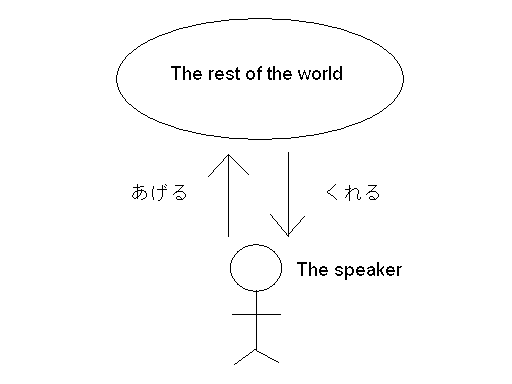
From the speaker's point of view, all the giving done to others "go up" to everybody else while the giving done by everybody else "goes down" to the speaker. This is probably related to the fact that there is an identical verb 「上げる」 meaning "to raise" that contains the character for "above" (上) and that the honorific version of 「くれる」 is 「下さる」 with the character for down (下). This restriction allows us to make certain deductions from vague sentences like the following:
(1) 先生が教えてあげるんですか。
- Teacher, will you be the one to give favor of teaching to... [anybody other than the speaker]?
Because all giving done to the speaker must always use 「くれる」, we know that the teacher must be doing it for someone else and not the speaker. The speaker is also looking at it from the teacher's point of view as doing a favor for someone else.
(2) 先生が教えてくれるんですか。
- Teacher, will you be the one to give favor of teaching to... [anybody including the speaker]?
Because the giver is not the speaker, the teacher is either giving to the speaker or anyone else. The speaker is viewing it from the receiver's point of view as receiving a favor done by the teacher.
Let's see some mistakes to watch out for.
(誤) 私が全部食べてくれました。- 「くれる」 is being used as giving done by the speaker. (Wrong)
(正) 私が全部食べてあげました。- I gave favor of eating it all. (Correct)
(誤) 友達がプレゼントを私にあげた。- 「あげる」 is being used as giving to the speaker. (Wrong)
(正) 友達がプレゼントを私にくれた。- Friend gave present to me. (Correct)
(1) 私が友達にプレゼントをもらった。
- I received present from friend.
(2) 友達からプレゼントをもらった。
- I received present from friend.
(3) これは友達に買ってもらった。
- About this, received the favor of buying it from friend.
(4) 宿題をチェックしてもらいたかったけど、時間がなくて無理だった。
- I wanted to receive the favor of checking homework but there was no time and it was impossible.
「もらう」 is seen from the perspective of the receiver, so in the case of first-person, others usually don't receive things from you. However, you might want to use 「私からもらう」 when you want to emphasive that fact that the other person received it from you. For instance, if you wanted to say, "Hey, I gave you that!" you would use 「あげる」. However, you would use 「もらう」 if you wanted to say, "Hey, you got that from me!"
(5) その時計は私からもらったのよ。
- [He] received that watch from me.
(1) 千円を貸してくれる?
- Will you give me the favor of lending 1000 yen?
(2) 千円を貸してもらえる?
- Can I receive the favor of you lending 1000 yen?
Notice that the two sentences essentially mean the same thing. This is because the giver and receiver has been omitted because it is obvious from the context. If we were to write out the full sentence, it would look like this:
(1) あなたが、私に千円を貸してくれる?
- Will you give me the favor of lending 1000 yen?
(2) 私が、あなたに千円を貸してもらえる?
- Can I receive the favor of you lending 1000 yen?
It is not normal to explicitly include the subject and target like this when directly addressing someone but is provided here to illustrate the change of subject and target depending on the verb 「くれる」 and 「もらえる」.
You can use the negative to make the request a little softer. You'll see that this is true in many other types of grammar.
(1) ちょっと静かにしてくれない?
- Won't you be a little quieter?
(2) 漢字で書いてもらえませんか。
- Can you write this in kanji for me?
In order to request that someone not do something, you simply attach 「で」 to the negative form of the verb and proceed as before.
(1) 全部食べないでくれますか。
- Can you not eat it all?
(2) 高い物を買わないでくれる?
- Can you not buy expensive thing(s)?
This page has last been revised on 2005/5/19
Fixed typo in example translation (2005/5/12)
Spread layout and improved 「もらう」 examples (2005/5/19)
(1) それをください。- Please give me that.
(2) それをくれる?- Can you give me that?
As you can see 「ください」 is a direct request for something while 「くれる」 is used as a question asking for someone to give something. However, it
is similar to 「くれる」 in that you can make a request for an action by simply attaching it to the te-form of the verb.
(1) 漢字で書いてください。- Please write it in kanji.
(2) ゆっくり話してください。- Please speak slowly.
The rules for negative requests are same as the rules for 「くれる」 as well.
(1) 落書きを書かないでください。- Please don't write graffiti.
(2) ここにこないでください。- Please don't come here.
In casual speech, it is often common to simply drop the 「ください」 part.
日本語で話して。- Please speak in Japanese.
消しゴムを貸して。- Please lend me the eraser.
遠い所に行かないで。- Please don't go to a far place.
For those who want to sound particularly commanding and manly, it is also possible to use 「くれる」 with the 「る」 removed.
日本語で話してくれ。- Speak in Japanese.
消しゴムを貸してくれ。- Lend me the eraser.
遠い所に行かないでくれ。- Don't go to a far place.
Because 「ください」 like the masu-form must always come at the end sentence or a
subordinate clause, you cannot use it to directly modify a noun. For example, the following is not possible with
「ください」.
(1) お父さんがくれた時計が壊れた。- The clock that father gave broke.
Of course, since direct quotes is merely repeating something someone said in verbatim, you can put practically anything in a direct quote.
(1) 「それをください」とお父さんが言った。- Father said, "Please give me that."
You can also drop 「さい」 portion of the 「なさい」 to make a casual version of this grammar.
(1) まだいっぱいあるから、たくさん食べな。- There's still a lot, so eat a lot.
(2) それでいいと思うなら、そうしなよ。 - If you think that's fine, then go ahead and do it.
Be sure to note that, in addition to the familiar 「する」, 「くる」 exception verbs, 「くれる」 is also an exception for the command form.
|
|
|
The negative command form is very simple: simply attach 「な」 to either ru-verbs or u-verbs. Don't confuse this with the 「な」 gobi we will be learning at the end of this section. The intonation is totally different.
This is not to be confused with the shortened version of 「~なさい」 we just learned in the last section. The most obvious difference (besides the clear difference in tone) is that in 「~なさい」, the verb is first converted to the stem while the negative command has no conjugation. For example, for 「する」, 「しな」 would be the short version of 「しなさい」 while 「するな」 would be a negative command.
This page has last been revised on 2005/9/21
Added くれ exception for command form. (2005/9/21)
What! ...is the air-speed velocity of an unladen swallow?
-Holy Grail Bridgekeeper
| Numerals | 1 | 2 | 3 | 4 | 5 | 6 | 7 | 8 | 9 | 10 |
|---|---|---|---|---|---|---|---|---|---|---|
| 漢字 | 一 | 二 | 三 | 四 | 五 | 六 | 七 | 八 | 九 | 十 |
| ひらがな | いち | に | さん | し/よん | ご | ろく | しち/なな | はち | きゅう | じゅう |
As the chart indicates, 4 can either be 「し」 or 「よん」 and 7 can either be 「しち」 or 「なな」. Basically, both are acceptable up to 10. However, past ten, the reading is almost always 「よん」 and 「なな」. In general, 「よん」 and 「なな」 are preferred over 「し」 and 「しち」 in most circumstances.
You can simply count from 1 to 99 with just these ten numbers. Japanese is easier than English in this respect because you do not have to memorize separate words such as "twenty" or "fifty". In Japanese, it's simply just "two ten" and "five ten".
(1) 三十一 (さんじゅういち) = 31
(2) 五十四 (ごじゅうよん)= 54
(3) 七十七 (ななじゅうなな)= 77
(4) 二十 (にじゅう) = 20
Notice that numbers are either always written in kanji or numerals because hiragana can get rather long and hard to decipher.
| Numerals | 100 | 1,000 | 10,000 | 10^8 | 10^12 |
|---|---|---|---|---|---|
| 漢字 | 百 | 千 | 万 | 億 | 兆 |
| ひらがな | ひゃく | せん | まん | おく | ちょう |
Notice how the numbers jumped four digits from 10^4 to 10^8 between 万 and 億? That's because Japanese is divided into units of four. Once you get past 1万 (10,000), you start all over until you reach 9,999万, then it rotates to 1億 (100,000,000). By the way, 百 is 100 and 千 is 1,000, but anything past that, and you need to attach a 1 so the rest of the units become 一万 (10^4)、一億 (10^8)、一兆 (10^12).
Now you can count up to 9,999,999,999,999,999 or 9,999兆 just by chaining the numbers same as before. This is where the problems start, however. Try saying 「いちちょう」 、「ろくひゃく」、「さんせん」 really quickly, you'll notice it's difficult because of the repetition of similar consonant sounds. Therefore, Japanese people have decided to make it easier on themselves by pronouncing them as 「いっちょう」、 「ろっぴゃく」、and 「さんぜん」. We already discussed this near the end of the Kanji section. Unfortunately, it makes it all the harder for you to remember when to pronounce what. Here are all the slight sound changes.
| Numerals | 漢字 | ひらがな |
|---|---|---|
| 300 | 三百 | さんびゃく |
| 600 | 六百 | ろっぴゃく |
| 800 | 八百 | はっぴゃく |
| 3000 | 三千 | さんぜん |
| 8000 | 八千 | はっせん |
| 10^12 | 一兆 | いっちょう |
(1) 四万三千七十六 (よんまんさんぜんななじゅうろく) = 43,076
(2) 七億六百二十四万九千二百二十二 (ななおくろっぴゃくにじゅうよんまんきゅうせんにひゃくにじゅうに) = 706,249,222
(3) 五百兆二万一 (ごひゃくちょうにまんいち) = 500,000,000,020,001
Notice that it is customary to write large numbers only in numerals as even kanji can become difficult to decipher.
Some of you may be clamoring for larger numbers but you'll hardly ever use 「億」 much less 「兆」. I will guarantee that you will not need to know this but I looked up a list for curiosity's sake.
For negative numbers, everything is the same as positive numbers except that you say 「マイナス」 first.
(1) マイナス二十九 = -29
Saying the months is actually easier than English because all you have to do is write the number (either in numerals or kanji) of the month and add 「月」 which is read as 「がつ」. However, you need to pay attention to April (4月), July (7月), and September (9月) which are pronounced 「しがつ」、 「しちがつ」、and 「くがつ」 respectively.
Finally, we get to the days of the month, which is where the headache starts. The first day of the month is 「ついたち」 (一日); different from 「いちにち」 (一日), which means "one day". Besides this and some other exceptions we'll soon cover, you can simply say the number and add 「日」 which is pronounced here as 「にち」. For example, the 26th becomes 26日 (にじゅうろくにち). Pretty simple, however, the first 10 days, the 14th, 19th, 20th, 29th have special readings that you must separately memorize. If you like memorizing things, you'll have a ball here. Notice that the kanji doesn't change but the reading does.
| 英 語 |
the 1st | the 2nd | the 3rd | the 4th | the 5th | the 6th | the 7th | the 8th | the 9th | the 10th | the 14th | the 19th | the 20th | the 24th | the 29th |
|---|---|---|---|---|---|---|---|---|---|---|---|---|---|---|---|
| 漢 字 |
一 日 |
二 日 |
三 日 |
四 日 |
五 日 |
六 日 |
七 日 |
八 日 |
九 日 |
十 日 |
十 四 日 |
十 九 日 |
二 十 日 |
二 十 四 日 |
二 十 九 日 |
| ひ ら が な |
つ い た ち |
ふ つ か |
み っ か |
よ っ か |
い つ か |
む い か |
な の か |
よ う か |
こ こ の か |
と お か |
じ ゅ う よ っ か |
じ ゅ う く に ち |
は つ か |
に じ ゅ う よ っ か |
に じ ゅ う く に ち |
In Japan, the full format for dates follows the international date format and looks like: XXXX年YY月ZZ日. For example, today's date would be: 2003年12月 2日
| 英語 | 4 o'clock | 7 o'clock | 9 o'clock |
|---|---|---|---|
| 漢字 | 四時 | 七時 | 九時 |
| ひらがな | よじ | しちじ | くじ |
The minutes are given by adding 「分」 which usually read as 「ふん」 with the following exceptions:
| 英語 | 1 min | 3 min | 4 min | 6 min | 8 min | 10 min |
|---|---|---|---|---|---|---|
| 漢字 | 一分 | 三分 | 四分 | 六分 | 八分 | 十分 |
| ひらがな | いっぷん | さんぷん | よんぷん | ろっぷん | はっぷん | じゅっぷん |
For higher number, you use the normal pronunciation for the higher digits and rotate around the same readings for 1 to 10. For instance, 24 minutes is 「にじゅうよんぷん」 (二十四分) while 30 minutes is 「さんじゅっぷん」 (三十分). There are also other less common but still correct pronunciations such as 「はちふん」 for 「八分」 and 「じっぷん」 for 「十分」 (this one is almost never used).
All readings for seconds consists of the number plus 「秒」, which is read as 「びょう」. There are no exceptions for seconds and all the readings are the same.
Some examples of time.
(1) 1時24分(いちじ・にじゅうよんぷん) - 1:24
(2) 午後4時10分 (ごご・よじ・じゅっぷん) - 4:10 PM
(3) 午前9時16分 (ごぜん・くじ・じゅうろっぷん) - 9:16 AM
(4) 13時16分 (じゅうさんじ・じゅうろっぷん) - 13:16
(5) 2時18分13秒 (にじ・じゅうはっぷん・じゅうさんびょう) - 2:18:13
(1) 二時間四十分 (にじかん・よんじゅっぷん) - 2 hours and 40 minutes
(2) 二十日間 (はつかかん) - 20 days
(3) 十五日間 (じゅうごにちかん) - 15 days
(4) 二年間 (にねんかん) - two years
(5) 三週間 (さんしゅうかん) - three weeks
(6) 一日 (いちにち) - 1 day
As mentioned before, a period of one day is 「一日」
(いちにち) which is different from the 1st of the month:
「ついたち」.
Pronunciations to watch out for when counting weeks is one week: 「一週間」 (いっしゅうかん) and 8 weeks: 「八週間」 (はっしゅうかん).
To count the number of months, you simple take a regular number and add 「か」 and 「月」 which is pronounced here as 「げつ」 and not 「がつ」. The 「か」 used in this counter is usually written as a small katakana 「ヶ」 which is confusing because it's still pronounced as 「か」 and not 「け」. The small 「ヶ」 is actually totally different from the katakana 「ケ」 and is really an abbreviation for the kanji 「箇」, the original kanji for the counter. This small 「ヶ」 is also used in some place names such as 「千駄ヶ谷」 and other counters, such as the counter for location described in the "Other Counters" section below.
In counting months, you should watch out for the following sound changes:
| 英語 | 1 month | 6 months | 10 months |
|---|---|---|---|
| 漢字 | 一ヶ月 | 六ヶ月 | 十ヶ月 |
| ひらがな | いっかげつ | ろっかげつ | じゅっかげつ |
Just like minutes, the high numbers rotate back using the same sounds for 1 to 10.
(1) 十一ヶ月 (じゅういっかげつ) - Eleven months
(2) 二十ヶ月 (にじゅっかげつ) - Twenty months
(3) 三十三ヶ月 (さんじゅうさんかげつ) - Thirty three months
| 日本語 | When to Use |
|---|---|
| 人 | To count the number of people |
| 本 | To count long, cylindrical objects such as bottles or chopsticks |
| 枚 | To count thin objects such as paper or shirts |
| 冊 | To count bound objects usually books |
| 匹 | To count small animals like cats or dogs |
| 歳 | To count the age of a living creatures such as people |
| 個 | To count small (often round) objects |
| 回 | To count number of times |
| ヶ所(箇所) | To count number of locations |
| つ | To count any generic object that has a rare or no counter |
| 人 | 本 | 枚 | 冊 | 匹 | 歳 | 個 | 回 | ヶ所(箇所) | つ | |
|---|---|---|---|---|---|---|---|---|---|---|
| 1 | ひとり | いっぽん | いちまい | いっさつ | いっぴき | いっさい | いっこ | いっかい | いっかしょ | ひとつ |
| 2 | ふたり | にほん | にまい | にさつ | にひき | にさい | にこ | にかい | にかしょ | ふたつ |
| 3 | さんにん | さんぼん | さんまい | さんさつ | さんびき | さんさい | さんこ | さんかい | さんかしょ | みっつ |
| 4 | よにん | よんほん | よんまい | よんさつ | よんひき | よんさい | よんこ | よんかい | よんかしょ | よっつ |
| 5 | ごにん | ごほん | ごまい | ごさつ | ごひき | ごさい | ごこ | ごかい | ごかしょ | いつつ |
| 6 | ろくにん | ろっぽん | ろくまい | ろくさつ | ろっぴき | ろくさい | ろっこ | ろっかい | ろっかしょ | むっつ |
| 7 | しちにん | ななほん | ななまい | ななさつ | ななひき | ななさい | ななこ | ななかい | ななかしょ | ななつ |
| 8 | はちにん | はちほん | はちまい | はっさつ | はっぴき | はっさい | はっこ | はちかい | はっかしょ | やっつ |
| 9 | きゅうにん | きゅうほん | きゅうまい | きゅうさつ | きゅうひき | きゅうさい | きゅうこ | きゅうかい | きゅうかしょ | ここのつ |
| 10 | じゅうにん | じゅっぽん | じゅうまい | じゅっさつ | じゅっぴき | じゅっさい | じゅっこ | じゅっかい | じゅっかしょ | とお |
The changed sounds have been highlighted.
You don't count 0 because there is nothing to count. You can simply use 「ない」 or
「いない」. The chart has hiragana for pronunciation but, as before,
it is usually written with either numbers or kanji plus the counter with the single exception of 「とお」 which is
simply written as 「十」.
For higher numbers, it's the same as before, you use
the normal pronunciation for the higher digits and rotate around the same readings for 1 to 10 except for 「一人」
and 「二人」 which transforms to the normal 「いち」
and 「に」 once you get past the first two. So 「一人」 is
「ひとり」 while 「11人」 is
「じゅういちにん」.
Also, the generic counter 「~つ」 only applies up to exactly ten items. Past that, you can just use regular plain numbers.
Note: The counter for age is often sometimes written as 「才」 for those who don't have the time to write out the more complex kanji. Plus, age 20 is usually read as 「はたち」 and not 「にじゅっさい」.
This page has last been revised on 2007/1/22
「さ」, which is basically a very casual form of 「よ」, is similar to the English "like" in that some people throw it in at the end of almost every single phrase. Of course, that doesn't mean it's necessarily a very sophisticated manner of speech but just like using "like" all the time, I cannot deny that it is an easy habit to fall into. In that sense, due to its over-use, it has almost lost any specific meaning. You may overhear a conversation like the following:
大学生1: あのさ・・・
大学生2: うん
大学生1: この間さ・・・
大学生2: うん
大学生1: ディズニーランドに行ったんだけどさ、なんかさ、すっごい込んでて・・・
大学生2: うん
大学生1: 何もできなくてさ・・・
And it goes on like this, sometimes the other person might break in to say something related to the topic.
You can use 「な」 in place of 「ね」 when it sounds too soft and reserved for what you want to say or for the audience you are speaking to. Its
rough sound generally applies to the male gender but is not necessarily restricted to only males.
洋介: 今、
図書館に行くんだよな。- You are going to the library now huh? (seeking explanation)
智子: うん、
なんで? - Yeah, why?
ボブ: 日本語は、たくさん勉強したけどな。まだ全然わからない。- I studied Japanese a lot, right? But, I still don't get it at all.
アリス: 大丈夫よ。きっとわかるようになるからさ。- No problem. You'll become able to understand for sure, you know?
ボブ: ならいいけどな。- If so, it would be good.
The 「な」 gobi is often used with the question marker 「か」 to indicate that the speaker is considering something.
(1) 今日は雨が降るかな?- I wonder if it'll rain today.
(2) いい大学に行けるかな? - I wonder if I can go to a good college.
(1) もう時間が
ないわ。- There is no more time.
(2) おい、行くぞ!- Hey, we're going!
(3) これで、もう終わりだぜ。- With this, it's over already.
(4) いい大学に入れるかしら?- I wonder if I can enter a good college.
加賀先生:
そうね。大体、
「こんにちは」と言うと思いますよ。
ただし、書く時
は「こんにちわ」じゃなくて、
「こんにちは」と書かなくてはなりません。
「と言うと思います」 = quoted sub-clause + quoted sub-clause
「じゃなくて」 = negative sequence of states
アリス: そうですか。他に何かいい 表現はありますか。
加賀先生:
これも覚えといてね。
朝は、「おはよう」と
言うの。でも、
上の人には
「おはようございます」と言ってください。
「覚えといて」 - 覚える +
abbreviated form of ~ておく + casual ~てください with ください dropped.
アリス: はい、分かりました。 間違えないようにします。 いい勉強になりました!
洋介: ちょっと英語を教えてもらいたいんだけどさ、もし時間があれば、教えてくれない?
「教えてもらいたい」 = receiving favor + to want (たい)
アリス: え?英語を勉強するの?
洋介: うん、アメリカで留学してみたいなと思ってね。去年も行こうとしたけど、お金がなくて・・・
「してみたいなと思って」 = to try something out (~てみる) + want to (たい) + な gobi + quoted subquote + te-form of 思う
「行こうとした」 = volitional of 行く + to attempt (とする)
アリス: 勉強を怠けたり、来なかったり、しないでね。
「怠けたり来なかったりしないで」 = List of actions (~たりする) + negative request of する.
洋介: そんなことしないよ!
(1) 全部食べさせた。- Made/Let (someone) eat it all.
(2) 全部食べさせてくれた。- Let (someone) eat it all.
|
|
|
(1) 先生が学生に宿題をたくさんさせた。
- Teacher made students do lots of homework.
(2) 先生が質問をたくさん聞かせてくれた。
- Teacher let [someone] ask lots of questions.
(3) 今日は仕事を休ませてください。
- Please let me rest from work today. (Please let me take the day off today.)
(4) その部長は、よく長時間働かせる。
- That manager often make [people] work long hours.
When asking for permission to let someone do something, it is more common to use the 「~てもいい」 grammar.
(1) トイレに行かせてくれますか。
- Can you let me go to the bathroom? (Sounds like a prisoner, even in English)
(2) トイレに行ってもいいですか。
- Is it ok to go to the bathroom? (No problem here)
The key difference in this version is that all verbs become an u-verbs with a 「す」 ending. Therefore, the resulting verb would conjugate just like any other u-verb ending in 「す」 such as 「話す」 or 「指す」. The first part of the conjugation is the same as the original causative form. However, for ru-verbs, instead of attaching 「させる」, you attach 「さす」 and for u-verbs, you attach 「す」 instead of 「せる」. As a result, all the verbs become an u-verb ending in 「す」.
(1) 同じことを何回も言わすな!
- Don't make me say the same thing again and again!
(2) お腹空いているんだから、なんか食べさしてくれよ。
- I'm hungry so let me eat something.
|
|
|
(1) ポリッジが誰かに食べられた!
- The porridge was eaten by somebody!
(2) みんなに変だと言われます。
- I am told by everybody that [I'm] strange.
(3) 光の速さを超えるのは、不可能だと思われる。
- Exceeding the speed of light is thought to be impossible.
(4) この教科書は多くの人に読まれている。
- This textbook is being read by a large number of people.
(5) 外国人に質問を聞かれたが、答えられなかった。
- I was asked a question by a foreigner but I couldn't answer.
(6) このパッケージには、あらゆるものが含まれている。
- Everything is included in this package.
(1) どうする?- What will you do? (lit: How do?)
(2) どうしますか? - Regular polite.
(3) どうされますか?- Passive polite.
(4) どうなさいますか?- Honorific (to be covered next lesson)
(5) どうなさいますでしょうか?- Honorific + a lesser degree of certainty.
Notice how the same sentence grows longer and longer as you get more and more indirect.
(1) レシートはどうされますか?
- What about your receipt? (lit: How will you do receipt?)
(2) 明日の会議に行かれるんですか?
- Are you going to tomorrow's meeting?
(1) 朝ご飯は食べたくなかったのに、食べさせられた。
- Despite not wanting to eat breakfast, I was made to eat it.
(2) 日本では、お酒を飲ませられることが多い。
- In Japan, the event of being made to drink is numerous.
(3) あいつに二時間も待たせられた。
- I was made to wait 2 hours by that guy.
(4) 親に毎日宿題をさせられる。
- I am made to do homework everyday by my parent(s).
(1) 学生が廊下に立たされた。
- The student was made to stand in the hall.
(2) 日本では、お酒を飲まされることが多い。
- In Japan, the event of being made to drink is numerous.
(3) あいつに二時間も待たされた。
- I was made to wait 2 hours by that guy.
This page has last been revised on 2006/1/28
Minor typos and conjugation example (食べさせられる) fixed (2005/3/31)
Added shorter causative alternative for completeness (2006/1/28)
| Plain | Honorific | Humble |
|---|---|---|
| する | なさる | 致す |
| 行く | いらっしゃる/おいでになる | 参る |
| 来る | いらっしゃる/おいでになる | 参る |
| いる | いらっしゃる/おいでになる | おる |
| 見る | ご覧になる | 拝見する |
| 聞く | - | 伺う |
| 言う | おっしゃる | 申す/申し上げる |
| あげる | - | 差し上げる |
| くれる | 下さる | - |
| もらう | - | いただく |
| 食べる | 召し上がる | - |
| 知っている | ご存知(です) | 存じる |
| Plain | ます-form | Past ます-form | Negative ます-form | Past-negative ます-form |
|---|---|---|---|---|
| なさる | なさいます | なさいました | なさいません | なさいませんでした |
| いらっしゃる | いらっしゃいます | いらっしゃいました | いらっしゃいません | いらっしゃいませんでした |
| おっしゃる | おっしゃいます | おっしゃいました | おっしゃいません | おっしゃいませんでした |
| 下さる | 下さいます | 下さいました | 下さいません | 下さいませんでした |
| ござる | ございます | ございました | ございません | ございませんでした |
By extension, the politer version of 「です」 is 「でございます」. This is essentially the masu-form conjugation of 「でござる」, which comes from 「である」 literally meaning, "to exist as" (to be covered much later).
Other examples include 「いい」, which is more formally expressed as 「よろしい」. There are also six different ways to say, "I'm sorry" (not counting 「悪いね」 or slight inflection changes like 「すいません」).
Successively politer expressions for apologizing:
(1) ごめん。
(2) ごめんなさい。
(3) すみません。
(4) 申し訳ありません。 (申し訳 is the humble form of 言い訳)
(5) 恐れ入ります。
(6) 恐縮です。
In addition, the politest suffix for names is 「様」, one level above 「さん」. You won't be using this suffix too often in actual speech even if you speak to that person in honorific/humble speech. However, expect to use it when writing letters even to people you are somewhat familiar with. Also, service people such as cashiers or waitresses/waiters will normally refer to the customer as 「お客様」. Of course, royalty and deities are always accompanied by 「様」 such as 「神様」.
Honorific Conjugation 1: お + stem + に + なる
This kind of makes sense if you think of it as a person becoming the honorific state of a verb. All subsequent conjugations follow the normal rules of conjugating the u-verb 「なる」. To be honest, this type of sentence formulation is rarely used.
(1) 先生はお見えになりますか。- Have you seen the teacher?
Honorific Conjugation 2: お + stem + です
(2) もうお帰りですか。- You're going home already?
(3) 店内でお召し上がりですか。- Will you be dining in?
Service people want to be extra polite so they will often use this type of "double honorific" conjugation or 二重敬語 (in this case, the honorific 「召し上がる」 combined with the honorific conjugation). Whether it's necessary or grammatically proper is another story.
Yet another often-used expression.
(1) 少々お待ちください。- Please wait a moment.
Similarly, with 「ご覧になる」, you simply replace 「になる」 with 「ください」.
(2) こちらにご覧下さい。- Please look this way.
This works for other nouns as well. For example, riding the trains...
(3) 閉まるドアにご注意下さい。- Please be careful of the closing doors.
Humble Conjugation: お + stem + する
You've probably already heard the first example many times before but now you know exactly where it comes from.
(1) よろしくお願いします。- I properly make request.
(2) 先生、お聞きしたいことがありますが。- Teacher, there's something I want to ask you.
(3) すみません、お待たせしました。- Sorry, I made you wait (causative form).
(4) 千円からお預かりいたします。- We'll be holding on [from?] your 1000 yen.
You'll hear something like example (4) when, for example, you need to get change after paying 1000 yen. Again, the 二重敬語 where 「する」 has been converted to the humble 「致す」 form when it's already in the お+stem+する humble form. Some Japanese people complain that this makes no sense and that 「から」 should really be 「を」.
Now you finally know where grammar such as 「しなさい」 and 「してください」 actually came from. Let's look at a few quick examples.
However, a middle-aged sushi chef will probably use the abbreviated version.
(2) いらっしゃい!- Please come in!
Some more examples...
(3) ありがとうございました。またお越しくださいませ。- Thank you very much. Please come again.
(4) どうぞ、ごゆっくりなさいませ。- Please take your time and relax.
This page has last been revised on 2006/8/19
康介: 宿題をやった?- Did you do homework?
アリス: しまった!- Oh no! (I screwed up!)
(1) そのケーキを全部食べてしまった。- Oops, I ate that whole cake.
(2) 毎日ケーキを食べて、2キロ太ってしまいました。- I ate cake everyday and I (unintentionally) gained two kilograms.
(3) ちゃんと食べないと、痩せてしまいますよ。- If you don't eat properly, you'll (unintentionally) lost weight you know.
(4) 結局、嫌なことをさせてしまった。- In the end, I (unintentionally) made [someone] do something distasteful.
(5) ごめん、待たせてしまって! - Sorry about (unintentionally) making you wait!
(6) 金魚がもう死んでしまった。 - The goldfish died already (oops).
If you want to see many more examples, look up 「しまう」 on WWWJDIC and click the [EX] link. There are over 100 examples with translations for you to enjoy.
(1) 金魚がもう死んじゃった。- The goldfish died already.
(2) もう帰っちゃっていい?- Is it OK if I went home already?
(3) みんな、どっか行っちゃったよ。- Everybody went off somewhere.
(4) そろそろ遅くなっちゃうよ。- It'll gradually become late, you know.
There is yet another very colloquial version of 「~てしまう」 and 「~でしまう」 where it is replaced by 「~ちまう」 and 「~じまう」 respectively. Unlike, the cuter
「~ちゃう」 and 「~じゃう」 slang, this version conjures a image of rough and course middle-aged man.
(1) また遅刻しちまったよ。- Darn, I'm late again.
(2) ごめん、ついお前を呼んじまった。- Sorry, I just ended up calling you unconsciously.
(1) 宿題をやってしまいなさい。- Finish your homework completely.
(1) 徹夜して、宿題することはある。
- There are times when I do homework while staying up all night.
(2) 一人で行くことはありません。
- I never go by myself.
Using the past tense of the verb with 「こと」, you can talk about whether an event has ever taken place. This is essentially the only way you can say "have done" in Japanese so this is a very useful expression. You need to use this grammar any time you want to talk about whether someone has ever done something.
(1) パリに行ったことはありますか。
- Have you ever gone to Paris?
(2) お寿司を食べたことがある。
- I've had sushi before.
(3) 日本の映画を観たことないの?
- You've never seen a Japanese movie?
(4) ヨーロッパに行ったことがあったらいいな。
- It would be nice if I ever go to Europe.
(5) そういうのを見たことがなかった。
- I had never seen anything like that.
(6) 一度行ったこともないんです。
- I've never gone, not even once.
(1) 早くきて。映画は、今ちょうどいいところだよ。
- Come quickly. We're at the good part of the movie.
(2) 彼は、優しいところもあるよ。
- His personality has some gentle parts too.
(3) 今は授業が終ったところです。
- Class has ended just now.
(4) これから行くところでした。
- I was just about to go from now.
(質問) どうしてこなかったの?- Why didn't (you) come?
(1) 授業があったの。- I had class. (feminine explanatory)
(2) 授業があったもの。- I had class. (feminine explanatory)
(3) 授業があったもん。- I had class, so there. (feminine explanatory)
This page has last been revised on 2004/12/16
If you want to sound really, really polite, you can even add 「~でしょうか」 to the end of a 「~ます」 ending.
(4) 休ませていただけますでしょうか。- May I receive the favor of resting, possibly?
(3) これから食べに行くんでしょ。- You're going to eat from now aren't you?
(4) だったら?- So what if I am?
(5) 掃除、手伝ってくれるでしょう。- You're going to help me clean, right?
(6) え?そうなの?- Huh? Is that so?
「だろう」 means essentially the same thing as 「でしょう」 except that it sounds more masculine and is used mostly by males.
(A) アリスはどこだ?- Where is Alice?
(B) もう寝ているだろう。- Probably sleeping already.
(A) もう家に帰るんだろう。- You're going home already, right?
(B) そうよ。- That's right.
This page has last been revised on 2004/12/29
(1) りんごだけ。
- Just apple(s) (and nothing else).
(2) これとそれだけ。
-Just that and this (and nothing else).
When one of the major particles we covered in Particles, Particles 2, and Particles 3 are also applied to a word, these particles must come after 「だけ」. In fact, the ordering of multiple particles usually start from the most specific to the most general.
(1) それだけは、食べないでください。
- Just don't eat that. (Anything else is assumed to be OK).
(2) この歌だけを歌わなかった。
- Didn't sing just this song.
(3) その人だけが好きだったんだ。
- That person was the only person I liked.
The same goes for double particles. Again 「だけ」 must come first.
(1) この販売機だけでは、500円玉が使えない。
- Cannot use 500 yen coin in just this vending machine.
With minor particles such as 「から」 or 「まで」, it is difficult to tell which should come first. When in doubt, try googling to see the level of popularity of each combination. It turns out that 「からだけ」 is almost twice as popular as 「だけから」 with a hit number of 90,000 vs. 50,000.
(1) 小林さんからだけは、返事が来なかった。
- A reply has not come from only Kobayashi-san.
Unlike some particles, you can directly attach 「だけ」 to verbs as well.
(1) 準備が終わったから、これからは食べるだけだ。
- Since the preparations are done, from here we just have to eat.
(2) ここに名前を書くだけでいいですか?
- Is it ok to just write [my] name here?
(1) この乗車券は発売当日のみ有効です。
- This boarding ticket is only valid on the date on which it was purchased.
(2) アンケート対象は大学生のみです。
- The targets of this survey are only college students.
(1) これしかない。- There's nothing but this.
The following is wrong.
(誤) これしかある。- (Wrong, wrong, wrong)
As you can see, 「しか」 has an embedded negative meaning while 「だけ」 doesn't have any particular nuance.
(1) これだけ見る。- See just this.
(2) これだけ見ない。- Don't see just this.
(3) これしか見ない。- Don't see anything else but this.
(1) 今日は忙しくて、朝ご飯しか食べられなかった。
- Today was busy and couldn't eat anything but breakfast.
Notice that unlike 「だけ」, it is necessary to finish off the sentence.
(質問) 全部買うの?- You're buying everything?
(1) ううん、これだけ。- Nah, just this.
(2) ううん、これしか買わない - Nah, won't buy anything else but this.
(誤) ううん、これしか。 - (Wrong, the sentence must explicitly indicate the negative.)
While the major particles always come last, it turns out that 「しか」 must come after 「から」 and 「まで」. A google search of 「からしか」 beats 「しかから」 by an overwhelming 60,000 to 600.
(1) アリスからしか何ももらってない。
- I didn't receive anything except from Alice.
You can also use this grammar with verbs.
(1) これから頑張るしかない!
- There's nothing to do but try our best!
(2) こうなったら、逃げるしかない。
- There no choice but to run away once it turns out like this.
(3) もう腐っているから、捨てるしかないよ。
- It's rotten already so there's nothing to do but throw it out.
(1) これは買うっきゃない!
- There's nothing but to buy this!
(2) こうなったら、もうやるっきゃない!
- If things turn out like this, there nothing to do but to just do it!
(1) 何だよ!おばさんばっかりじゃないか?
- What the? Isn't it nothing but obasan?
Or perhaps a little more girly:
(2) いやだ。おばさんばっかり。
- Eww. It's nothing but obasan.
(1) 崇君は漫画ばっかり読んでてさ。かっこ悪い。
- Takashi-kun is reading nothing but comic books... He's so uncool.
It is quite common in casual speech to end midsentence like this. Notice 「読んでて」 is the te-form of 「読んでいる」 with the 「い」 dropped. We assume that the conclusion will come somewhere later in the story.
(2) 彼は麻雀ばかりです。
- He's nothing but mahjong. (He does nothing but play mahjong.)
(3) 直美ちゃんと遊ぶばっかりでしょう!
- You're hanging out with Naomi-chan all the time, aren't you!
(4) 最近は仕事ばっかだよ。
- Lately, it's nothing but work.
(1) 佐藤さんは料理が上手で、また食べ過ぎました。
- Satou-san is good at cooking and I ate too much again.
(2) お酒を飲みすぎないように気をつけてね。
- Be careful to not drink too much, ok?
(3) 大きすぎるからトランクに入らないぞ。
- It won't fit in the trunk cause it's too big, man.
(4) 静かすぎる。罠かもしれないよ。
- It's too quiet. It might be a trap, you know.
(5) 時間が足りなさすぎて、何もできなかった。
- Due to too much of a lack of time, I couldn't do anything.
(6) 彼には、彼女がもったいなさすぎるよ。
- She is totally wasted on him (too good for him).
It is also common to change 「すぎる」 into its stem and use it as a noun.
(Aさん) 昨晩のこと、全然覚えてないな。
- Man, I don't remember anything about last night.
(Bさん) それは飲みすぎだよ。
- That's drinking too much.
(1) 昨日、電話三回もしたよ!
- I called you like three times yesterday!
Notice that the 「も」 particle is attached to the amount "three times". This sentence implies that the speaker called even three times and still the person didn't pick up the phone. We understand this to mean that three times are a lot of times to call someone.
(2) 試験のために三時間も勉強した。
- I studied three whole hours for the exam.
(3) 今年、十キロも太っちゃった!
- I gained 10 whole kilograms this year!
(1) 今日の天気はそれほど寒くない。
- Today's weather is not cold to that extent.
(2) 寝る時間がないほど忙しい。
- Busy to the extent that there's no time to sleep.
When you use this with conditionals, you can express something that translates into English as, "The more you [verb], the more..." The grammar is always formed in the following sequence: [conditional of verb] followed immediately by [same verb+ ほど]
(1) 韓国料理は食べれば食べるほど、おいしくなる。
- About Korean food, the more you eat the tastier it becomes.
The literal translation is, "About Korean food, if you eat, to the extent that you eat, it becomes tasty." which essentially means the same thing. The example uses the 「ば」 conditional form, but the 「たら」 conditional will work as well. Since this is a general statement, the contextual 「なら」 conditional will never work. The decided 「と」 conditional won't work very well here either since it may not always be true depending on the extent of the action.
(1) 歩いたら歩くほど、迷ってしまった。
- The more I walked, the more I got lost.
(2) 勉強をすればするほど、頭がよくなるよ。
- The more you study, the more you will become smarter.
You can also use this grammar with i-adjectives by using the 「ば」 conditional.
(1) iPodは、ハードディスクの容量が大きければ大きいほどもっとたくさんの曲が保存できます。
- About iPod, the larger the hard disk capacity, the more songs you can save.
(2) 航空券は安ければ安いほどいいとは限らない。
- It's not necessarily the case that the cheaper the ticket, the better it is.
For na-adjectives, since you can't use the 「ば」 conditional you have to resort to the 「なら」 conditional. Because it sounds strange to use the 「なら」 conditional in this fashion, you will hardly ever see this grammar used with na-adjectives. Since 「ほど」 is treated as a noun, make sure you don't forget to use 「な」 to attach the noun to the na-adjective.
(1) 文章は、短ければ短いほど、簡単なら簡単なほどよいです。
- The shorter and simpler the sentences, the better it is.
(1) このビルの高さは何ですか?
- What is the height of this building?
(2) 犬の聴覚の敏感さを人間と比べると、はるかに上だ。
- If you compare the level of sensitivity of hearing of dogs to humans, it is far above.
This page has last been revised on 2006/6/24
Fixed 「なさそう」 examples to reflect only negatives (2006/2/18)
Added 「っきゃ」 to 「しか」 section (2006/6/24)
(1) ここには、誰もいないようだ。- Looks like no one is here.
(2) 映画を観たようです。- Looks like [he] watched the movie.
When directly modifying nouns or na-adjectives, you must use the 「の」 particle for nouns or attach 「な」 to na-adjectives.
(3) 学生のようだ。- Looks like it's a student.
(4) ここは静かなようだ。- Looks like it's quiet.
Notice that (3) does not say that the person looks like a student. Rather, the explicit state of being states
that the person appears to be a student. On a side note, you can't say 「おいしいようだ」 to say that something looks tasty. This is like
saying, "This dish apparently is tasty," which can actually be kind of rude.
You can also use it as a na-adjective to describe something that appears to be something else.
(5) あの人を見たような気がした。- Had a feeling like I saw that person before.
(6) 彼は学生のような雰囲気ですね。- He has a student-like atmosphere.
Finally, we can attach the target particle to say things like, "I heard it like that" or "I said it like...".
(7) ちょっと怒ったように聞こえた。- Was able to hear it like (she) was a little mad.
(8) 何も起こらなかったように言った。- Said (it) like nothing happened.
| Positive | Negative | |||
|---|---|---|---|---|
| Non-Past | 犬みたい | Looks like a dog | 犬じゃないみたい | Doesn't look like a dog |
| Past | 犬だったみたい | Looked like a dog | 犬じゃなかったみたい | Didn't look like a dog |
The implied meaning here is the person wearing the uniform is not really a student because he/she only looks like a student. This is different from (3) of the previous 「よう」 section which implied that the person appears to be (but might not be) a student. Again, we also can't say 「おいしいみたい」 to say that something looks tasty because it implies that, in actuality, the food might not be so good. Similarly, you would never say 「かわいいみたい」 to say that something looks cute.
Don't forget that 「みたい」 does not conjugate like the 「~たい」 form or i-adjectives.
(誤) このピザはお好み焼きみたくない?- (みたい conjugates like a na-adjective.)
(3) このピザはお好み焼きみたいじゃない?- Doesn't this pizza looks like okonomiyaki?
「みたい」 is really a grammar only used in conversation.
Do not use it in essays, articles, anything that needs to sound authoritative. You can use 「よう」 instead in the following fashion.
(6) もう売り切れのようだ。- It appears that it is sold-out already.
(7) このピザはお好み焼きのように見える。- This pizza looks like okonomiyaki.
Just like the grammar we have learned so far in this lesson, we can use this grammar by simply attaching 「そう」 to the end of verbs, and adjectives. However, there are four important different cases. Actually, I just noticed this but the conjugation rules are exactly the same as the 「~すぎる」 grammar we learned in the last section. The only difference is that for the adjective 「いい」, you need to change it to 「よさ」 before attaching 「そう」 to create 「よさそう」.
For ru-verbs, remove the 「る」
(1) バランスが崩れて、一瞬倒れそうだった。
- Losing my balance, I seemed likely to fall for a moment.
For u-verbs, change the / u / vowel sound to an / i / vowel sound
(2) この辺りにありそうだけどな。
- It seems likely that it would be around here but...
In the next example, the 「い」 has been dropped from 「おいしい」.
(1) この漬物はおいしそう!
- I bet this pickled vegetable is tasty! (This pickled vegetable looks good!)
Exception: The only exception to this rule is the adjective 「いい」. When using this grammar with 「いい」, you must first change it to 「よさ」.
(2) これも結構よさそうだけど、やっぱり高いよね。
- This one also seems to be good but, as expected, it's expensive, huh?
Nothing needs to be done for na-adjectives.
(3) お前なら、金髪の女が好きそうだな。
- Knowing you, I bet you like blond-haired girls.
The negative of 「来る」 is 「こない」 so when used with 「~そう」, it becomes 「こなさそう」.
(1) もう10時になったから、来なさそうだね。
- Since it already became 10:00, it's likely that (person) won't come.
(2) これはただの試合じゃなさそうだ。
- This isn't likely to be an ordinary match.
Identical to the 「~すぎる」 grammar, i-adjectives that are derived from the negative 「~ない」 like 「もったいない」 or 「情けない」 also follow this rule as well (which would be 「もったいなさそう」 and 「情けなさそう」 in this case).
(誤) その人は学生そう。
There are other grammars we have already covered that can be used to indicate that something is likely to be something else.
(1) その人は学生でしょう。
- That person is probably student.
(2) その人は学生だろう。
- That person is probably student.
Be careful never to use 「かわいい」 with this grammar. 「かわいそう」 is a completely different word used when you feel sorry for something or someone. 「かわいい」 means, "to look cute" already so you never need to use any of the grammar in this lesson to say something looks cute.
(1) この犬はかわいそう。
- Oh, this poor dog.
(2) この犬はかわいい。
- This dog is cute.
(1) 明日、雨が降るそうだ。- I hear that it's going to rain tomorrow.
(2) 毎日会いに行ったそうです。- I heard he went to meet everyday.
Don't forget to add 「だ」 for nouns or na-adjectives.
(3) 彼は、高校生だそうです。- I hear that he is a high school student.
When starting the
sentence with this grammar, you also need to add 「だ」 just like you do with 「だから」
(1) 今日、田中さんはこないの?- Is Tanaka-san not coming today?
(2) だそうです。- So I hear.
(A) 今日、田中さんはこないの?- Is Tanaka-san not coming today?
(B) こないらしい。- Seems like it (based on what I heard).
(A) あの人は何なの?- What is that person over there?
(B) 美由紀さんの友達らしいですよ。- Seems to be Miyuki-san's friend (based on what I heard).
Another way to use 「らしい」 is to indicate that a person seems to be a certain thing due to his behavior.
(1) あの子は子供らしくない。- That child does not act like a child.
(2) 大人らしくするつもりだったのに、大騒ぎしてしまった。- Despite the fact that I planned to act like an adult, I ended up making a big ruckus.
「 っぽい」 conjugates just like an i-adjective, as seen by example (3) below.
(1) あの人はちょっと韓国人っぽいよね。- That person looks like a Korean person, huh?
(2) みんなで、もう全部食べてしまったっぽいよ。- It appears that everybody ate everything already.
(3) 恭子は全然女っぽくないね。- Kyouko is not womanly at all, huh?
This page has last been revised on 2006/2/18
Revised explanation for 「らしい」 (2005/4/26)
Fixed 「なさそう」 examples to reflect only negatives (2006/2/18)
Grammatically, it's no different from a regular noun.
(3) 学生じゃない方がいいよ。- It's better to not be a student. (lit: The way of not being student is good.)
(4) 赤ちゃんは、静かな方が好き。- Like quiet babies more. (lit: About babies, the quiet way is desirable.)
The tricky part of making comparisons with verb is the use of tenses. For absolutely no reason, non-negative verbs must always be
past tense.
(5) ゆっくり食べた方が健康にいいよ。- It's better for your health to eat slowly.
(6) こちらから行った方が早かった。- It was faster to go from this way.
The same thing does not apply for negative verbs.
(7) マトリックス・レボリューションを観ない方がいいよ。- It's better not to watch "Matrix Revolution".
The negative verb is only in the past tense when the comparison is of something that happened in the past.
(8) そんなに飲まなかった方がよかった。- It was better not to have drunk that much.
(2) ご飯の方が、パンよりおいしい。
- Rice tastes better than bread. (lit: The rice way is tasty as opposed to bread.)
(3) キムさんより鈴木さんの方が若い。
- Suzuki-san is younger than Kim-san. (lit: The way of Suzuki is young as opposed to Kim-san.)
For those curious about the meaning of the proverb, dango is a sweet doughy treat usually sold at festivals. The proverb is saying that people prefer this treat to watching the flowers, referring to the 「花見」 event where people go out to see the cherry blossoms (and get smashed). The deeper meaning of the proverb, like all good proverbs, depends on how you apply it.
Of course, there is no rule that 「より」 must be used with 「方」. The other way of things can be gleaned from context.
(鈴木) 毎日仕事に行くのが嫌だ。- I don't like going to work everyday.
(スミス) 仕事がないよりましだよ。- It's not as bad as opposed to not having a job.
Words associated with 「より」 do not need any tense. Notice in the following sentence that 「食べる」 in front of 「より」 is present tense even
though 「食べる」 in front of 「方」 is past tense.
(1) ゆっくり食べた方が早く食べるよりいい。- It is better to eat slowly as opposed to eating quickly.
(1) 商品の品質を何より大切にしています。
- We place value in product's quality over anything else.
(2) この仕事は誰よりも早くできます。
- Can do this job more quickly than anyone else.
(1) 新宿の行き方は分かりますか。
- Do you know the way to go to Shinjuku?
(2) そういう食べ方は体によくないよ。
- Eating in that way is not good for your body.
(3) 漢字の書き方を教えてくれますか?
- Can you teach me the way of writing kanji?
(4) パソコンの使い方は、みんな知っているでしょう。
- Probably everybody knows the way to use PC's.
When verbs are transformed to this form, the result becomes a noun clause. Sometimes, this requires a change of particles. For instance, while 「行く」 usually involves a target (the 「に」 or 「へ」 particle), since 「行き方」 is a noun clause, (1) becomes 「新宿の行き方」 instead of the familiar 「新宿に行く」.
(1) 人によって話が違う。
- The story is different depending on the person.
(2) 季節によって果物はおいしくなったり、まずくなったりする。
- Fruit becomes tasty or nasty depending on the season.
This is simply the te-form of 「よる」 as seen by the following simple exchange.
(和子) 今日は飲みに行こうか?- Shall we go drinking today?
(大樹) それは、裕子によるね。- That depends on Yuuko.
(1) 天気予報によると、今日は雨だそうだ。
- According to the weather forecast, I hear today is rain.
(2) 友達の話によると、朋子はやっとボーイフレンドを見つけたらしい。
- According to a friend's story, it appears that Tomoko finally found a boyfriend.
This page has last been revised on 2005/1/5
| Positive | Negative | |
|---|---|---|
| Non-Past | 食べにくい | 食べにくくない |
| Past | 食べにくかった | 食べにくくなかった |
(1) この字は読みにくい
- This hand-writing is hard to read.
(2) カクテルはビールより飲みやすい。
- Cocktails are easier to drink than beer.
(3) 部屋が暗かったので、見にくかった。
- Since the room was dark, it was hard to see.
As an aside: Be careful with 「見にくい」 because 「醜い」 is a rarely used adjective meaning, "ugly". I wonder if it's just coincidence that "difficult to see" and "ugly" sound exactly the same?
Of course, you can always use some other grammatical structure that we have already learned to express the same thing using appropriate adjectives such as 「難しい」、「易しい」、 「簡単」、「容易」、etc. The following two sentences are essentially identical in meaning.
(1) あの肉は食べにくい。
- That meat is hard to eat.
(2) あの肉を食べるのは難しい。
- The thing of eating that meat is difficult.
(1) 彼との忘れがたい思い出を大切にしている。
- I am treating importantly the hard to forget memories of and with him.
(2) とても信じがたい話だが、本当に起こったらしい。
- It's a very difficult to believe story but it seems (from hearsay) that it really happened.
Yet another, more coarse variation of stem + 「にくい」 is to use 「づらい」 instead which is a slightly transformed version of 「辛い」(つらい). This is not to be confused with the same 「辛い」(からい), which means spicy!
(1) 日本語は読みづらいな。
- Man, Japanese is hard to read.
(2) 待ち合わせは、分かりづらい場所にしないでね。
- Please don't pick a difficult to understand location for the meeting arrangement.
This page has last been revised on 2005/2/23
(1) 何も食べないで寝ました。
- Went to sleep without eating anything.
(2) 歯を磨かないで、学校に行っちゃいました。
- Went to school without brushing teeth (by accident).
(3) 宿題をしないで、授業に行くのは、やめた方がいいよ。
- It's better to stop going to class without doing homework.
(4) 先生と相談しないで、この授業を取ることは出来ない。
- You cannot take this class without consulting with teacher.
Hopefully not too difficult. Another way to express the exact same thing is to replace the last 「ない」 part with 「ず」. However, the two exception verbs 「する」 and 「くる」 become 「せず」 and 「こず」 respectively. It is also common to see this grammar combined with the target 「に」 particle. This version is more formal than 「ないで」 and is not used as much in regular conversations.
(1) 彼は何も言わず、帰ってしまった。
- He went home without saying anything.
(2) 何も食べずにそんなにお酒を飲むと当然酔っ払いますよ。
- Obviously, you're going to get drunk if you drink that much without eating anything.
(3) 勉強せずに東大に入れると思わないな。
- I don't think you can get in Tokyo University without studying.
(1) すまん。
- Sorry.
(2) 韓国人と結婚しなくてはならん!
- You must marry a Korean!
(3) そんなことはさせん!
- I won't let you do such a thing!
You can even use this slang for past tense verbs by adding 「かった」.
(4) 皆、今日行くって、知らんかったよ。
- I didn't know everybody was going today.
For any verb, you can replace 「ない」 with 「ぬ」 to get to an old-fashion sounding version of the negative. Similar to the last section, 「する」 becomes 「せぬ」 and 「くる」 becomes 「こぬ」. You may hear this grammar being used from older people or your friends if they want to bring back ye olde days.
(1) 韓国人と結婚してはならぬ!
- You must not marry a Korean!
(2) 模擬試験に何回も失敗して、実際に受けてみたら思わぬ結果が出た。
- After having failed mock examination any number of times, a result I wouldn't have thought came out when I actually tried taking the test.
This page has last been revised on 2005/2/24
(直子) いくら英語を勉強しても、うまくならないの。
- No matter how much I study, I don't become better at English.
(ジム) つまり、語学には、能力がないという訳か。
- So basically, it means that you don't have ability at language.
(直子) 失礼ね。
- How rude.
As you can see, Jim is concluding from what Naoko said that she must not have any skills at learning languages. This is completely different from the explanatory 「の」, which is used to explain something that may or may not be obvious. 「わけ」 is instead used to draw conclusions that anyone might be able to arrive at given certain information.
A very useful application of this grammar is to combine it with 「ない」 to indicate that there is no reasonable conclusion. This allows some very useful expression like, "How in the world am I supposed to know that?"
(1) 中国語が読めるわけがない。
- There's no way I can read Chinese. (lit: There is no reasoning for [me] to be able to read Chinese.)
Under the normal rules of grammar, we must have a particle for the noun 「わけ」 in order to use it with the verb but since this type of expression is used so often, the particle is often dropped to create just 「~わけない」.
(直子) 広子の家に行ったことある?
- Have you ever gone to Hiroko's house?
(一郎) あるわけないでしょう。
- There's no way I would have ever gone to her house, right?
(直子) 微積分は分かる?
- Do you understand (differential and integral) calculus?
(一郎) 分かるわけないよ!
- There's no way I would understand!
There is one thing to be careful of because 「わけない」 can also mean that something is very easy (lit: requires no explanation). You can easily tell when this meaning is intended however, because it is used in the same manner as an adjective.
(1) ここの試験に合格するのはわけない。- It's easy to pass the tests here.Finally, although not as common, 「わけ」 can also be used as a formal expression for saying that something must or must not be done at all costs. This is simply a stronger and more formal version of 「~てはいけない」. This grammar is created by simply attaching 「わけにはいかない」. The 「は」 is the topic particle and is pronounced 「わ」. The reason 「いけない」 changes to 「いかない」 is probably related to intransitive and transitive verbs but I don't want to get too caught up in the logistics of it. Just take note that it's 「いかない」 in this case and not 「いけない」.
(1) 今度は負けるわけにはいかない。
- This time, I must not lose at all costs.
(2) ここまできて、あきらめるわけにはいかない。
- After coming this far, I must not give up.
(1) 明日に行くとする。
- Assume we go tomorrow.
In (1), the example is considering what would happen supposing that they should decide to go tomorrow. You can see that the literal translation still makes sense, "Do like we go tomorrow." but in this situation, we are making a hypothesis unlike the grammar we have gone over before with the volitional form of the verb. Since we are considering a hypothesis, it is reasonable that the conditional will be very handy here and indeed, you will often see sentences like the following:
(2) 今から行くとしたら、9時に着くと思います。
- If we suppose that we go from now, I think we will arrive at 9:00.
As you can see, the verb 「する」 has been conjugated to the 「たら」 conditional form to consider what would happen if you assume a certain case. You can also change 「する」 to the te-form (して) and use it as a sequence of actions like so:
(3) 観客として参加させてもらった。
- Received favor of allowing to participate as spectator.
(4) 被害者としては、非常に幸いだった。
- As a victim, was extremely fortunate.
(5) 朝ご飯を食べたとしても、もう昼だからお腹が空いたでしょう。
- Even assuming that you ate breakfast, because it's already noon, you're probably hungry, right?
The same idea applies here as well. In (3), you are doing like a "spectator" and doing like a "victim" in (4) and finally, doing like you ate breakfast in (5). So you can see why the same grammar applies for all these types of sentences because they all mean the same thing in Japanese (minus the use of additional particles and various conjugations of 「する」).
This page has last been revised on 2007/1/21
Just like the other type of 「ばかり」 we have covered before, in slang, you can hear people use 「ばっか」 instead of 「ばかり」.
| Positive | Negative | ||
|---|---|---|---|
| 食べたばかり(だ) | Just ate | 食べたばかりじゃない | Didn't just eat |
(1) すみません、今食べたばかりなので、お腹がいっぱいです。
- Sorry, but I'm full having just eaten.
(2) 10キロを走ったばかりで、凄く疲れた。
- I just ran 10 kilometers and am really tired.
(3) 今、家に帰ったばかりです。
- I got back home just now.
Here are some examples of the abbreviated version.
(1) 昼ご飯を食べたばっかなのに、もうお腹が空いた。
- Despite the fact that I just ate lunch, I'm hungry already.
(2) まさか、今起きたばっかなの?
- No way, did you wake up just now?
An important thing to realize is that you can only use this grammar for things that occur immediately after something else
and not for an action that you, yourself carry out. For instance, compare the following two sentences.
(誤) 映画を観たとたんに、トイレに行きました。
- (You carried out the action of going to the bathroom so this is not correct.)
(正) 映画を観たとたんに、眠くなりました。
- (Since becoming sleepy is something that happened outside your control, this sentence is ok.)
Notice that the sentence ends with the main verb just like it always does. This means that the main action of the sentence is the verb that ends the clause. The 「ながら」 simply describes another action that is also taking place. For example, if we switched the verbs in (1) to say, 「宿題をしながら、 テレビを観る。」, this changes the sentence to say, "Watch TV while doing homework." In other words, the main action, in this case, becomes watching TV and the action of doing homework is describing an action that is taking place at the same time.
The tense is controlled by the main verb so the verb used with 「ながら」 cannot have a tense.
(1) ポップコーンを食べながら、映画を観る。- Watch movie while eating popcorn.
(2) ポップコーンを食べながら、映画を観た。- Watched movie while eating popcorn.
(3) 口笛をしながら、手紙を書いていた。- Was writing letter while whistling.
You can also attach the inclusive 「も」 particle to 「ながら」 to get 「ながらも」. This changes the meaning from "while" to "even while".
| Positive | Negative | |||
|---|---|---|---|---|
| Non-Past | やりまくっている | Doing all the time | やりまくっていない | Don't do all the time |
| Past | やりまくっていた | Did all the time | やりまくっていなかった | Didn't do all the time |
This page has last been revised on 2004/12/18
(1) このままで宜しいですか?
- Is it ok just like this?
In other words, the clerk wants to know if you'll take it just like that or whether you want it in a small bag. 「宜しい」, in case I haven't gone over it yet, is simply a very polite version of 「いい」. Notice that 「まま」 grammatically works just like a regular noun which means, as usual, that you can modify it with verb phrases or adjectives.
(2) 半分しか食べてないままで捨てちゃダメ!
- You can't throw it out leaving it in that half-eaten condition!
Ok, the translation is very loose, but the idea is that it's in an unchanged state of being half-eaten and you can't just throw that out.
Here's a good example I found googling around. It is chock full of grammar which are explained here,
here, and here.
Hint: The 「いさせる」 is the causative form of 「いる」 meaning "let/make me exist".
(3) 今日だけは悲しいままでいさせてほしい。
- For only today, I want you to let me stay in this sad condition.
Finally, just in case, here's an example of direct noun modification.
(4) その格好のままでクラブに入れないよ。
- You can't get in the club in that getup (without changing it).
The grammar I would like to discuss here is the 「っぱなし」 suffix variant. You can attach this suffix to the stem of any verb to describe the act of doing something and leaving it that way without changing it. You can treat the combination like a regular noun.
As usual, you can click the [EX] link after looking up the word at the WWWJDIC to see examples. In fact, here's a direct link to examples of this grammar. As you can see by the examples, this suffix carries a nuance that the thing left alone is due to oversight or neglect. Here are the (simple) conjugation rules for this grammar.
(1) テレビを付けっぱなしにしなければ眠れない人は、結構いる。
- There exists a fair number of people who cannot sleep unless they turn on the TV and leave it that way.
(2) 窓が開けっ放しだったので、蚊がいっぱい入った。
- The window was left wide open so a lot of mosquitoes got in.
This page has last been revised on 2005/4/13
Fixed some typos and cleaned up format (2005/4/13)
This page has last been revised on 2005/2/7
(1) 吾輩は猫である
- I am a cat. (This is the title of a famous novel by 夏目漱石)
Since I'm too lazy to look up facts, let's trot on over to the Japanese version of Wikipedia and look at some random articles by clicking on 「おまかせ表示」.
(2) 混合物(こんごうぶつ, mixture)とは、2種類以上の純物質が混じりあっている物質である。(Wikipedia - 混合物, July 2004)
- An amalgam is a mixture of two or more pure substances.
To give you an idea of how changing the 「である」 changes the tone, I've included some fake content around that sentence.
Newspaper articles are different in that the main objective is to convey current events as succinctly and quickly as possible. For this reason, 「である」 is not normally used in newspaper articles favoring 「だ」 or nothing at all. Though, in general, since newspaper articles detail events that took place or quotations, almost all sentences end in plain dictionary-form verbs anyway.
(1) 国土交通省は2年後に利用率を70%まで引き上げる考えで、買い替え時に利用する気になるかどうかがカギになりそうだ。
(朝日新聞, 2004/8/16)
-With the idea of raising percentage of usage to 70% in two years, it seems likely that the key will become whether the
Ministry of Land, Infrastructure, and Transport will employ [it] when it buys replacements.
(1) それは不公平ではないでしょうか。
- Wouldn't you consider that to be unfair?
(2) 言語は簡単にマスターできることではない。
- Language is not something that can be mastered easily.
| Positive | Negative | ||
|---|---|---|---|
| 学生である | is student | 学生ではない | is not student |
| 学生であった | was student | 学生ではなかった | was not student |
(1) 花火(はなび)は、火薬と金属の粉末を混ぜたものに火を付け、燃焼時の火花を楽しむためのもの。
(Wikipedia - 花火, August 2004)
-Fireworks are for the enjoyment of sparks created from combustion created by lighting up a mixture of gunpowder and metal powder.
(2) 企業内の顧客データを利用し、彼の行方を調べることが出来た。
- Was able to investigate his whereabouts using the company's internal customer data.
For the ~ている forms, the stem becomes 「~てい」 but because that doesn't fit very well into the middle of a sentence, it is common to use the humble form of 「いる」 which you will remember is 「おる」. This is simply so you can employ 「おり」 to connect subordinate clauses instead of just 「い」. It has nothing to do with the humble aspect of 「おる」
(3) 封筒には写真が数枚入っており、手紙が添えられていた。
- Several pictures were inside the envelope, and a letter was attached.
(4) このファイルにはパスワードが設定されており、開く際にはそれを入力する必要がある。
- A password has been set on this file, and it needs to entered when opening.
The only thing to be careful about here is expressing an expectation of something not happening. To do this, you must use the negative existence verb 「ない」 to say that such an expectation does not exist. This might be in the form of 「~はずがない」 or 「~はずはない」 depending on which particle you want to use. The negative conjugation 「はずじゃない」 is really only used when you want to confirm in a positive sense such as 「~はずじゃないか?」.
(1) 彼は漫画マニアだから、これらをもう全部読んだはずだよ。
- He's has a mania for comic book so I expect he read all these already.
(2) この料理はおいしいはずだったが、焦げちゃって、まずくなった。
- This dish was expected to be tasty but it burned and became distasteful.
(3) 色々予定してあるから、今年は楽しいクリスマスのはず。
- Because various things have been planned out, I expect a fun Christmas this year.
(4) そう簡単に直せるはずがないよ。
- It's not supposed to be that easy to fix.
(5) 打合せは毎週2時から始まるはずじゃないですか?
- This meeting is supposed to start every week at 2 o'clock, isn't it?
Here are more examples from the WWWJDIC.
You may also want to check out the jeKai entry.
Unlike the 「はず」 grammar, there is no expectation that something is going to happen. Rather, this grammar describes what one should do in a given circumstance. In Japanese, you might define it as meaning 「絶対ではないが、強く推奨されている」.
There is very little of grammatical interest. 「べき」 works just like a regular noun and so you can conjugated it as 「べきじゃない」、「べきだった」, and so on. The only thing to note here is that when you're using it with 「する」, the verb meaning "to do", you can optionally drop the 「る」 from 「するべき」 to produce 「すべき」. You can do this with this verb only and it does not apply for any other verbs even if the verb is written as 「する」 such as 「擦る」, the verb meaning "to rub".
(1) 何かを買う前に本当に必要かどうかをよく考えるべきだ。
- Before buying something, one should think well on whether it's really necessary or not.
(2) 例え国のためであっても、国民を騙すべきではないと思う。
- Even if it is, for example, for the country, I don't think the country's citizens should be deceived.
(3) 預金者が大手銀行を相手取って訴訟を起こすケースも出ており、金融庁は被害者の救済を優先させて、金融機関に犯罪防止対策の強化を促すべきだと判断。(朝日新聞)
- With cases coming out of depositors suing large banks, the Financial Services Agency decided it should prioritize relief for victims and urge banks to strengthen measures for crime prevention.
Here are more examples from the WWWJDIC.
(1) 早く帰るべき。
Should go home early.
(2) 早く帰るべく、準備をし始めた。
In trying to go home early, started the preparations.
As we can see in this example, adding the 「準備をし始めた」 tells us what the subject did in order to carry out the action he/she was supposed to do. In this way we can define 「べく」 as meaning, "in order to" or "in an effort to". Similarly, 「べく」 might mean the Japanese equivalent of 「しようと思って」 or 「できるように」. This is a very seldom-used old-fashioned expression and is merely presented here to completely cover all aspects of 「べき」.
(1) 試験に合格すべく、皆一生懸命に勉強している。
Everybody is studying very hard in an effort to pass the exam.
(2) 今後もお客様との対話の窓口として、より充実していくべく努力してまいります
We are working from here in an effort to provide a enriched window for customer interaction.
(1) ゴミ捨てるべからず。
-You must not throw away trash.
(2) 安全措置を忘れるべからず。
-You must not forget the safety measures.
This page has last been revised on 2005/1/13
(1) 宿題が多すぎて、トイレに行く時間さえなかった。
- There was so much homework, I didn't even have time to go to the bathroom.
(2) お金さえあれば、何でも出来るよ。
- The least you need is money and you can do anything.
(3) お弁当を買うお金さえなかった。
- I didn't even have money to buy lunch.
For nouns only, you can add 「で」 and use 「でさえ」 instead of just 「さえ」. There are no grammatical differences but it does sound a bit more emphatic.
(4) 私でさえ出来れば、あんたには楽ちんでしょう。
- If even I can do it, it should be a breeze for you.
You can also attach 「さえ」 to the stem of verbs to express a minimum action for a result. This is usually followed up immediately by 「する」 to show that the minimum action was done (or not done in the case of negative).
(5) ビタミンを食べさえすれば、健康が保証されますよ。
- If you just eat vitamins, your health will be guaranteed.
(6) 自分の過ちを認めさえしなければ、問題は解決しないよ。
- The problem won't be solved if you don't even recognize your own mistake, you know.
(1) この天才の私ですらわからなかった。
- Even a genius such as myself couldn't solve it.
(2) 私は緊張しすぎて、ちらっと見ることすら出来ませんでした。
- I was so nervous that I couldn't even take a quick peek.
(3) 「人」の漢字すら知らない生徒は、いないでしょ!
- There are no students that don't even know the 「人」 kanji!
(1) 漢字はおろか、ひらがなさえ読めないよ!
- Forget about kanji, I can't even read hiragana!
(2) 結婚はおろか、2ヶ月付き合って、結局別れてしまった。
- We eventually broke up after going out two months much less get married.
(3) 大学はおろか、高校すら卒業しなかった。
- I didn't even graduate from high school much less college.
| Positive | Negative | |||
|---|---|---|---|---|
| Non-Past | 怖がる | act scared | 怖がらない | not act scared |
| Past | 怖がった | acted scared | 怖がらなかった | didn't act scared |
(1) 早くきてよ!何を恥ずかしがっているの?
- Hurry up and come here. What are you acting all embarrassed for?
(2) 彼女は朝早く起こされるのを嫌がるタイプです。
- My girlfriend is the type to show dislike towards getting woken up early in the morning.
(3) うちの子供はプールに入るのを理由もなく怖がる。
- Our child acts afraid about entering a pool without any reason.
This grammar is also used to observe very frankly on what you think someone other than yourself wants. This involves the adjective 「欲しい」 for things one wants or the 「~たい」 conjugation for actions one wants to do, which is essentially a verb conjugated to an i-adjective. This type of grammar is more suited for things like narration in a story and is rarely used in this fashion for normal conversations because of its impersonal style of observation. For casual conversations, it is more common to use 「でしょう」 such as in, 「カレーを食べたいでしょう。」. For polite conversations, it is normal to not make any assumptions at all or to use the 「よね」 sentence ending such as in 「カレーを食べたいですか。」 or 「カレーを食べたいですよね。」
(1) 家に帰ったら、すぐパソコンを使いたがる。
- [He] soon acts like wanting to use computer as soon as [he] gets home.
(2) みんなイタリアに行きたがってるんだけど、私の予算で行けるかどうかはとても怪しい。
- Everybody is acting like they want to go to Italy but it's suspicious whether I can go or not going by my budget.
(3) 妻はルイヴィトンのバッグを欲しがっているんだけど、そんなもん、買えるわけないでしょう!
- My wife was showing signs of wanting a Louis Vuitton bag but there's no way I can buy something like that!
「~がる」 is also used with 「屋」 to indicate a type of person that often feels a certain way such as 「恥ずかしがり屋」 (one who easily feels or acts embarrassed)、 「寒がり屋」 (one who easily feels cold)、or 「暑がり屋」 (one who easily feels hot).
(3) 私は寒がり屋だから、ミネソタで暮らすのは辛かった。
- I'm the type who easily gets cold and so living in Minnesota was painful.
For the regular non-past, non-negative verb, you must first conjugate the verb to the negative ending with 「ん」, which was covered here. Then, you just attach 「ばかり」 to the end of the verb. For all other conjugations, nothing else is necessary except to just add 「ばかり」 to the verb. The most common verb used with this grammar is 「言う」 . It is also usually used with the 「に」 target particle attached to the end of 「ばかり」.
This grammar is completely different from the 「ばかり」 used to express amounts and the 「ばかり」 used to express the proximity of an action.
| Positive | Negative | |||
|---|---|---|---|---|
| Non-Past | 言わんばかり | as if to say | 言わないばかり | as if [she] doesn't say |
| Past | 言ったばかり | as if [she] said | 言わなかったばかり | as if [she] didn't say |
(1) ボールは爆発せんばかりに、膨らんでいた。
- The ball was expanding as if it was going to explode.
(2) 「あんたと関係ない」と言わんばかりに彼女は彼を無視していた。
- She ignored him as if to say, "You have nothing to do with this."
(3) 昨日のケンカで何も言わなかったばかりに、平気な顔をしている。
- Has a calm face as if [he] didn't say anything during the fight yesterday.
| Positive | Negative | |||
|---|---|---|---|---|
| Non-Past | 謎めく | puzzling atmosphere | *謎めかない | not puzzling atmosphere |
| Past | 謎めいた | puzzled atmosphere | *謎めかなかった | not puzzled atmosphere |
(1) 紅葉が始まり、すっかり秋めいた空気になってきた。
- With the leaves starting to change color, the air came to become quite autumn like.
(2) そんな謎めいた顔をされても、うまく説明できないよ。
- Even having that kind of puzzled look done to me, I can't explain it very well, you know.
(3) いつも皮肉めいた言い方をしたら、みんなを嫌がらせるよ。
- You'll make everyone dislike you if you keep speaking with that ironic tone, you know.
For a whole slew of additional real world examples, check out the jeKai entry. It states that the grammar can be used for adverbs and other parts of speech but none of the numerous examples show this and even assuming it's possible, it's probably not practiced in reality.
This page has last been revised on 2004/11/14
This grammar uses an archaic negative form of verbs that ends in 「~ざる」. It is really not used in modern Japanese with the exception of this grammar and some expressions such as 「意図せざる」. The rules for conjugation are the same as the negative verbs we covered in this section, except this grammar attaches 「ざる」 instead. To reiterate, all you have to do is conjugate the verb to the negative form and then replace the 「ない」 with 「ざる」. The two exception verbs are 「する」 which becomes 「せざる」 and 「くる」 which becomes 「こざる」. Finally, all that's left to be done is to attach 「を得ない」 to the verb. It is also not uncommon to use hiragana instead of the kanji.
(2) ずっと我慢してきたが、この状態だと歯医者さんに行かざるを得ない。
- I tolerated it all this time but in this situation, I can't not go to the dentist.
(3) 上司の話を聞くと、どうしても海外に出張をせざるを得ないようです。
- Hearing the story from the boss, it seems like I can't not go on a business trip overseas no matter what.
Since this is a set expression, there are really no grammar points to discuss. You only need to take the phrase and use it as you would any regular subordinate clause.
(2) この仕事は厳しいかもしれませんが、最近の不景気では新しい仕事が見つからないのでやむを得ない状態です。
- This job may be bad but with the recent economic downturn, it's a situation where nothing can be done.
「かねる」 is more often used in the negative tense as 「かねない」 to indicate that there is a possibility that the verb in question might happen. As the jeKai entry mentions, this is usually in reference to something bad, which you might express in English as, "there is a risk that..." or "there is a fear that..."
One important thing that the jeKai doesn't mention is how you would go about using this grammar. It's not difficult and you may have already guessed from the example sentences that all you need to do is just attach 「かねる」 or 「かねない」 to the stem of the verb.
(2) このままでは、個人情報が漏洩しかねないので、速やかに対応をお願い致します。
- At this rate, there is a possibility that personal information might leak so I request that this be dealt with promptly.
This page has last been revised on 2006/9/14
With this grammar, you can say that something is likely to occur by simply attaching 「がち」 to the stem of the verb. While, 「がち」 is a suffix, it works in much same way as a noun or na-adjective. In other words, the result becomes a description of something as being likely. This means that we can do things like modifying nouns by attaching 「な」 and other things we're used to doing with na-adjectives. You can also say that something is prone to be something by attaching 「がち」 to the noun.
As the word "prone" suggest, 「がち」 is usually used for tendencies that are bad or undesirable.
| Positive | Negative | |||
|---|---|---|---|---|
| Non-Past | なりがち | prone to become | なりがちじゃない | is not prone to become |
| Past | なりがちだった | was prone to become | なりがちじゃなかった | was not prone to become |
(1) 確定申告は忘れがちな手続のひとつだ。
- Filing income taxes is one of those processes that one is prone to forget.
(2) 留守がちなご家庭には、犬よりも、猫の方がおすすめです。
- For families that tend to be away from home, cats are recommended over dogs.
(3) 父親は病気がちで、みんなが心配している。
- Father is prone to illness and everybody is worried.
For example, it would sound very strange to say the following.
(誤) テレビを見つつ、寝ちゃダメよ!- (Sounds unnatural)
(1) テレビを見ながら、寝ちゃダメよ!- Don't watch TV while sleeping!
The second way to use this grammar is to express the existence of a continuing process by using 「ある」, the verb for existence. Everything is the same as before except that you attach 「ある」 to 「つつ」 to produce 「~つつある」. This is often used in magazine or newspaper articles to describe a certain trend or tide.
(1) 二日酔いで痛む頭を押さえつつ、トイレに入った。
- Went into the bathroom while holding an aching head from a hangover.
(2) 体によくないと思いつつ、最近は全然運動してない。
- While thinking it's bad for body, haven't exercised at all recently.
(3) 電気製品の発展につれて、ハードディスクの容量はますます大きくなりつつある。
- With the development of electronic goods, hard disk drive capacities are becoming ever larger.
(4) 今の日本では、終身雇用や年功序列という雇用慣行が崩れつつある。
- In today's Japan, hiring practices like life-time employment and age-based ranking are tending to break down.
(1) 多くの大学生は、締切日ぎりぎりまで、宿題をやらないきらいがある。
- A lot of college students have a bad tendency of not doing their homework until just barely it's due date.
(2) コーディングが好きな開発者は、ちゃんとしたドキュメント作成と十分なテストを怠るきらいがある。
- Developers that like coding have a bad tendency to neglect proper documents and adequate testing.
This page has last been revised on 2008/8/13
The negative volitional is used to express negative intention. This means that there is a will for something to not happen or that someone is set out to not do something. As a result, because one is trying not to do something, it's probably not going to happen. Essentially, it is a very stiff and formal version of 「でしょう」 and 「だろう」. While this form is practically never used in daily conversations, you might still hear it in movies, etc.
Verbs are conjugated to the negative volitional by simply attaching 「まい」 to the verb. Another alternative is to attach 「まい」 to the stem. The conjugation for the negative volitional is quite different from those we are used to because it is always the last conjugation to apply even for the masu-form. There is no way to conjugate 「まい」 to the masu-form, you simply attach 「まい」 to the masu-form conjugation.
(1) 相手は剣の達人だ。そう簡単には勝てまい。
- Your opponent is a master of the sword. I doubt you can win so easily.
(2) そんな無茶な手段は認めますまい!
- I won't approve of such an unreasonable method!
We already learned that you could use the volitional form to say "let's" and to express an attempt do something. But that doesn't mean you can use the negative volitional to say "let's not" or "try not to". The tone of this grammar is one of very strong determination to not do something, as you can see in the following examples.
(1) その時までは決して彼に会うまいと心に決めていた。
- Until that time, I had decided in my heart to not meet him by any means.
(2) あの人は、二度と嘘をつくまいと誓ったのです。
- That person had sworn to never lie again.
In order to express "let's not", you can use the verb, 「やめる」 with the regular volitional. In order to express an effort to not do something, you can use 「ようにする」 with the negative verb.
(1) 明日に行くのをやめよう。
- Let's not go tomorrow. (lit: Let's quit going tomorrow.)
(2) 肉を食べないようにしている。
- Trying not to eat meat.
(1) あいつが大学に入ろうが入るまいが、俺とは関係ないよ。
- Whether that guy is going to college or not, it has nothing to do with me.
(2) 時間があろうがあるまいが、間に合わせるしかない。
- Whether there is time or not, there's nothing to do but make it on time.
(3) 最近のウィルスは強力で、プログラムを実行しようがしまいが、ページを見るだけで感染するらしい。
- The viruses lately have been strong and whether you run a program or not, I hear it will spread just by looking at the page.
(1) 今後50年、人間が直面するであろう問題に正面から向き合って、自ら解決をはかりつつ、そのノウハウが次の産業となるシナリオを考えたい。(from www.jkokuryo.com)
- I would like to directly approach problems that humans have likely encounter the next 50 years and while measuring solutions, take that knowledge and think about scenarios that will become the next industry.
(2) もちろん、生徒数減少の現在、学科の新設は困難であろうが、職業科の統廃合や科内コースの改編などで時代に合わせた変革が求められているはずである。(from www1.normanet.ne.jp)
- Of course, new educational facilities will likely be difficult with this period of decreasing student population but with reorganizations of subjects and courses within subjects, there is supposed to be demand for reform fit for this period.
The conjugation rule is simple: remove the last 「い」 and attach 「かろう」. You can use it for negative tenses and i-adjectives just like the 「かった」 past conjugation form.
(1) どんな商品でもネットで販売するだけで売上が伸びるというものではなかろう。(from www.kojii.net)
- It's not necessarily the case that sales go up just by selling any type of product on the net.
(2) 運動を始めるのが早かろうが遅かろうが、健康にいいというのは変わりません。
- Whether you start exercising early or late, the fact that it's good for you health doesn't change.
(3) 休日であろうが、なかろうが、この仕事では関係ないみたい。
- Whether it's a holiday or not, it looks like it doesn't matter for this job.
This page has last been revised on 2009/7/9
(1) このドキュメントは間違えだらけで、全然役に立たない。
- This document is just riddled with mistakes and is not useful at all.
(2) 携帯を2年間使ってたら、傷だらけになった。
- After using cell phone for 2 years, it became covered with scratches.
※Notice how the 「の」 particle is used to modify since 「だらけ」 functions like a noun.
(3) この埃だれけのテレビをちゃんと拭いてくれない?
- Can you properly dust this TV completely covered in dust?
The grammatical rules are the same as 「だらけ」.
(1) 彼は油まみれになりながら、車の修理に頑張りました。
- While becoming covered in oil, he worked hard at fixing the car.
(2) たった1キロを走っただけで、汗まみれになるのは情けない。
- It's pitiful that one gets covered in sweat from running just 1 kilometer.
名詞およびそれに準ずる語句に付いて、何から何まで、そればかりであることを表す。すべて…である。 「うそ―の言いわけ」「いいこと―」「黒―の服装」「結構―」
In other words, 「ずくめ」 describes something that applies to the whole thing. For instance, if we were talking about the human body, the expression "is [X] from head to toe" might be close to what 「ずくめ」 means.
In actuality, 「ずくめ」 is an expression that is rarely used and usually with a color to describe people completely dressed in that color. For example, you can see some examples of 「黒ずくめ」 via Google Images.
Grammatically, 「ずくめ」 works in exactly the same ways as 「だらけ」 and 「まみれ」.
(1) 白ずくめ団体は去年ニューズになっていた。
- The organization dressed all in white was on the news last year.
(2) 女の子と共通の話題ができて、自分の体も健康になる。いいことずくめですよ。(from www.de-sire.net)
- A common topic to talk about with girls is able to be made and one's own body also becomes healthy. It's all good things.
This page has last been revised on 2006/6/28
It is more common to use the word 「すぐ」 with the te-form of the verb to describe the same type of thing but 「が早いか」 has a more instantaneous nuance. In addition, unlike 「すぐ」, which simply means "soon", 「が早いか」 has several distinct characteristics.
First of all, this grammar is used to describe an action that immediately occurs as a direct result of the first verb so it is unnatural to use this grammar for unrelated or naturally occurring events. For instance, you would not use it to say, "It started raining the moment we went out" because it was going to rain whether or not you went out. In addition, this grammar is only used for things that have actually occurred and therefore always employs the past tense. This site gives a very detailed description of the particulars of this grammar.
To use this grammar, you attach 「が早いか」 to the first verb, then you describe the event that happened the next instant. While it's conventional to use the non-past tense (dictionary form) for the first verb, you can also use the past tense. For example, you can say either 「言うが早いか」 or 「言ったが早いか」. The curious thing about this grammar is that the 「が」 particle comes right after the verb. Remember, you can do this only with this specific grammatical phrase.
(1) 彼女は、教授の姿を見るが早いか、教室から逃げ出した。
- The instant [she] saw the teacher's figure, [she] ran away from the classroom.
(2) 「食べてみよう」と言うが早いか、口の中に放り込んだ。
- The instant [he] said "let's try eating it", he threw [it] into his mouth.
(3) 「食べてみよう」と言ったが早いか、口の中に放り込んだ。
- The instant [he] said "let's try eating it", he threw [it] into his mouth.
「否」 (read here as 「いな」) is a fancy Kanji for "no" used in words like 「否定」 and similar to 「不」. The literal meaning of this grammar is "whether the action was taken or not". In order words, the second action is taken before you even take the time to determine whether the first event really happened or not.
You can use this grammar by attaching 「や」 or 「や否や」 to the dictionary form of the first verb that occurred. Since this grammar is used for events that already have occurred, the second verb is usually in the past tense. However, you can use the dictionary tense to indicate that the events happen regularly. Refer to this site to see more examples and details about this grammar.
(1) 私の顔を見るや、何か言おうとした。
- [He] tried to say something as soon as he saw my face.
(2) 搭乗のアナウンスが聞こえるや否や、みんながゲートの方へ走り出した。
- As soon as the announcement to board was audible, everybody started running toward the gate.
Besides this difference, the rules for using this expression are exactly the same as 「が早いか」 and 「や否や」. Just attach 「そばから」 to the dictionary form of the first verb that occurred. The past tense, though rare, also appears to be acceptable. However, the event that immediately follows is usually expressed with the non-past dictionary form because this grammar is used for repeated events and not a specific event in the past. You can take a look at this site for more details and examples.
(1) 子供が掃除するそばから散らかすから、もうあきらめたくなった。
- The child messes up [the room] (repeatedly) as soon as I clean so I already became wanting to give up.
(2) 教科書を読んだそばから忘れてしまうので勉強ができない。
- Forget (repeatedly) right after I read the textbook so I can't study.
This page has last been revised on 2006/6/28
(1) 昼間だから絶対込んでいると思いきや、一人もいなかった。
- Despite having thought that it must be crowded since it was afternoon, (surprisingly) not a single person was there.
(2) このレストランは安いと思いきや、会計は5千円以上だった!
- Thought this restaurant would be cheap but (surprisingly) the bill was over 5,000 yen!
The interesting thing about this grammar is that no verb is required. You can just attach it a noun, and the verb "to do" is inferred. For instance, "while taking a stroll" can simply be expressed as 「散歩がてら」. In the case where you want to employ a different verb, you also have the option of attaching 「がてら」 to the stem similar to the 「ながら」 usage. In addition, the verb or noun that is accompanied by 「がてら」 is the main action while the following action is the one done on the side. Refer to this site to see more examples and details about this grammar.
(1) 散歩がてら、タバコを買いに行きました。
- While taking a stroll, I also used that time to buy cigarettes.
(2) 博物館を見がてらに、お土産を買うつもりです。
- While seeing the museum, I plan to also use that time to buy souvenirs.
「あげくの果て」 is another stronger version of this grammar. Refer to this site to see more examples and details about this grammar.
(1) 事情を2時間かけて説明をしたあげく、納得してもらえなかった。
- [After a great deal of] explaining the circumstances for 2 hours, [in the end], couldn't receive understanding.
(2) 先生と相談のあげく、退学することにした。
- [After much] consulting with teacher, [in the end], decided on dropping out of school.
This page has last been revised on 2005/7/12
This page has last been revised on 2006/9/18
While comprehensively covering slang and relevant vocabulary would require a book in and of itself (a book that would soon become out of date), I'll instead cover some broad patterns and common phenomenon which will at least help you get started in understanding the most common aspects of Japanese slang. There is no particular order in the material presented here and I expect this page to grow continuously as I find different things to cover.
Please note that slang is also heavily influenced by local dialects. Although all the material presented here is valid for the greater Tokyo area, your mileage may vary depending on where you are located.
In the world of slang, anything goes and rules that apply to written Japanese are often broken. The most difficult part is that, of course, you can't just say whatever you want. When you break the rules, you have to break it the correct way. Taking what you learned from textbooks or Japanese classes and applying it to the real world is not so easy because it is impossible to teach all the possible ways things can get jumbled up in the spoken language. Learning how to speak naturally with all the correct idiosyncrasies and inconsistencies in a language is something that requires practice with real people in real-world situations. In this section, we'll look at some common patterns and themes that will at least help you get an idea of where the majority of slang originates from.
One thing you'll soon realize when you first start talking to Japanese people in real life is that many sounds are slurred together. This is especially true for males. The fact is voices in instructional material such as language tapes often exaggerate the pronunciation of each letter in order to make aural comprehension easier. In reality, not all the sounds are pronounced as clearly as it should be and things end up sounding different from how it's written on paper.
There is one major driving factor behind the majority of slang in Japanese. The primary goal of most slang is to make things easier to say. In other words, the goal is to reduce or simplify the movement of your mouth. There are two primary ways in which this is accomplished, 1) By making things shorter or, 2) By slurring the sounds together. We have already seen many examples of the first method such as shortening 「かもしれない」 to 「かも」 or preferring 「と」 to the longer conditional forms. The second method makes things easier to say usually by substituting parts of words with sounds that fit better with the sounds surrounding it or by merging two or more sounds together. For example, the same 「かもしれない」 might be pronounced 「かもしんない」 since 「しん」 requires less movement than 「しれ」.
| The fundamental goal of slang is to reduce mouth movement |
Let's see some more examples of words that get shortened or slurred. Try saying both versions to get a feel for how the slang saves space and some calories for your mouth.
(A) ここはつまらないから私の家に行こう。
(B) ここつまんないから、私んち行こう。
(A) まったく、いつまでこんなところで、ぐずぐずするんだよ。
(B) ったく、いつまでこんなとこで、ぐずぐずすんだよ。
You'll see that a great deal of slang in Japanese stems from this single principle of making things easier to say. It's very natural because it's guided by how your mouth moves. With a fair amount of practice, you should be able to naturally pick up shorter, alternative pronunciations and incorporate them into your own speech.
Conversations are sporadic and chaotic in any language and it's common for people to say the first thing that pops into their head without thinking out the whole proper sentence.
For example, if you wanted to ask what something was, the normal, proper way would be to ask, 「それは何?」 However, if the first thing that popped into your head, "What the?" then it would be more natural to say 「何」 first. However, since 「何はそれ?」 doesn't make any sense (Is what that?), Japanese people simply break it up into what are essentially two sentence fragments asking "what" first (何?), and then following it up with the explanation of what you were talking about (「それ」 in this case). For the sake of convenience, this is lumped into what looks like one sentence.
(A) それは何?
- What is that?
(B) 何それ?
- What? That. (Two sentences lumped into one)
Sometimes, the first thing that pops into your head might be main verb. But if the main verb has already slipped out of your mouth, you're now left with the rest of the sentence without a verb to complete the thought. In conversational Japanese, it's perfectly acceptable to have the verb come first using the same technique we just saw by breaking them into two sentences. The second sentence is incomplete of course, but that kind of thing is common in the speech of any language.
(1) 見た? あの人?
- Did you see? That guy?
(2) もう食べた?昨日買ったアイス。
- You ate it already? The ice cream I bought yesterday.
「じゃん」 is an abbreviation of 「じゃない」, the negative conjugation for nouns and na-adjectives. However, this only applies to 「じゃない」 used in the following fashion.
(1) サラリーマンだから、残業はたくさんするんじゃない?
-Because he’s a salaryman, doesn’t he do a lot of overtime?
The important thing to note about the example above is that 「じゃない」 here is actually confirming the positive. In fact, a closer translation is, “Because he’s a salaryman, he probably does a lot of overtime.” But it’s still a question so there’s a slight nuance that you are seeking confirmation even though you are relatively sure.
「じゃん」 is a shorter slang for expressing the same type of thing except it doesn’t even bother to ask a question to confirm. It’s completely affirmative in tone.
In fact, the closest equivalent to 「じゃん」 is 「じゃない」 used in the following fashion.
(2) まあ、いいじゃない。
- Well, it’s probably fine (don’t you think?).
This type of expression is the only case where you can attach 「じゃない」 directly to i-adjectives and verbs. Once you actually hear this expression in real life, you’ll see that it has a distinct pronunciation that is different from simply using the negative. Plus, you have to realize that this type of 「じゃない」 sounds rather mature and feminine, unlike 「じゃん」, which is gender-neutral.
Like the above, specialized use of 「じゃない」, you can also attach 「じゃん」 directly to verbs and i-adjectives as well as the usual nouns and na-adjectives. Because slang is usually created to make things easier, it’s not surprising that the rules for using 「じゃん」 are so lax and easy.
Finally, let’s get to the examples. Hopefully, you can see that 「じゃん」 is basically saying something along the lines of, “See, I’m right, aren’t I?”
(1) ほら、やっぱりレポートを書かないとだめじゃん。
-See, as I thought, you have to write the report.
(2) 誰もいないからここで着替えてもいいじゃん。
-Since there’s nobody, it’s probably fine to change here.
(A) たかし君は、ここにいる? - Is Takashi here?
(B) 知らない。- Dunno.
(A) あっ!やっぱ、いるじゃん!- Ah! See, he is here!
There’s also another variation, which attaches the question marker as well. The meaning is mostly the same but it adds more to the questioning, confirming tone.
(A) 駅の近くにカラオケがあるじゃんか。- There’s a karaoke place near the station, right?
(B) うん。- Yeah.
(A) あそこのすぐ隣だ。- It’s right next to there.
This may sound hard to believe but if you really slur 「という」 together, it becomes something resembling 「つ」. Or least, that's what somebody thought when he or she began replacing 「という」 with 「つ」 or in some case 「つう」.
Now, in my opinion, 「つ」 is a lot harder to say than 「という」 so using it like a native might take a bit of practice. Rather than making things easier to say, as is usually the case, the real purpose of this substitution is to sound rougher because 「つ」 has a harder, hissing sound. This is ideal for when you're pissed or for that young and rough image you've always wanted. As you might expect, this type of speech is usually used by males or very tough females.
(1) つうか、なんでお前がここにいんのよ!
-Or rather, why are you here?!
(2) 宿題で時間がないつってんのに、みきちゃんとデートしにいったらしい。
-Although he's saying he doesn't have time due to homework, I hear he went on a date with Miki-chan.
(3) 明日は試験だぞ。つっても、勉強はしてないだろうな。
-Yo, tomorrow's the test. Even if I say that, you probably didn't study anyway, huh?
(4) だから、違うんだつうの!
-Like I said, you're wrong!
If you want even more emphasis, you can even add a small 「つ」. This usually means you are really at the brink of your patience.
(4) だから、違うんだっつうの!
-Like I said, you're wrong!
1) もう行くってば!
-I told you I'm going already!
2) あなたったら、いつも忘れるんだから。
-You're always forgetting.
(A) なにか食べる?
-Eat something?
(B) なんか食べる?
-Eat something?
1) 今日は、なんか忙しいみたいよ。
-I guess he's like busy today.
While 「なんか」 is a shorter version of 「なにか」, only 「なんか」 can be used in this way as a filler.
誤) 今日は、なにか忙しいみたいよ。
-(「なにか」 cannot be used as a filler word.)
Let's take a look at a few more examples.
1) なんかね。お風呂って超気持ちいいよね!
-Like, baths feel really good, huh?
2) お母さんが、なんか明日まで戻らないんだってよ。
-Mom said she's not coming back until like tomorrow.
3) なんかさ。ボブは、私のことなんか本当に好きかな?
-Hey like, do you really think that Bob likes somebody like me?
In order to use 「やがる」, you simply attach it to the stem of the verb. After that, 「やがる」 conjugated just like a regular u-verb.
1) あんなやつに負けやがって。じゃ、どうすんだよ?
-Losing to a guy like that. Well, what are you going to do?
2) やる気か?だったらさっさと来やがれ!
-You want to fight? If so, then hurry up and come on!
This page has last been revised on 2006/9/18