Now that we learned how to use numbers and express date and time, it would be a good time to review how to express various amounts. Most amounts can be expressed with just vocabulary, many of which we’ve already seen. Below is a list of just some of the vocabulary used to describe various amounts.
- 少し 【すこ・し】 - a little
- ちょっと – a little (casual)
- たくさん – a lot
- 少ない 【すく・ない】 (i-adj) – few
- 多い 【おお・い】 (i-adj) – many
- まだ – not yet
- もう – already; more
- もう少し 【もう・すこ・し】 – a little more
- もっと – a lot more
- ずっと – a long time
- こんなに – this much
- そんなに – that much
- あんなに – that much (over there)
- ~くらい/~ぐらい – about ~
Expectation of more
There are two particles that are used to express the word “only”: 「だけ」 and 「しか」. Just like every other particle, these particles attach to the end of the word that they apply to. The primary difference with 「しか」 is that it must be used with the negative and emphasizes the lack of something.
Example
- 肉 【にく】 – meat
- 今夜 【こん・や】 – tonight
- 肉だけ食べる。
Eat only meat. - 肉しか食べない。
Not eat anything but meat. - 今夜は、二人だけで行きましょう。
Let’s go just the two of us tonight. (lit: As for tonight, let’s go by way of only two people.) - 500円しか持っていません。
(I) only have 500 yen.
Too much of something
An excess of something is expressed with the ru-verb 「過ぎる」(す・ぎる) which means, “to pass” or “to exceed”. There are several rules for attaching this verb to adjectives and other verbs. As 「すぎる」 is a regular ru-verb, all subsequent conjugations are the same as any other ru-verb.
- Verbs: Change the verb to the stem and attach 「すぎる」
Examples- 食べ
る+すぎる = 食べすぎる - 太
る→ 太り+すぎる = 太りすぎる
- 食べ
- Na-adjectives: Attach 「すぎる」
Examples- 静か+すぎる = 静かすぎる
- きれい+すぎる = きれいすぎる
- I-adjectives: Remove the last 「い」 and attach 「すぎる」
As always, 「いい」 conjugates from 「よい」
Examples- 大き
い+すぎる = 大きすぎる - 高
い+すぎる = 高すぎる - いい → よ
い+すぎる = よすぎる
- 大き
- Negative verbs and adjectives: Replace the last 「い」 from 「ない」 with 「さ」 and then attach 「すぎる」
Examples- 食べな
い→ 食べなさ+すぎる = 食べなさすぎる - 面白くな
い→ 面白くなさ+すぎる = 面白くなさすぎる
- 食べな
Example
- 昨日 【き・のう】 – yesterday
- 飲む 【の・む】(u-verb) – to drink
- 二日酔い 【ふつ・か・よい】 – hangover
- 頭 【あたま】 – head
- 痛い 【いた・い】(i-adj) – painful
- 量 【りょう】 – amount
- 多い 【おお・い】 (i-adj) – many
- もっと – a lot more
- 小さい 【ちい・さい】(i-adj) – small
- サイズ – size
- 頼む 【たの・む】(u-verb) – to request; to order
- ダイエット – diet
- する – to do
- いい(i-adj) – good
- 食べる 【たべ・る】(ru-verb) – to eat
- 昨日は飲みすぎて、二日酔いで頭が痛いです。
(I) drank too much yesterday and (my) head hurts with hangover. - 量が多すぎるから、もっと小さいサイズを頼んだ。
The amount is too much so (I) ordered a much smaller size. - ダイエットをするのはいいけど、食べなさすぎているよ。
Doing (a) diet is fine but (you’re) not eating too much (too much of not eating).
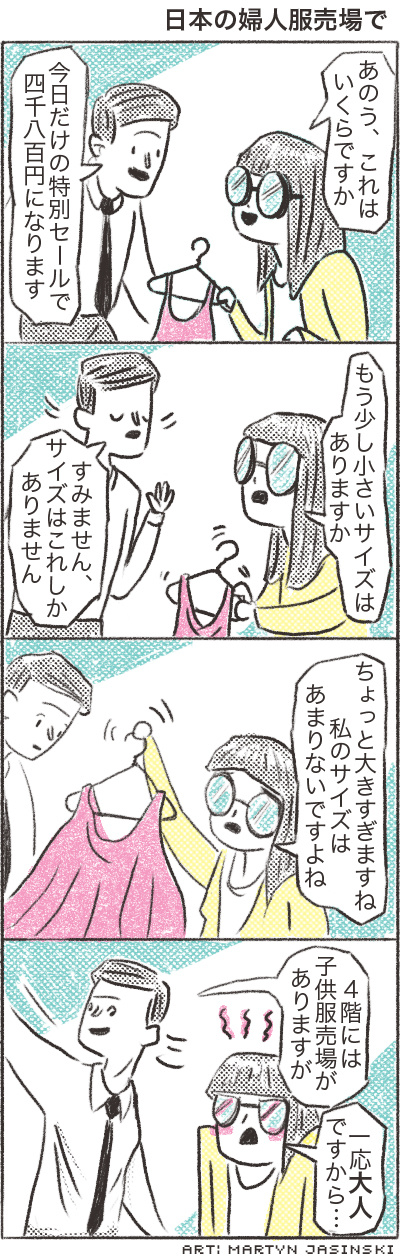
Comic 9: 日本の婦人服売場で
- 日本 【に・ほん】 – Japan
- 婦人服 【ふ・じん・ふく】 – women’s clothing
- 売場 【うり・ば】(also 売り場) – place where things are sold
- あのう/あの – say; well; errr
- これ – this
- いくら – how much
- 今日 【きょう】 – today
- 特別 【とく・べつ】(na-adj) – special
- セール – sale
- ~円 【~えん】 – counter for yen (Japanese currency)
- なる (u-verb) – to become
- もう – already; further
- 少し 【すこ・し】 - a little
- 大きい 【おお・きい】(i-adj) – big
- サイズ – size
- ある (u-verb) – to exist (inanimate)
- すみません – sorry (polite)
- 私 【わたし】 – me; myself; I
- あまり – not very (when used with negative)
- ~階 【~かい】 – counter for story/floor
- 子供服 【こ・ども・ふく】 – children’s clothing
- 一応 【いち・おう】 – for the time being; just in case
- 大人 【おとな】 – adult
先生:あのう、これはいくらですか。
Teacher: Excuse me, how much is this?
店員:今日だけの特別セールで四千八百円になります。
Store Clerk: (It) is 4,800 yen by sale today only.
先生:もう少し小さいサイズはありますか。
Teacher: Is there size that a little smaller?
店員:すみません、サイズはこれしかありません。
Store Clerk: Sorry, there is no other size but this.
先生:ちょっと大きすぎますね。私のサイズはあまりないですよね。
Teacher: (It’s a) little too big, isn’t it? As for my size, there isn’t much, is there?
店員:4階には子供服売場がありますが…。
Store Clerk: There is (a) children’s clothing section on the 4th floor but…
先生:一応大人ですから…。
Teacher: Just so you know, (I AM an) adult so…
On a diet
- お腹 【お・なか】 – stomach
- 空く 【す・く】(u-verb) – to empty
- なんで – why
- まだ – yet; still
- ~時 【~じ】 – hour counter
- 今日 【きょう】 – today
- 朝ご飯 【あさ・ご・はん】 – breakfast
- 食べる 【たべ・る】(ru-verb) – to eat
- 昼ご飯 【ひる・ご・はん】 – lunch
- 昨日 【きのう】 – yesterday
- 夜 【よる】 – evening
- 晩ご飯 【ばん・ご・はん】 – dinner
- ダイエット – diet
- する – to do
- たくさん – a lot
- 普通 【ふ・つう】 – normal
- 言う 【い・う】(u-verb) – to say
- 始める 【はじ・める】 (ru-verb) – to begin
- いつ – when
- ~まで (particle) – until ~
- つもり – intention
- もう – already
- 明日 【あした】 – tomorrow
- やめる (ru-verb) – to stop; to quit
- 一日 【いち・にち】 – span of one day
- 聞く 【き・く】 – to ask; to listen
- 事 【こと】 – event, matter, generic happening
- 痩せる 【や・せる】(ru-verb) – to get skinny
- 当たり前 【あ・たり・まえ】 – obvious
アリス:お腹空いたよ。
Alice: (I’m) hungry. (lit: stomach has emptied)
ジョン:なんで?まだ2時だよ。
John: Why? It’s still 2 o’clock, you know.
アリス:今日は、朝ご飯しか食べてないの。
Alice: (I) didn’t eat anything but breakfast today.
ジョン:なんで昼ご飯を食べなかったの?
John: Why didn’t (you) eat lunch?
アリス:昨日の夜、晩ご飯を食べ過ぎたから、ダイエットをしているの。
Alice: Last night, (I) ate too much dinner so (I’m) on a diet.
ジョン:昨日たくさん食べて、「ダイエットしている」と普通言わないよ。
John: Normally, (you) don’t say you’re on a diet after you ate a lot yesterday.
アリス:だから、今日始めたよ。
Alice: That’s why I just started.
ジョン:いつまでダイエットをするつもり?
John: (You) intend to be on a diet until when?
アリス:もうダメ。明日からやめる。
Alice: (It’s) no good already. (I) will quit from tomorrow.
ジョン:一日だけのダイエットは、聞いたことない。
John: (I’ve) never heard of a one day only diet.
アリス:だから、痩せないのかな?
Alice: (I) wonder if that’s why (I) don’t lose weight?
ジョン:当たり前だ。
John: Obviously.