LearnJapanese Tae Kim's Guide to Learning Japanese


Hiragana

Posted by Tae Kim

The table below represents the entire Hiragana syllabary categorized by the consonant and vowel sounds. With the exception of a few sounds (as shown by the pronunciation in parentheses), most sounds in Japanese are easily represented by a vowel or consonant-vowel. There is also one consonant-only sound: 「ん」.

Hiragana - Click for stroke order and sound
n w r y m h n t s k    

(n)
a
     
(chi)

(shi)
i
   
(fu)

(tsu)
u
      e
 
(o)
o
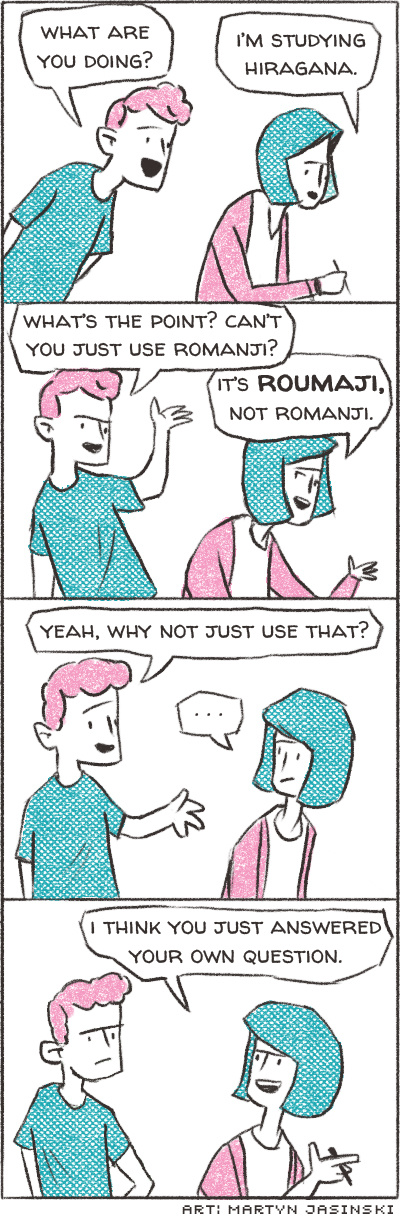
Roumaji comic

To understand how this chart works, let's start by looking at the right-most column, which are all the vowel-only sounds.

a
i
u
e
o

Here are some sample words for reading practice.
Example: あい - love (read as "ai")

  1. あう - to meet
  2. いえ - house
  3. おい - nephew
  4. うえ - above
  5. いう - to say

Each additional column represents a consonant sound with each of the five vowel sounds. For example, the "k" column has the following sounds.

ka
ki
ku
ke
ko

「ん」 is the only character with no vowel sound. It adds an "n" sound as shown in the examples below.

  • きん - gold (read as "kin")
  • おんな - woman; girl (read as "on-na")
  • おんがく - music (read as "on-ga-ku")

Here are my recommendations for learning how to read, write, hear, and say the characters and sounds in Hiragana.

  • Reading: You'll be getting plenty of reading practice with the material in this book.
  • Writing: You'll need to develop muscle memory so use regular pen and paper. Below are handy PDFs for Hiragana writing practice.
  • Hearing: You can listen to the pronunciation for each character by clicking on it in the first chart. If your browser doesn't support audio, you can also download them at http://www.guidetojapanese.org/audio/basic_sounds.zip. There are also other free resources with audio samples.
  • Speaking: Practice repeating the sounds. I recommend recording yourself to get an accurate idea of what you sound like. Pay careful attention to the "r" sounds!

While most of the sounds are pretty straightforward, the "r" sounds deserve careful attention for English speakers because there is no equivalent sound in English. It is more similar to the "r" sound in Spanish.

What works for some English speakers (even if it may not be technically correct) is to shape the lips something like the sound that is made for the English "r," but to make the sound with a single trill or flap of the tongue against the front of the palate.

What´s the difference between

What´s the difference between を and お?


Not all kanjis have 2

Not all kanjis have 2 rengiads. Some have 3, 4, 5 and so on and even there are some kanjis that when joined together, are read as a totally different thing, like 今日, 今 can be read as ima', kon' and 日 can be read as hi', ni', nichi' (that's just as far as I know), but in this particular case, it is read as kyou', meaning today (kanjis from now' + day'). But when you face THIS: 「今日は」 it could either be referring to [kyouwa] or [konnichiwa], depending on the context.


I think いけ means "pond" and

I think いけ means "pond" and こすい (湖水) means "lake", but I could be wrong. I found "pond" as いけ somewhere else, so I wanted to know if "pond" and "lake" had different words in Japanese. I did a search on Jisho.com and came up with 湖水 for "lake". I'd be interested to know how the two words are different.


池 (いけ) does mean pond. Lake

池 (いけ) does mean pond. Lake is 湖 (みずうみ)。
I think 湖水 (こすい) also means lake, but may refer to the water in the lake more than the lake itself.


Here are some sample words

Here are some sample words for reading practice.
Example: あい - love (read as "ai")

1. あう - to meet
2. いえ - house
3. おい - nephew
4. うえ - above
5. いう - to say

We could really use some guidance on the correct pronunciation for these vowel-sound-combo words.


I just wanted to say for

I just wanted to say for anybody struggling with the "r" sound, that article linked at the end of this page made it click for me, especially when it says try substituting the "r" in Pero for a "d". I know it isn't literally pronounced that way, and I do not speak Spanish at all, but I do know what the word is supposed to sound like. Now I can prounounce the "r" perfectly. Also, I am a 10th grader just learning Japanese out of interest, because I plan to visit Japan one day even if not in the near future. This is a really good guide, thanks a ton for all the work you put into this, Tae Kim!


About Hiragana symbols, on

About Hiragana symbols, on the practice sheets there are symbols for "we" and "wi" but not on the matrix shown in this tutorial. What's the reason for this?


Hey there, I'm not Mr. Tae

Hey there, I'm not Mr. Tae Kim but I can provide an answer
"we" and "wi" are seldom ever used in Japanese. Very few words are spelled with them and they're pretty much on their way out of the language.

Even if you type them in the normal Japanese keyboard setting, "we" turns up as うぇ and "wi" turns up as うぃ.


I'm 30, and I am moving to

I'm 30, and I am moving to Japan in December. I traveled there in April for a few weeks and was frustrated with not being able to communicate with anyone in their native language. I researched thoroughly and your site is not only the most informative but it's an extremely user friendly site that cues my brain exactly the way needed for learning. THANK YOU SOOOOOO MUCH TAE KIM! You are Master!


Post new comment

Important
Wait! Are you about to ask a question about Japanese? You will have a better chance of getting your question answered at the forum instead.