Particles can be used with some question words to form other useful vocabulary. Let’s first learn or review all the various questions words.
- 誰 【だれ】 – who
- 何 【なに/なん】 – what
- どこ – where
- どう – how
- どうして – why
- どちら – which way
- どれ – which
- なんで – why (casual)
- なぜ – why (formal)
- いつ – when
- いくつ – how many
- いくら – how much
「も」 with question words
The following question words can be used with 「も」 to include and/or exclude everything.
- 誰も 【だれ・も】 – everybody or nobody when used with negative
- 何も 【なに・も】 – nothing when used with negative
- どこも – everywhere or nowhere when used with negative
- どうしても – no matter what
- どちらも – both ways
- いつも – always
Things aren’t as consistent as one would hope however. For example, 「何も」 is usually not used to mean “everything”. And 「いつも」 always means “always” for both positive and negative forms. Other words can be used instead to express similar concepts.
- 皆 【みんな】 – everybody
- 皆さん 【みな・さん】 – everybody (polite)
- 全部 【ぜん・ぶ】 – everything
- 全然 【ぜん・ぜん】 – not at all (when used with negative)
- 絶対 【ぜっ・たい】 – absolutely, unconditionally or never when used with negative
「でも」 with question words
The combination of two particles 「でも」 can be used with question words to indicate “any”.
- 誰でも 【だれ・でも】 – anybody
- 何でも 【なん・でも】 – anything
- どこでも – anywhere
- どうでも – anyhow
- どちらでも – any way
- いつでも – any time
- いくつでも – any number of things
- いくらでも – any amount
「か」 with question words
The question marker can also be used with some question words to indicate “some”.
- 誰か 【だれ・か】 – somebody
- 何か 【なに・か】 – something
- どこか – somewhere
- どうか – somehow
- どちらか – one way (of the two)
- どうしてか – for some reason
- なんでか – for some reason (casual)
- なぜか – for some reason (formal)
- いつか – sometime
- いくつか – some number of things
- いくらか – some amount
Comic 5
- やっと – finally
- 週末 【しゅう・まつ】 – weekend
- 今週末 【こん・しゅう・まつ】 – this weekend
- 暇 【ひま】 (na-adj) – free (as in not busy)
- どっか – somewhere (slang for どこか)
- 遊ぶ 【あそ・ぶ】(u-verb) – to play
- 行く 【い・く】(u-verb) – to go
- 来週 【らい・しゅう】 – next week
- 日本語 【に・ほん・ご】 – Japanese language
- テスト – test
- ある (u-verb) – to exist (inanimate)
- 大丈夫 【だい・じょう・ぶ】 (na-adj) – ok
- うん – yes (casual)
- 多分 【た・ぶん】 – probably; maybe
- じゃ – then (casual)
- この – this
- 単語 【たん・ご】 – word; vocabulary
- 漢字 【かん・じ】 – Kanji
- どう – how
- 書く 【か・く】(u-verb) – to write
- 憂鬱 【ゆう・うつ】 – depression
- 朦朧 【もう・ろう】 – dim, hazy
- 躊躇 【ちゅう・ちょ】 – hesitation
- それ – that
- 出る 【で・る】(ru-verb) – to come out
- 冗談 【じょう・だん】 – joke
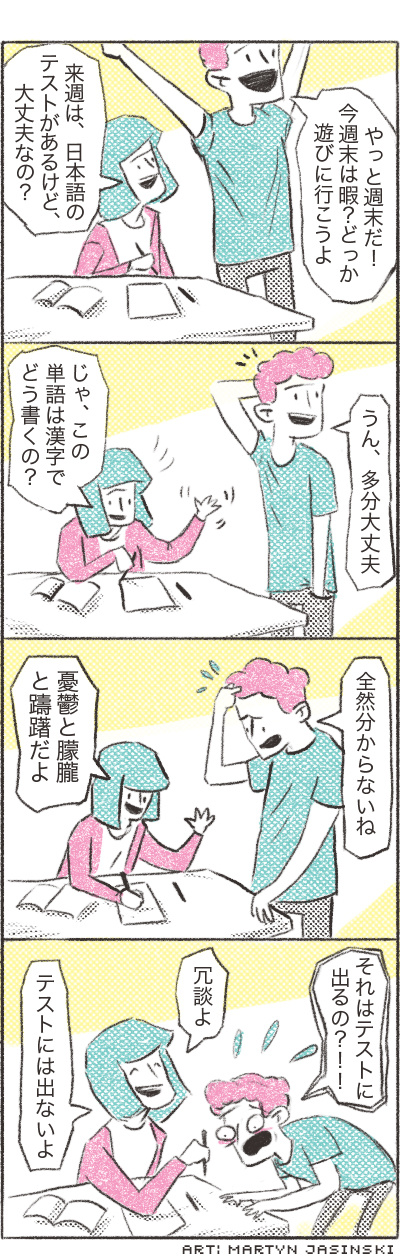
ジョン:やっと週末だ!今週末は暇?どっか遊びに行こうよ。
John: (It’s) finally (the) weekend. (Are you) free this weekend? Let’s go somewhere to play.
アリス:来週は、日本語のテストがあるけど、大丈夫なの?
Alice: There’s (a) Japanese test next week but are (you) ok?
ジョン:うん、多分大丈夫。
John: Yeah, probably ok.
アリス:じゃ、この単語は漢字でどう書くの?
Alice: Then how do (you) write this word in Kanji?
ジョン:全然分からないね。
John: (I) don’t know at all.
アリス:憂鬱と朦朧と躊躇だよ。
Alice: (It’s) 憂鬱 and 朦朧 and 躊躇.
ジョン:それはテストに出るの?!
John: Is that coming out on (the) test?
アリス:冗談よ。テストには出ないよ。
Alice: (It’s a) joke. (It) won’t come out on the test.
Never mind, you guys are too weird
- ね/ねえ – hey (casual)
- 今日 【きょう】 – today
- 昼ご飯 【ひる・ご・はん】 – lunch
- どっか – somewhere (slang for どこか)
- 僕 【ぼく】 – me, myself (polite, masculine)
- 何でも 【なん・でも】 – anything
- じゃ – then (casual)
- おいしい (i-adj) – tasty
- 物 【もの】 – physical object
- 当たり前 【あ・たり・まえ】 – obvious
- 誰 【だれ】 – who
- 皆 【みんな】- everybody (casual)
- 相変わらず 【あい・か・わらず】- as usual, without change
- 変 【へん】 (na-adj) – strange
- 食堂 【しょく・どう】- cafeteria
アリス: ねえ、今日の昼ご飯は、どっかに食べに行こうよ。
Alice: Hey, as for today’s lunch, let’s go somewhere to eat.
ジョン: そうだね。何を食べようか?
John: Right. What shall we eat?
リー: 僕は、何でもいいよ。
Lee: I’m fine with anything.
アリス: じゃ、何かおいしい物を食べたくない?
Alice: Then, don’t (you) want to eat something tasty?
ジョン: それは当たり前だ。誰がおいしくない物を食べたいんだ?
John: That’s obvious. Who wants to eat a thing not tasty?
リー: 僕は、何でもいいよ。
Lee: I’m fine with anything.
ジョン: じゃ、今日はおいしくない物にチャレンジしよう!
John: Then, let’s challenge (ourselves) today with something not tasty!
アリス: 皆、相変わらず変ね。今日も食堂でいいよ。
Alice: Everybody is strange as usual, huh? The cafeteria is fine for today as well.