There are several different ways to try something in Japanese including making an effort toward something, making an attempt at something, and trying something out to see what happens.
Striving for a goal
In order to express “try” as striving toward a goal, we use the same 「よう」 we learned in the last section to describe the manner or appearance of the way we want to act. In this case, we use the verb 「する」 (meaning “to do”) and the 「に」 target particle to do toward the manner or appearance of the verb clause.
Example
- タバコを吸わないようにする。
Try not to smoke cigarettes.
(lit: Do toward manner of not smoking.) - 甘い物を食べないようにしている。
Trying not to eat sweet things.
(lit: Doing toward manner of not eating sweet things). - もっと運動をするようにしていたけど、すぐあきらめた。
Was trying to exercise a lot more but soon gave up.
(lit: Was doing toward manner of doing more exercise but soon gave up.)
Achieving an action
If you use the same grammar as before but with the verb 「なる」 (meaning “to become”) instead of 「する」, we can describe reaching the state of the verb.
Example
- タバコを吸わないようになる。
(It) became so that (I) don’t smoke.
(lit: Become manner of not smoking.) - 毎日運動したから簡単に太らないようになった。
(I) exercised every day so (it) became so that (I) won’t get fat easily. - 2年間日本に住んでいたから、日本語が話せるようになりました。
(I) lived in Japan for two years so (I) became able to speak Japanese.
Making an attempt
The volitional form can also be used to describe an attempt or effort to do a single action. In this case, we use the volitional form followed by 「と」 and the verb 「する」 (“to do”).
Example
- 犬はいつも人の食べ物を食べようとする。
Dog always tries (attempts) to eat people’s food. - 休みなのに、両親はどこにも行こうとしないから、つまらないよ。
Even though (it’s a) holiday, (my) parents don’t try (make an effort) to go anywhere so (it’s) boring.
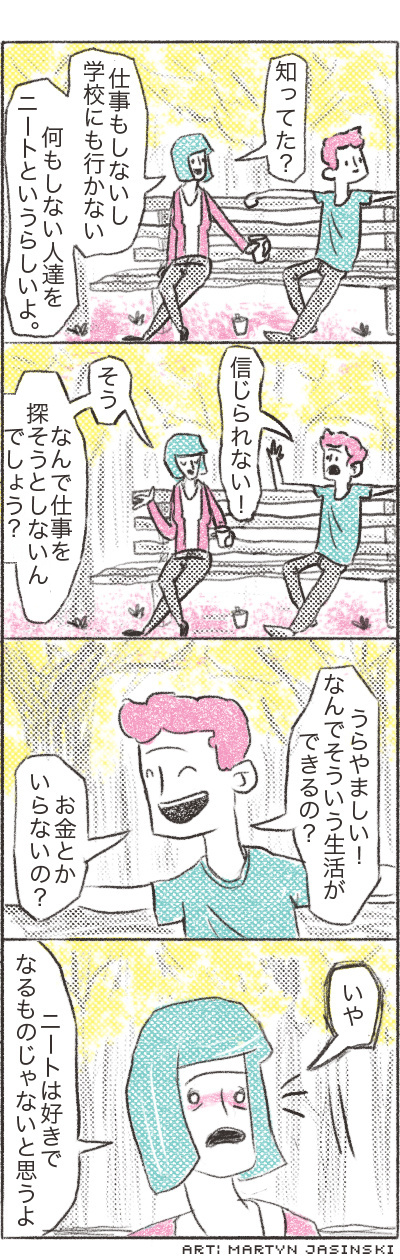
Comic 11 – ニートの話
- 知る 【し・る】 (u-verb) – to know
- いる (ru-verb) – to exist (animate)
- 仕事 【し・ごと】 – job
- する (exception) – to do
- 学校 【がっ・こう】 – school
- 行く 【い・く】 (u-verb) – to go
- 人達 【ひと・たち】 – people
- ニート – NEET (Not in Education, Employment or Training)
- 言う 【い・う】 (u-verb) – to say
- 信じる 【しん・じる】 (ru-verb) – to believe
- そう – (things are) that way
- 何で 【なん・で】 – why; how
- 探す 【さが・す】 (u-verb) – to look for
- 羨ましい 【うらや・ましい】 (i-adj) – envious, jealous
- 生活 【せい・かつ】 – lifestyle
- 出来る 【で・き・る】 (ru-verb) – to be able to do
- お金 【お・かね】 – money
- いる (u-verb) – to need
- いや – no (casual)
- 好き 【す・き】 (na-adj) – likable; desirable
- なる (u-verb) – to become
- 物 【もの】 – object
アリス:知ってた?仕事もしないし、学校にも行かない何もしない人達をニートというらしいよ。
Alice: Did (you) know. (I) hear (that you) call people (who) don’t do things like go to work or go to school NEET.
ジョン:信じられない!
John: (I) can’t believe it!
アリス:そう。なんで仕事を探そうとしないんでしょう?
Alice: That’s right. I wonder why (they) don’t try to look for (a) job?
ジョン:うらやましい!なんでそういう生活ができるの?お金とかいらないの?
John: (I’m) jealous! Why are (they) able to do that kind of lifestyle? Don’t (you) need things like money?
アリス:いや、ニートは好きでなるものじゃないと思うよ
Alice: No, I don’t think NEET is something (you) become because (you) like it.
Experimenting
A third way to express trying (not as a goal or effort) is to do something as an experiment. For example, trying out something for the first time. This grammar is expressed by changing the verb to the te-form and attaching the verb 「みる」 (“to see”).
Example
- 先生に質問を聞いてみる
Try asking teacher question. - 日本料理を食べてみた。
Tried eating Japanese food.
会話の練習
アリス: 田中先生、ちょっと相談があります。
Alice: Tanaka-sensei, (I) have something I’d like advice on (lit: there is a consulation).
田中: はい、何でしょうか。
Tanaka: Yes, what is it?
アリス: 最近、日本語があまり上達しない気がしますが、どうしましょうか。
Alice: Lately, (I) feel like (my) Japanese isn’t improving very much but what should I do?
田中: アリスさんの日本語は上達していますよ。でも、そうですね。もっと会話の練習をしてみるのはどうですか。たくさん会話の練習をすることでもっと上手に話せるようになると思いますよ。
Tanaka: Alice-san’s Japanese is improving, you know. But, let’s see. How about trying to do much more conversation practice? (I) think (you) can become so that (you) can speak much more skillfully by doing (a) lot of conversation practice.
アリス: そうですね。でも、クラスメート達は授業以外では、全然日本語で話そうとしないんです。
Alice: That’s so, isn’t it. But (my) classmates don’t try to speak Japanese outside of class at all.
田中: それはだめですね。オンラインで日本人の友達を作るのはどうでしょう。
Tanaka: That’s bad, isn’t it? How about making Japanese friends online?
アリス: それはいい考えですね。オンラインで友達を作ってみて、もっと日本語で会話をするようにします。
Alice: That is a good idea, isn’t it? I will try making friends online and try to do much more conversation in Japanese.
田中: ところで勉強をサボっているのは誰ですか。
Tanaka: By the way, who is slacking off on (their) studies?
アリス: はい?それは…ええと。
Alice: What? That is umm…