Now that we are familiar with both state-of-being and verbs, we can begin to look at how to use verb clauses to construct more complicated sentences. As we have learned, a complete sentence must end either in a real verb or state-of-being. This sentence can also be used as a clause as a part of a larger sentence.
Remember also that the polite form only goes at the end of a complete sentence so a verb clause used within a sentence must be in the plain form.
Verb clauses as adjectives
A verb clause can be used to describe a noun just like an adjective by attaching the noun to the end of the clause. The highlighted areas show the clause that is being used in a larger sentence.
Example
- ご飯 【ご・はん】 – rice; meal
- 時 【とき】 – when
- テレビ – television
- 本 【ほん】 – book
- 読む 【よ・む】 (u-verb) – read
- 頭 【あたま】 – head; mind
- 背 【せ】 – height
- すてき (na-adj) – lovely
- 高い 【たか・い】 (i-adj) – tall
- 性格 【せい・かく】 – personality
- 優しい 【やさ・しい】 – gentle
- ご飯を食べる時は、テレビを見ない。
When eating a meal, don’t watch TV. - 本を読まない人は、頭がよくない。
People that do not read books are not smart. - 背が高い人は、すてきだね。
Tall people are lovely, huh? - 性格が優しくない人は、あまり好きじゃない。
Don’t like people whose personality is not gentle.
For clauses that end in a na-adjectives, once again, we need to use 「な」 to attach it to a noun. As for nouns, there is no need to use a clause to modify a noun with another noun as the 「の」 particle allows us to chain any number of nouns.
- 形 【かたち】 – shape, form
- きれい (na-adj) – pretty; clean
- 果物 【くだ・もの】 – fruit
- 運 【うん】 – luck
- 形がとてもきれいな果物は、おいしい。
Fruit that has very pretty form is tasty. - 二年生の日本語の学生は、運がいい。
As for second year Japanese students, luck is good.
I’m going alone
- 今年 【こ・とし】 – this year
- 春休み 【はる・やすみ】 – spring vacation
- 予定 【よ・てい】 – plan(s)
- 観光 【かん・こう】 – sightseeing
- メキシコ – Mexico
- 一人 【ひとり】 – one person; alone
- つもり – intention
- 一緒 【いっ・しょ】 – together
- 訳 【わけ】 – explanation, reasoning
山本: 田中さんは、今年の春休みに何か予定ありますか?
Yamamoto: Tanaka-san, do (you) have some (kind of) plan this spring vacation?
田中: ええ、観光にメキシコに行く予定です。
Tanaka: Yes, (I) plan to go sightseeing to Mexico.
山本: いいですね。私もメキシコに行きたいですね。
Yamamoto: That’s nice. I want to go to Mexico too.
田中: 私は、一人で行くつもりですが・・・
Tanaka: I intend to by myself…
山本: いいえ、私は田中さんと一緒に行きたい訳じゃないですから!
Yamamoto: No, it’s not the case that I want to go together with you in particular!
Verb clauses as nouns
Verbs clauses are different from nouns and are limited in many ways because you cannot attach any particles to them. However, we just learned that verb clauses can act as an adjectives. All we need to treat verb clauses as a noun is by attaching a generic noun to the clause: 「こと」(事)
「の」 can also be used as a noun replacement. The difference is 「こと」 is a more general statement while 「の」 is specific to the context of the sentence.
Example
- 事 【こと】 – event, matter, generic happening
- 料理 【りょう・り】 – cooking
- お箸 【お・はし】 – chopsticks
- ご飯 【ご・はん】 – rice; meal
- 難しい 【むずか・しい】 (i-adj) – difficult, hard
- 朝 【あさ】 – morning
- 早い 【はや・い】 – early
- 起きる 【お・きる】 – to occur; to awake
- 苦手 【にが・て】 (na-adj) – poor/weak at
- 料理をするのが好き。
(I) like cooking. - お箸でご飯を食べることは、難しい。
It is difficult to eat rice by way of chopsticks. - 朝、早く起きるのは、苦手。
Not good at waking up early in the morning.
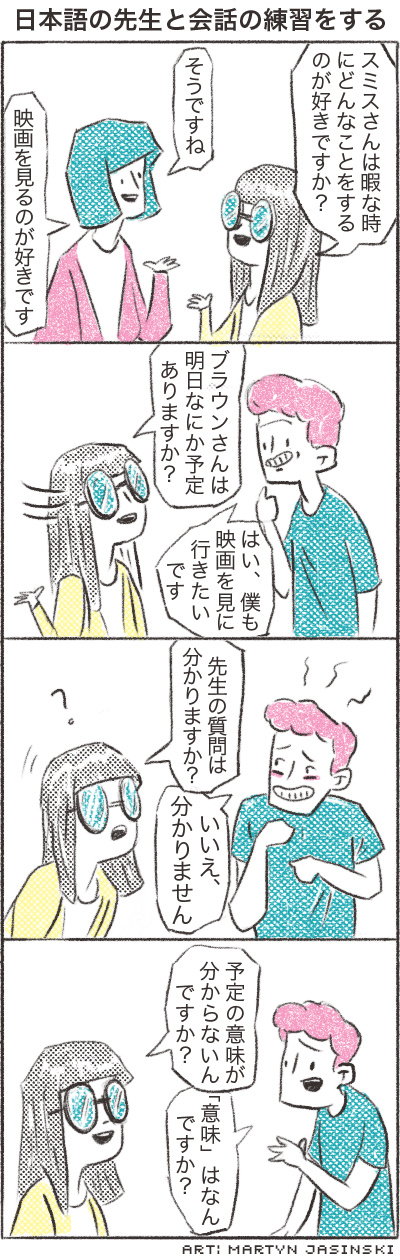
Comic 6: 日本語の先生と会話を練習する
- 日本語 【に・ほん・ご】 – Japanese (language)
- 先生 【せん・せい】 – teacher
- 会話 【かい・わ】 – conversation
- 練習 【れん・しゅう】 – practice
- する (exception) – to do
- 暇 【ひま】 (na-adj) – free (as in not busy)
- 時 【とき】 – when
- どんな – what kind
- こと – matter; event
- 好き 【す・き】 (na-adj) – likable
- そう – (things are) that way
- 映画 【えい・が】 – movie
- 見る 【み・る】 – to see; to watch
- 明日 【あした】 – tomorrow
- 何か 【なに・か】 – something
- 予定 【よ・てい】 – plan(s)
- ある (u-verb) – to exist (inanimate)
- はい – yes (polite)
- 僕 【ぼく】 – me; myself; I (polite, masculine)
- 行く 【い・く】 – to go
- 質問 【しつ・もん】 – question
- 分かる 【わ・かる】 (u-verb) – to understand
- いいえ – no (polite)
- 意味 【い・み】 – meaning
- 何 【なに/なん】 – what
先生:スミスさんは、暇な時にどんなことをするのが好きですか?
Teacher: Smith-san, what kind of thing(s) do (you) like to do when (you’re) free?
スミス:そうですね。映画を見るのが好きです。
Smith: Let’s see. (I) like to watch movie(s).
先生:ブラウンさんは、明日何か予定ありますか?
Teacher: Brown-san, do you have any plans tomorrow?
ブラウン:はい、僕も映画を見に行きたいです。
Brown: Yes, I also want to go see (a) movie.
先生:先生の質問は分かりますか?
Teacher: ? Do (you) understand my (the teacher’s) question?
ブラウン:いいえ、分かりません。
Brown: No, (I) don’t understand.
先生:予定の意味が分からないんですか?
Teacher: Do (you) not understand the meaning of “予定”?
ブラウン:「意味」は何ですか?
Brown: What is “meaning”?
What do you like to do when you’re free?
- 今週末 【こん・しゅう・まつ】 – this weekend
- 特 【とく】 – particular
- 本屋 【ほん・や】 – bookstore
- めんどくさい (i-adj) – bothersome
- 俺 【おれ】 – me, myself (masculine, casual
- 暇 【ひま】 (na-adj) – free (as in not busy)
- やはり/やっぱり – as I thought, as expected
スミス: 今週末は、何か予定ある?
Smith: Do you have some kind of plan this weekend?
ジョン: 特にないけど?
John: Not particularly but?
スミス: 皆で、日本の本屋さんに行くのは、どう?
Smith: How about going to Japanese bookstore with everybody?
ジョン: めんどくさいから、俺はいい。
John: It’s too bothersome so I’m fine.
スミス: 暇な時に何をするのが好きなの?
Smith: What do you like to do when you’re free?
ジョン: 何もしないのが好きだね。
John: I like not doing anything.
スミス: やっぱり・・・。
Smith: As I thought.