
When I was a naive little student earnestly learning kanji with glee, I remember thinking, “Yeah, now that I learned 「見る」, I now know the kanji for 「みる」!” Ha ha, if Japanese was that easy, I would have spend all that extra time not studying on training to become a professional StarCraft player instead like all the cool Koreans. Actually, what you learn later on is that some words may have more than one kanji with slight differences in meaning such as, “This kanji means that you are feeling blue but this kanji is used when you are feeling blue and you want to sneeze but it just won’t come out. It also implies that your right index finger itches.” Ok, ok, now I’m just trying to be funny… or am I? (Waggles eyebrows) Let’s see by taking a look at some alternative kanji for some common words and when to use them. Hint: It’s when you want to look “cool” and “smart”. (Emphasis on the quotation marks) For example, let’s look at alternatives for 「見る」 (to see) and 「聞く」 (to hear/to ask).
You can see it, my child, yes, but can you see it?
While 「見る」 is fine for just regular “seeing” (whatever that means), you might see 「観る」 instead for when you are watching things such as movies and plays. I have no idea what the exact distinction is but I can tell you that 「観る」 uses the same kanji as the one for 「観光」, which means “sightseeing”. A coincidence? I think not. Actually, I can’t complain about this too much because it’s easier than trying to explain the difference between the words, “to watch” and “to see”. Why don’t we try?
No, you can’t “see television”, you can only watch it. Yes, you can “see a movie”. Huh? Why, you ask? Hmm… I think it’s because native English speakers hate you. Yes, that sounds about right.
Moving on, if a doctor is examining you, you use 「診る」 instead, which uses the same kanji from 「診断」 meaning “diagnosis”.
Ask, hear, eh, what’s the difference?
In Japanese, 「聞く」 can mean either “to ask” or “to hear”. (After all, they are so totally related.) But if you want to be specific, you can use 「訊く」, which only means “to ask” or more accurately, “to inquire”. Also, when you are listening to music, you might use 「聴く」 instead. 「効く」 is also another alternative to mean that something is “taking effect”. It is often used in the context of taking medicine (or rather “drinking” in Japanese).
How do I figure out this madness??
So how do you figure this stuff out? Well, your best bet are Japanese-Japanese dictionaries such as 広辞苑 or 大辞泉. For instance, here is the definition for 「聴く」
.
2 (聴く)注意して耳にとめる。耳を傾ける。「名曲を―・く」「有権者の声を―・く」
Or better yet, if you use the Windows IME, the kanji selection menu will have explanations of the differences… in Japanese.
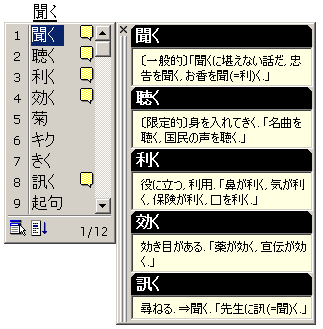
IME, the only Microsoft software I know of that doesn't suck (until they build a vacuum).
For bonus points, see if you can figure out the difference between:
1. 速い vs 早い
2. 取る vs 撮る vs 盗る
3. 飛ぶ vs 跳ぶ
4. 熱い vs 暑い
5. 彫る vs 掘る
6. 閉める vs 締める vs 占める
7. “Japanese” vs “A tongue invented by the devil to prevent the spread of Christianity”.
8. 止まる vs 停まる vs 泊まる