Follow my twitter account!
I’m going to try something interesting (or at least I hope it turns out interesting). (Hint: read post title)
I’ll wait a few days to start or until I get 100+ followers.

Follow my twitter account!
I’m going to try something interesting (or at least I hope it turns out interesting). (Hint: read post title)
I’ll wait a few days to start or until I get 100+ followers.
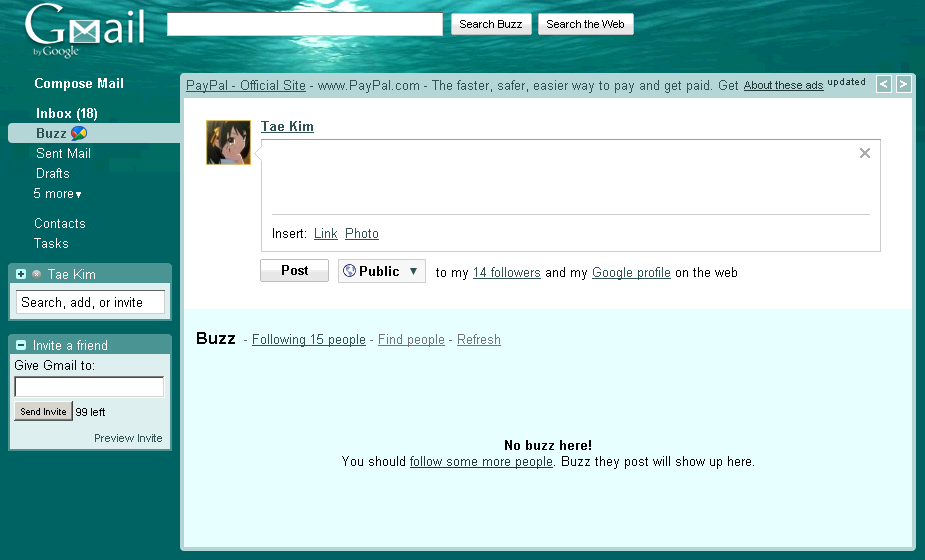
Great, another Twitter account but now in my email and without the hassle of having to add followers (they pre-load from your contacts). I guess my major problem is I don’t spend enough time online ALREADY.
I was recently informed that Death Note is available to watch completely for free on Hulu. And with none of that dubbing crap, which used to be all so common back in the day. I feel like an old fogey when I think back on how difficult it was to get any sort of Japanese content in the United States back in the day. I used to feverishly grab onto whether random stuff I could get my hands on. For crying out loud, at one point, my only source for study was a 単行本 of 「新きまぐれオレンジ★ロード」 that I happened to get a hold of somehow. Seriously, I had that exact book, cover and everything. You guys no longer have any excuse!!
(An an aside, I still remember one of the FIRST words I ever looked up in my Kanji dictionary was in the first couple sentences of that book: 「瞳」. Guess what? Since it’s not in the 常用漢字 list, it wasn’t in my dictionary. So I was pretty screwed to begin with until I luckily managed to find WWWJDIC. Thanks, Jim Breen!)
By the way, my favorite anime of all time is Lain. Who can resist an anime that talks about internet protocols and Memex? Yes, I’m a geek at heart and personally, I can’t wait for IPv7!
Twitterを使ってみた。でも、使う意味がいまいちわからん。ブログはもう持っているし。
この投稿は、140文字以内だよ。だから何だ?どうでもいいじゃないか?
As a short follow-up on memorable moments in language acquisition, I’ve noticed that sometimes you learn a new word and suddenly you hear it all around you.
Some words or expressions that I’ve wrote about before because I simply couldn’t believe they were not taught or used in most textbooks are 「別に」、「なんで」、「他に」 and 「やばい」.
What words have you learned recently that you can’t imagine getting by without once you’ve learned it?
A commenter left this interesting link about the Baader-Meinhof Phenomenon. Now lets see if I hear people talking about this phenomenon all the time. 🙂
最近、自分のスケジュールをよく見て、運動する時間がまったくないことに気づいた。体重が本当にやばくなっているので、仕方なく、運動の優先度を上げることにした。でも、今のスケジュールに入る余地もない。こうなったら、睡眠時間を削るしかないと、そういう結論にたどり着いて、朝6時に起きてジョギングを始めた。
6時起床は、2日連続で、まだ死んでいないから、とりあえず可能だということがわかった。しかし、早起きが苦手で有名な私は、いつまでこんなことを続けられるかは不明。昨晩は、8時に倒れて11時まで寝たら、朝3時まで眠れなくなっちゃった。
う~、1日の時間を増やせないかな?火星では、1日には24時間+39分があるらしい。火星植民地化はいつごろできるんだろう?あんまり期待しない方がいいか。
新しい車を買う時、車に貼ってあるステッカーにその車のパーツが作製された場所がちゃんと書いている。車達を見て、Hondaは、日本の会社だけど、エンジンや色んなパーツがアメリカで作成されているとわかった。でも、私の車は違う。エンジン、トランスミッション、すべてのパーツが日本で作製された。私の車は、三重県鈴鹿市で生まれたらしい。おそらく、「本田研究工業鈴鹿製作所」でしょう。
アメリカでは、運転手が左側に座るから、日本版と逆だけど、それ以外、インテリアは全く一緒。特に、ラジオが同じだと思う。なのに、iPodを繋げて、日本の曲名やアーティスト名を見ようとしたら、「—–」って文字化けする。なんでや!あんた、日本からきたでしょう?!日本が好きでしょう?バックミラーにケロロとギロロが飾ってあるし。あんた、日本で生まれたんだから、日本語頑張って!
If your workplace is practically empty like mine, here’s a funny video to lighten up your Chinese studies, that is if you’re studying Chinese at all.
China’s Andy Rooney Has Some Funny Opinions About How Great The Chinese Government Is
「それどころじゃない」 is one of those strange phrases whose meaning isn’t obvious by the words themselves. I guess those things are called idioms, a word that looks suspiciously similar to “idiot” as in “only an idiot wouldn’t know what it meant”. Well excuse me but we’re not all native speakers, you know.
In any case, I thought of this expression when I contemplated updating my blog. My life is rather hectic right now so updating my blog is the least of my concerns. So here I am, in the ultimate of ironies, updating my blog to talk about a phrase that perfectly expresses how I can’t update my blog.
You: 最近、ブログを更新してないね。
Me: それどころじゃないんだよ!
However, I will post all your submissions for September’s Blog Matsuri sometime near the end of this week. There’s still time to write and submit something to me! Just email me at taekim.japanese AT gmail.com
Hey guys, you have only 1 week left to submit your Japan+Language related blog entries to me! So far, I’ve received 1 relevant submission.
See here for details or just email me a link to your post at taekim.japanese AT gmail.com.
Maybe I picked a bad topic… I hope this month’s Japan Matsuri doesn’t end in complete failure due to my incompetence and lack of audience. いかん!前向きにならなきゃ。
みなさんの投稿をお待ちしております!m(*^_^*)m よろしく
